
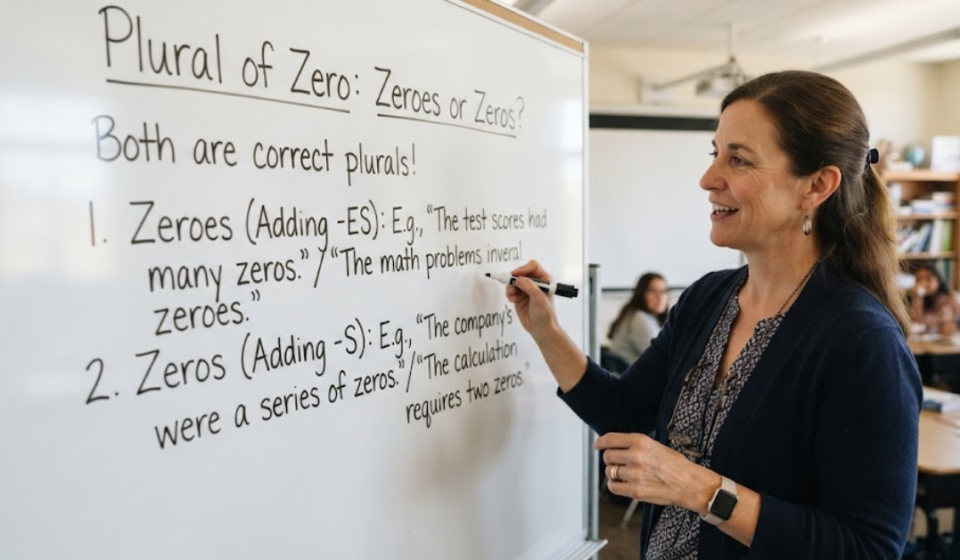

When you’re writing about more than one zero, a surprisingly common question comes up: should you write zeroes or zeros? Both spellings exist, so the confusion is understandable.
The good news is that both “zeroes” and “zeros” are correct plural forms of “zero.” However, zeros is generally the more common spelling in modern English, particularly in American English. “Zeroes” is also standard and may appear more often in some varieties or contexts.
Let’s look at zeroes vs zeros, how each form is used, and which spelling is best for your writing.
Zeroes or Zeros: The Quick Answer
The short answer is:
- Zeros — correct and generally more common
- Zeroes — also correct
- Zero — singular form
For example:
“The number contains three zeros.”
You could also write:
“The number contains three zeroes.”
Both sentences are grammatically correct.
If you’re wondering “is it zeros or zeroes?”, either spelling can work. However, zeros is usually the safer choice for general modern writing.
What Is the Plural of Zero?
The plural of zero can be written as either:
- zeros
- zeroes
The word zero comes from the Italian zero, which ultimately traces back to Arabic through medieval mathematical terminology. Over time, English developed more than one accepted way of forming its plural.
Unlike some spelling variations where one form is considered incorrect, both zeros and zeroes are recognized English words.
Singular vs Plural
Use zero when you’re talking about one:
“There is one zero in the number.”
Use zeros or zeroes when you’re talking about more than one:
“There are three zeros in the number.”
or:
“There are three zeroes in the number.”
Is It Zeros or Zeroes?
If you’re asking “is it zeros or zeroes?”, the answer depends partly on style and preference.
Zeros
Zeros is the more commonly preferred spelling in many modern contexts, especially in American English.
Examples include:
- “The account has several zeros.”
- “The number ends in two zeros.”
- “Add three zeros to the number.”
- “The score had two zeros.”
Zeroes
Zeroes is also correct.
Examples:
- “The number contains four zeroes.”
- “Several zeroes appear after the decimal.”
- “The value was followed by two zeroes.”
There’s no grammatical error in using zeroes.
How to Spell Zeros Correctly
If you’re wondering how to spell zeros, the most straightforward modern spelling is:
Z-E-R-O-S → zeros
The singular is:
Z-E-R-O → zero
The alternative plural is:
Z-E-R-O-E-S → zeroes
So you may see:
zero → zeros
or:
zero → zeroes
Both are accepted.
Zeroes vs Zeros in American English
In American English, zeros is generally the more common form.
For example:
“The report contains several zeros.”
This spelling is concise and widely used in everyday writing, mathematics, computing, finance, and technical contexts.
You’ll commonly encounter zeros in phrases such as:
- Leading zeros
- Trailing zeros
- Multiple zeros
- Three zeros
- Zeros in a number
For general American English writing, zeros is usually the best default choice.
Zeroes vs Zeros in British English
British English also recognizes zeros and zeroes.
However, zeroes can be encountered more frequently in some British usage, especially when the word is treated like other verbs or nouns ending in certain patterns.
That said, there isn’t a simple rule that says American English must use zeros and British English must use zeroes. Both forms can be found across English varieties.
If you’re writing for an international audience, zeros is a clear and widely recognized choice.
Why Are Both “Zeros” and “Zeroes” Correct?
The variation comes from the way English handles plural forms.
Many English words ending in -o take -s:
- photo → photos
- piano → pianos
- video → videos
Others have historically appeared with -es:
- potato → potatoes
- tomato → tomatoes
But English doesn’t apply one universal rule to every word ending in -o. Usage, history, and convention all play a role.
Zero is one of the words that developed both zeros and zeroes as accepted plural forms.
Zeros in Mathematics
In mathematics, zeros is extremely common.
A zero can refer to the numerical value 0, and the plural refers to multiple instances of that value.
For example:
“The number 1000 contains three zeros.”
You could technically write:
“The number 1000 contains three zeroes.”
But zeros is especially common in mathematical and technical writing.
Zeros in Numbers
Consider these examples:
- 100 → two zeros
- 1,000 → three zeros
- 10,000 → four zeros
- 1,000,000 → six zeros
In these contexts, zeros is generally the preferred form.
Leading Zeros and Trailing Zeros
Certain technical phrases strongly favor zeros.
Leading Zeros
A leading zero appears before the significant digits of a number.
For example:
007
The number has two leading zeros.
You may see this in:
- Identification codes
- Dates
- Digital clocks
- Computer systems
- Numerical databases
Trailing Zeros
A trailing zero appears at the end of a number.
For example:
5.00
The two zeros after the decimal point are trailing zeros.
In technical and mathematical writing, leading zeros and trailing zeros are by far the most familiar forms.
Zeros in Money and Finance
The word zeros is also common when discussing money.
For example:
“The price has several zeros.”
You might also say:
“He earns a salary with five zeros.”
This informal expression refers to the number of digits in an amount.
The spelling zeros is particularly natural in these everyday contexts.
Zeros in Computing
Computing provides another area where zeros is overwhelmingly common.
Binary numbers use only two digits:
- 0
- 1
So technical writing often refers to:
“A sequence of zeros and ones.”
For example:
“The system stores the data as a combination of zeros and ones.”
Although zeroes isn’t necessarily grammatically wrong, zeros is the standard-looking choice in most technical writing.
Common Mistakes With Zeroes and Zeros
Mistake 1: Assuming “zeroes” is wrong
It isn’t.
Zeroes is a legitimate plural form of zero.
Mistake 2: Assuming “zeros” is the only correct spelling
That’s also incorrect.
Zeros is correct, but so is zeroes.
Mistake 3: Switching spellings randomly
While both forms are correct, consistency is useful.
If you’re writing an article and choose zeros, use that form throughout rather than switching between zeros and zeroes without a reason.
Mistake 4: Confusing the plural with a verb
The word zero can also be used as a verb.
For example:
“The technician zeroes the instrument.”
Here, zeroes is a third-person singular verb, not a plural noun.
This distinction is important.
“Zeroes” Can Have Two Different Uses
One interesting feature of zeroes is that it can be either a plural noun or a verb form.
As a plural noun
“There are three zeroes in the number.”
Here, zeroes means multiple zeros.
As a verb
“She zeroes the scale before measuring.”
Here, zeroes means she sets the scale to zero.
The context tells you which meaning is intended.
Interestingly, zeros can also function as a verb:
“She zeros the scale before measuring.”
Both zeros and zeroes can therefore appear as verb forms, depending on the spelling preference being used.
Zeroes or Zeros: Which Should You Use?
If you’re still unsure which spelling to choose, here’s a practical approach.
Use “zeros” when:
- You’re writing general modern English.
- You’re writing for an American audience.
- You’re writing technical or mathematical content.
- You’re discussing computing or data.
- You want the shorter, more common plural form.
Use “zeroes” when:
- Your preferred style uses the -es form.
- You’re following a particular publication’s spelling conventions.
- You’re writing in a context where this form is commonly preferred.
- You want consistency with surrounding usage.
There is no need to treat zeroes as a spelling mistake.
Zeroes vs Zeros Examples
| Singular | Plural | Example |
| zero | zeros | “The number has three zeros.” |
| zero | zeroes | “The number has three zeroes.” |
| zero | zeros | “The price contains several zeros.” |
| zero | zeroes | “Several zeroes appear in the code.” |
The meaning remains the same.
Frequently Asked Questions About Zeroes or Zeros
Is it zeros or zeroes?
Both zeros and zeroes are correct plural forms of zero. However, zeros is generally more common in modern English.
How do you spell zeros?
The most common spelling is zeros, spelled Z-E-R-O-S. Zeroes, spelled Z-E-R-O-E-S, is also correct.
Is “zeroes” grammatically correct?
Yes. Zeroes is a recognized plural spelling of zero.
Is “zeros” grammatically correct?
Yes. Zeros is a standard and very common plural form of zero.
Which is more common, zeroes or zeros?
Zeros is generally more common, particularly in American English and technical contexts.
Is “zeroes” British or American?
Zeroes is used in both British and American English. It isn’t exclusively British, although usage preferences can vary by region and context.
Should I write “three zeros” or “three zeroes”?
Both are correct. Three zeros is the more common choice in modern general and technical writing.
What is the plural of zero?
The plural can be zeros or zeroes.
Are zeros and zeroes pronounced the same?
Yes. In normal English pronunciation, zeros and zeroes are pronounced the same.
Is “zeroes” a spelling mistake?
No. Zeroes is a legitimate spelling and is not inherently a spelling mistake.
Conclusion: Zeroes or Zeros?
When it comes to zeroes or zeros, there isn’t a single spelling that makes the other one wrong. Both forms are correct plurals of zero.
That said, zeros is generally the better default for modern writing, particularly in American English, mathematics, computing, and technical contexts.
Remember:
- Zero = one
- Zeros = multiple, common plural
- Zeroes = alternative accepted plural
So if you’re wondering “is it zeros or zeroes?”, you can confidently use zeros in most situations. If you encounter zeroes, don’t assume it’s an error—it is a perfectly valid spelling too.