
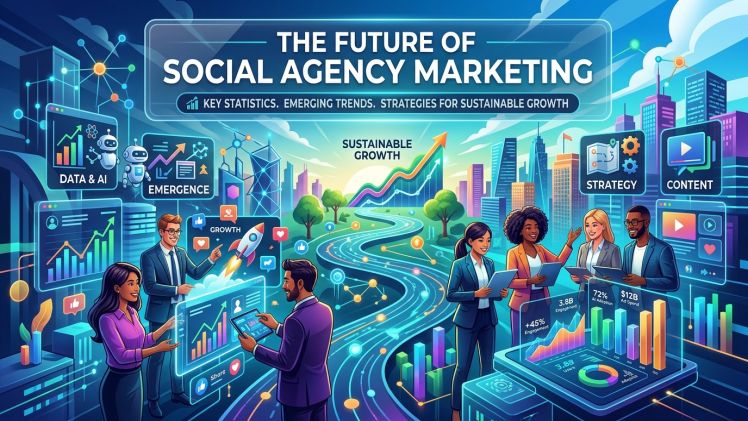
The Future of Social Agency Marketing: Key Statistics, Emerging Trends, and Strategies for Sustainable Growth

Introduction
Digital communication continues to transform how businesses connect with customers, establish credibility, and generate revenue. Social media platforms have become essential channels for brand discovery, audience engagement, customer service, and online advertising. As consumer expectations evolve, working with a social agency can help businesses develop structured marketing strategies, understand audience behavior, and turn digital interactions into measurable business opportunities.
The growing importance of social media marketing reflects a broader shift toward data-driven decision-making. Businesses increasingly evaluate marketing performance through engagement rates, website traffic, lead generation, customer acquisition costs, and conversion rates. Rather than publishing content without a defined objective, organizations are prioritizing campaigns that connect creative storytelling with measurable outcomes.
Understanding the latest industry statistics and marketing trends can help businesses make informed decisions, allocate budgets effectively, and build stronger relationships with their audiences. By combining audience research, strategic content development, paid advertising, and performance analysis, companies can establish a more consistent and competitive digital presence.
Social Media Marketing Statistics That Matter for Businesses
Marketing statistics provide valuable insights into consumer behavior and the effectiveness of digital communication. However, numbers become useful only when businesses understand how to apply them to their objectives.
1. Audience Reach and Digital Visibility
Social media offers businesses opportunities to reach audiences beyond traditional geographic boundaries. A carefully planned content strategy can introduce a brand to potential customers who may not discover it through conventional advertising.
Reach measures the number of unique accounts exposed to content, while impressions indicate how many times content appears on users’ screens. These metrics help marketers understand the visibility of individual posts and campaigns.
Businesses should evaluate reach alongside audience relevance. A campaign reaching thousands of people may produce limited commercial value if those individuals are unlikely to become customers. A smaller, highly relevant audience can sometimes generate stronger engagement and more qualified inquiries.
2. Engagement as an Indicator of Audience Interest
Likes, comments, shares, saves, and meaningful interactions can indicate whether content resonates with its intended audience. Engagement rates provide additional context by comparing interactions with a defined audience or exposure metric.
For example, a post receiving 240 interactions from 8,000 impressions has an interaction-to-impression rate of 3%.
This calculation is useful for comparing content performance, provided the same measurement method is used consistently. Businesses should also consider the quality of engagement. Questions from prospective customers, informative discussions, and content shares may provide more actionable insights than passive reactions alone.
3. Website Traffic and Conversion Performance
Social media activity becomes more commercially valuable when it supports broader business goals. Referral traffic helps businesses understand how many visitors arrive at their websites through social channels.
Conversion tracking can then reveal whether those visitors complete desired actions, such as submitting a contact form, requesting a consultation, subscribing to a newsletter, or making a purchase.
Suppose a campaign generates 1,500 website visits and 75 completed inquiries. The resulting conversion rate is 5%.
This example illustrates why traffic volume should not be the only measure of success. Businesses need to understand what visitors do after clicking a link and whether those actions contribute to meaningful outcomes.
Emerging Social Media Marketing Trends
Social media strategies continue to change as platforms introduce new features and audiences develop different content preferences. Businesses that monitor these developments can adapt their campaigns while maintaining a consistent brand identity.
Short-Form Video and Visual Storytelling
Short-form video remains an important content format for product demonstrations, educational explanations, behind-the-scenes updates, and customer questions. Its appeal lies in the ability to communicate useful information quickly.
Businesses do not need elaborate production to create effective videos. Clear messaging, relevant examples, strong openings, readable captions, and appropriate pacing can make content easier to understand.
A professional content plan can include several recurring video formats, such as answering common questions, explaining industry concepts, demonstrating a service, and introducing team members. Reusing these formats helps maintain consistency while reducing production complexity.
Authenticity and Community Building
Audiences increasingly encounter a large volume of promotional content. Consequently, communication that feels informative, transparent, and relevant can help businesses establish stronger relationships.
Authenticity does not mean abandoning professional standards. It means presenting accurate information, responding thoughtfully to questions, acknowledging customer concerns, and communicating in a recognizable brand voice.
Community building also requires participation. Businesses can encourage discussions, respond to comments, share useful resources, and use audience feedback to improve future content.
Artificial Intelligence and Marketing Efficiency
Artificial intelligence tools are changing how marketing teams research topics, organize content ideas, analyze campaign performance, and develop initial creative concepts.
These tools can support brainstorming, identify recurring customer questions, and help teams work more efficiently. However, automated output still requires human review to ensure accuracy, originality, brand alignment, and appropriate context.
The strongest approach combines technological assistance with human judgment. Businesses should use automation to reduce repetitive work while preserving the expertise and creativity necessary for meaningful communication.
How Data-Driven Strategies Improve Marketing Performance
A successful social media program requires more than regular posting. It needs a framework that connects business objectives with content decisions and measurable results.
Establish Clear Marketing Objectives
The first step is defining what the business wants to accomplish. Objectives might include increasing brand awareness, attracting qualified leads, improving customer retention, or generating online sales.
Each objective requires different performance indicators. Awareness campaigns may prioritize reach and relevant audience growth, while lead-generation campaigns should emphasize qualified inquiries and conversion rates.
Clear objectives also help prevent marketing teams from spending resources on activities that produce attractive statistics but limited business value.
Use Audience Research to Guide Content
Audience research helps businesses understand customer needs, purchasing concerns, preferred formats, and common questions. Sources may include website analytics, customer conversations, social media comments, surveys, and sales-team feedback.
These insights can inform a content calendar organized around educational information, practical advice, service explanations, customer questions, and brand updates.
When content addresses genuine audience needs, it becomes easier to maintain relevance without relying on repetitive promotional messages.
Frequently Asked Questions About Social Media Marketing
How does a social media agency support business growth?
A social media agency can help businesses plan campaigns, develop content, manage publishing schedules, monitor audience engagement, coordinate advertising, and evaluate performance. The scope of work depends on the organization’s goals, budget, and internal capabilities.
Which metrics should businesses monitor?
Important metrics include reach, impressions, engagement rate, website referral traffic, click-through rate, conversion rate, cost per lead, and return on advertising spend. The most relevant indicators depend on the campaign objective.
How often should businesses publish content?
Publishing frequency should reflect audience preferences, platform requirements, content quality, and available resources. A manageable schedule with consistent, relevant posts is generally more sustainable than publishing frequently without a clear purpose.
Does every business need paid social media advertising?
Not necessarily. Organic content can support community development, education, and brand visibility, while paid campaigns can help businesses target specific audiences and test commercial messages. The appropriate balance depends on objectives, competition, resources, and campaign performance.
How long does it take to evaluate results?
Initial engagement data may appear shortly after publishing, but meaningful business outcomes often require a longer evaluation period. The appropriate timeframe depends on the campaign, purchasing cycle, budget, and volume of conversion data available.
Conclusion
Social media marketing has developed into a measurable business function that combines communication, creative development, audience research, and performance analysis. Industry statistics can help organizations identify opportunities, but their real value comes from applying the findings to specific business objectives.
By monitoring meaningful engagement, evaluating website conversions, testing campaign variations, and measuring financial outcomes, businesses can make more informed marketing decisions. Short-form video, authentic communication, artificial intelligence, and community-focused content also provide opportunities to improve relevance and operational efficiency.
A structured strategy enables businesses to move beyond posting for visibility and toward building stronger customer relationships. With clear goals, reliable measurement, and consistent refinement, social media marketing can become a practical contributor to brand awareness, lead generation, and sustainable business growth.