
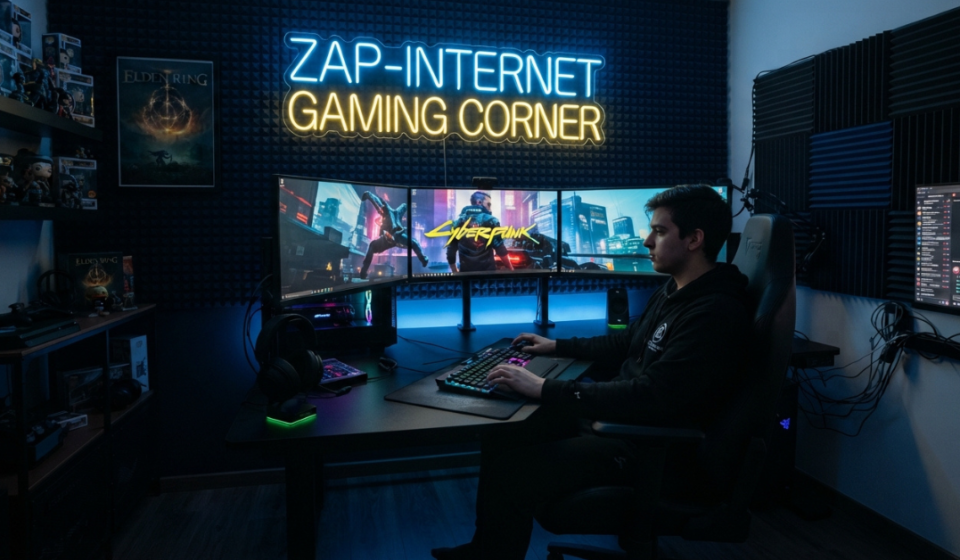

If you’ve ever had a perfect gaming setup ruined by lag, you’ve probably learned an annoying lesson: great gaming hardware isn’t enough.
That’s where the zap-internet gaming corner comes into the picture. The phrase is associated with ZAP Internet’s gaming-focused content, but it is also being used online to describe a broader idea—a dedicated gaming environment where the hardware, internet connection, networking equipment, and overall player experience are designed to work together.
ZAP Internet currently has a dedicated Gaming Corner section covering gaming, connectivity, technology, gadgets, and digital entertainment. Its site describes itself as a platform focused on gaming and gadgets.
But there’s an important distinction worth making. Zap-internet gaming corner is not a universally recognized technical standard like Wi-Fi 6 or Ethernet. Instead, it is best understood as a gaming-focused concept and content category rather than a standardized networking technology.
So, what does it actually mean, and how can you build a gaming corner that performs well?
Let’s break it down.
What Is Zap-Internet Gaming Corner?
The simplest way to understand zap-internet gaming corner is to think of two things working together:
- A dedicated gaming environment
- A reliable, responsive internet connection
The physical side might include a gaming PC or console, monitor, keyboard, mouse, controller, headset, desk, chair, lighting, and other accessories.
The networking side involves your internet connection, router, Ethernet or Wi-Fi setup, latency, packet loss, bandwidth, and network congestion.
ZAP Internet’s own Gaming Corner content discusses gaming setups, social play, connectivity, local gaming spaces, and related technology.
That doesn’t mean every article using the phrase is describing one official ZAP Internet product. Several third-party pages use the term more broadly to describe a gaming environment optimized for low latency and stable online play.
This distinction is important because it prevents a common misunderstanding: a gaming corner isn’t automatically a special internet protocol or guaranteed low-ping service.
It’s a setup philosophy.
Why Internet Quality Matters for Gaming
A powerful gaming PC can render a game beautifully, but it can’t control how quickly information travels between your device and the game server.
That’s where networking becomes important.
During an online match, your device is constantly communicating with a remote server. Your movements, actions, and other game information travel across the network and return with updates from the server.
If that communication becomes delayed or unstable, you may experience:
- Delayed controls
- Rubber-banding
- Sudden freezes
- Disconnections
- Players appearing to teleport
- Voice-chat interruptions
- Inconsistent multiplayer performance
And here’s the part many people get wrong: a higher download speed doesn’t automatically eliminate gaming lag.
Latency, jitter, packet loss, network congestion, and server distance can matter just as much—or sometimes more—than raw bandwidth.
Ping vs. Latency vs. Internet Speed
These terms are often used interchangeably, but they’re not exactly the same thing.
Internet Speed
Internet speed generally refers to how much data your connection can transfer over a period of time.
It’s usually expressed in Mbps or Gbps.
High bandwidth is useful for:
- Large game downloads
- Game updates
- Streaming
- Multiple connected devices
- Cloud gaming
- Uploading videos
But having 1 Gbps internet doesn’t automatically mean you’ll have perfect gaming performance.
Ping
Ping generally describes the round-trip time between your device and a server.
A lower ping usually means a more responsive connection.
For competitive games, this can be particularly noticeable because small delays can affect how quickly your actions are registered.
Latency
Latency is the delay involved in transmitting data.
You can have extremely fast internet but still experience high latency because of factors such as:
- Server distance
- Network routing
- Congestion
- Wireless interference
- Router performance
- ISP network conditions
Jitter
Jitter refers to variation in latency.
A connection that normally sits around a stable latency but suddenly jumps much higher can feel inconsistent even if the average ping looks reasonable.
Packet Loss
Packet loss occurs when packets of data fail to reach their intended destination.
It can result in:
- Stuttering
- Missing game updates
- Rubber-banding
- Voice-chat problems
- Disconnects
That’s why a good gaming corner zap-internet setup should focus on stability rather than simply chasing the highest advertised download number.
Wired Ethernet vs. Wi-Fi for Gaming
If your gaming device is close enough to your router, Ethernet is often worth considering.
A wired connection avoids many of the wireless variables that can affect performance.
Benefits of Ethernet
A wired setup can provide:
- Consistent connectivity
- Reduced wireless interference
- Reliable latency
- Fewer Wi-Fi signal problems
- Stable performance during heavy network usage
This is particularly useful for competitive gaming.
When Wi-Fi Makes Sense
Wi-Fi can still work very well, especially with modern equipment and a strong signal.
It’s often the practical choice when:
- Your router is far from the gaming device
- Running Ethernet isn’t convenient
- You play on a mobile device
- You use a laptop
- You need flexible device placement
If you’re using Wi-Fi, placing the router appropriately and choosing a suitable Wi-Fi band can make a meaningful difference.
How to Build a Zap-Internet Gaming Corner
You don’t need to spend thousands of dollars to create a good gaming environment.
Start with the fundamentals.
1. Choose the Right Location
Place your gaming station somewhere with:
- Good ventilation
- Minimal glare
- Comfortable seating
- Convenient power access
- Reasonable distance from the router
Avoid squeezing a powerful PC into an enclosed area where heat can accumulate.
2. Connect With Ethernet When Practical
If running a network cable is possible, connect your main gaming PC or console directly to the router.
This removes one major variable from your connection.
3. Optimize Your Router Position
If you’re using Wi-Fi, don’t hide the router behind furniture or inside a cabinet.
Ideally, place it somewhere:
- Elevated
- Open
- Relatively central
- Away from major sources of interference
4. Reduce Background Network Traffic
A gaming session can be affected when other devices are heavily consuming bandwidth.
Before starting an important multiplayer session, consider pausing:
- Large downloads
- Cloud backups
- Operating-system updates
- Game updates
- High-resolution video streams
5. Check Your Ping and Packet Loss
Don’t guess what’s causing the problem.
Test your connection.
If your ping is consistently high or your packet loss is significant, investigate the network before buying new gaming hardware.
6. Keep Firmware Updated
Routers and gaming devices periodically receive firmware or software updates.
Keeping equipment updated can improve stability, security, compatibility, and performance.
What Hardware Belongs in a Gaming Corner?
The exact equipment depends on your budget and the type of games you play.
A basic setup could include:
- Gaming PC or console
- Monitor or television
- Keyboard and mouse
- Controller
- Headset
- Gaming desk
- Comfortable chair
- Router
- Ethernet cable
- Surge protection
A more advanced gaming corner could add:
- High-refresh-rate monitor
- Dual-monitor setup
- Mechanical keyboard
- Gaming mouse
- Dedicated microphone
- Webcam
- Capture card
- Streaming lights
- Network switch
- UPS backup power
- Cable-management system
The important thing is not to buy everything at once.
Build around your actual use.
Gaming Corner Zap-Internet for Competitive Players
Competitive gaming places greater demands on network consistency.
In a casual single-player game, a brief internet interruption might not matter at all.
In an online competitive match, it can be much more noticeable.
Competitive players should pay particular attention to:
Stable Latency
A stable connection is generally more useful than one that fluctuates dramatically.
Packet Loss
Even small amounts of packet loss can interfere with online gameplay.
Server Selection
If a game allows you to choose a region or server, a geographically closer server may reduce network distance.
Wired Connectivity
For stationary gaming devices, Ethernet can remove wireless interference as a variable.
Network Congestion
If multiple people are simultaneously streaming, downloading, uploading, and gaming, your network can become more complicated to manage.
Gaming Corner Zap-Internet for Streamers
Streamers have another challenge: they’re not simply receiving game data.
They’re also uploading a live video stream.
That means upload performance matters.
A streaming setup may require:
- Stable upload bandwidth
- Reliable latency
- Good microphone
- Webcam
- Capture hardware where necessary
- Streaming software
- Adequate PC performance
- Stable network connection
A household might have excellent download speeds but still struggle with livestreaming if its upload performance or network stability is poor.
This is why gaming and streaming setups should be evaluated separately from simple web browsing.
Gaming Corner for Local Gaming Hubs
The phrase gaming corner zap-internet can also refer to a physical local gaming space.
ZAP Internet has published material describing a gaming-corner concept involving shared hardware, fast internet, social play, events, and local esports.
A small gaming hub could include:
- Several gaming PCs
- Consoles
- Shared displays
- Gaming peripherals
- High-speed internet
- Comfortable seating
- Tournament space
- Streaming stations
- Community events
This type of setup is different from a home gaming corner.
A home gamer is optimizing one environment for personal use. A gaming-hub operator has to think about reliability, maintenance, security, customer experience, scheduling, and capacity.
How to Design a Gaming Corner for Long Sessions
Internet performance isn’t the only consideration.
Comfort matters too.
A good gaming space should consider:
Monitor Position
The monitor should be positioned so you’re not constantly looking sharply upward or downward.
Chair Support
A comfortable chair can make long sessions considerably easier.
Lighting
Avoid placing bright lights directly behind or in front of the screen where they create distracting reflections.
Ventilation
Gaming computers and consoles produce heat.
Keep vents clear and provide sufficient airflow.
Cable Management
Loose cables can become both annoying and hazardous.
Use cable clips, sleeves, or channels to keep power and network cables organized.
Power Protection
A quality surge protector can help protect electronics from electrical surges.
For more demanding setups, some users may also consider an uninterruptible power supply.
How Much Internet Speed Does Gaming Need?
There’s no single speed number that guarantees good gaming.
Online games generally don’t require enormous bandwidth merely to transmit gameplay data. The bigger issue is often connection quality and consistency.
However, higher bandwidth can become useful when gaming happens alongside other activities.
For example, a household might simultaneously have:
- One person gaming
- Another streaming 4K video
- Someone downloading a large file
- Cloud backups running
- Several smartphones connected
In that situation, adequate bandwidth can help prevent competing traffic from becoming a problem.
But don’t confuse bandwidth with latency.
A faster plan doesn’t automatically mean a closer game server or better routing.
Does a Gaming Internet Plan Automatically Reduce Ping?
Not necessarily.
This is one of the most important things to understand when researching gaming-focused internet services.
An ISP may market a plan toward gamers, but actual gaming performance depends on the route between your device and the particular game server.
Factors can include:
- Your physical location
- Server location
- Network routing
- Congestion
- Peering arrangements
- Wi-Fi conditions
- Home-network configuration
So don’t judge a gaming service solely by its advertised download speed.
Look at the complete network experience.
Router Features That Can Help Gamers
Modern routers can include features designed to manage network traffic.
One commonly discussed feature is Quality of Service, or QoS.
QoS can allow certain traffic or devices to receive priority under network congestion.
For example, you might prioritize your gaming PC over a device downloading a large file.
However, QoS isn’t magic.
If your underlying connection has serious packet loss or your game server is geographically distant, router settings can’t completely eliminate those limitations.
Common Gaming Network Problems
Problem 1: Sudden Ping Spikes
Possible causes include:
- Network congestion
- Wi-Fi interference
- Background downloads
- Router problems
- ISP congestion
Problem 2: Rubber-Banding
Possible causes include:
- Packet loss
- High latency
- Server problems
- Network instability
Problem 3: Random Disconnects
Potential causes include:
- Weak Wi-Fi
- Router instability
- ISP interruptions
- Game-server problems
- Faulty network hardware
Problem 4: Slow Game Downloads
This is more closely related to bandwidth and server availability than gameplay latency.
A slow download doesn’t necessarily mean your in-game ping will be bad.
Gaming Hardware vs. Internet Performance
It’s easy to spend hundreds of dollars upgrading a graphics card while ignoring the network.
But these components solve different problems.
Your GPU primarily affects graphical rendering.
Your CPU handles game processing and other computational tasks.
Your monitor affects display characteristics such as refresh rate and response behavior.
Your network affects communication with online servers.
So if your game looks beautiful but players teleport around the map, buying a more powerful graphics card probably isn’t the first thing to investigate.
Is Zap-Internet Gaming Corner an Official Gaming Technology?
This is where some caution is useful.
ZAP Internet does have a dedicated Gaming Corner section and publishes articles about gaming, connectivity, gadgets, and related topics.
However, the phrase zap-internet gaming corner is not a universally recognized networking standard or technical specification.
Some third-party articles describe it as a gaming-focused internet setup or local gaming hub, while ZAP Internet’s own articles use the term in connection with gaming-space concepts and related content.
Therefore, readers should check the exact article or service being discussed rather than assuming every use of the phrase refers to the same product.
How to Improve Your Gaming Corner Internet
If your main goal is smoother online gaming, try these steps in order.
Step 1: Test Your Existing Connection
Measure:
- Download speed
- Upload speed
- Ping
- Jitter
- Packet loss
Step 2: Try Ethernet
If you’re currently gaming over Wi-Fi, test a wired connection.
If the problem disappears, your wireless environment may be contributing to the issue.
Step 3: Check Other Devices
Temporarily pause heavy downloads and streaming.
Then test your game again.
Step 4: Restart and Update Your Router
Simple, but surprisingly useful.
Check whether your router has a firmware update available.
Step 5: Check the Game Server
If the game provides server selection, choose an appropriate nearby region.
Step 6: Investigate Persistent Problems
If the connection remains unstable, contact your ISP and provide actual test results rather than simply saying, “My internet is slow.”
Specific evidence is much easier to troubleshoot.
Common Mistakes When Building a Gaming Corner
Buying the Fastest Internet Plan Without Testing
More Mbps doesn’t automatically mean lower latency.
Ignoring Upload Performance
This is particularly important for streamers.
Using Weak Wi-Fi From Too Far Away
Distance and interference can seriously affect wireless reliability.
Putting the Router in a Cabinet
Blocking a router’s antennas or surrounding it with dense objects isn’t ideal for wireless performance.
Forgetting About Heat
Gaming hardware needs adequate airflow.
Spending Everything on RGB
Lighting can make a gaming corner look fantastic, but it doesn’t improve network performance.
Start with the fundamentals.
Gaming Corner Zap-Internet: Quick Checklist
Before calling your setup complete, check the following:
-
Gaming device has adequate hardware
-
Monitor is positioned comfortably
-
Router has good placement
-
Ethernet is used where practical
-
Wi-Fi signal is strong if Ethernet isn’t available
-
Background downloads are controlled
-
Firmware is updated
-
Ping has been tested
-
Packet loss has been checked
-
Cables are organized
-
Gaming equipment has adequate ventilation
-
Power connections are protected
-
Headset and microphone are working properly
-
Seating is comfortable
-
Server region is appropriate
Frequently Asked Questions
What is the zap-internet gaming corner?
The zap-internet gaming corner is a term associated with ZAP Internet’s Gaming Corner content and is also used more broadly to describe a gaming environment combining dedicated hardware with reliable internet connectivity. ZAP Internet maintains a dedicated Gaming Corner section on its website.
Is Gaming Corner Zap-Internet a special type of Wi-Fi?
Not in the sense of being a recognized wireless networking standard. The phrase is better understood as a gaming-focused setup or content concept rather than a technical Wi-Fi standard.
What is the difference between gaming corner zap-internet and gaming corner zap-internet?
There is no meaningful technical difference between the two phrases. They are simply different word orders referring to the same search concept.
Can Ethernet improve gaming performance?
Ethernet can provide a more consistent connection than Wi-Fi in many home environments because it avoids wireless interference and signal-strength issues. Actual performance still depends on the ISP connection, routing, server location, and other network factors.
Does faster internet reduce gaming lag?
Not automatically. Bandwidth and latency are different measurements. Faster bandwidth can help with downloads and multiple simultaneous activities, while latency, jitter, packet loss, routing, and server distance have a major effect on online responsiveness.
Is a gaming router necessary?
No. A standard modern router can be perfectly adequate for many gamers. Advanced features such as QoS can be useful in networks with heavy competing traffic, but buying a gaming-branded router isn’t automatically a solution for every connection problem.
Is the zap-internet gaming corner suitable for streamers?
A well-designed gaming corner can work very well for streamers, but streaming requires additional considerations such as upload stability, microphone quality, camera equipment, encoding performance, and sufficient network capacity.
How can I reduce ping in online games?
Start by using Ethernet where practical, selecting an appropriate game server, reducing network congestion, checking for packet loss, and improving Wi-Fi conditions if you’re using wireless. If the problem persists, investigate your router and ISP connection.
Does a powerful PC fix internet lag?
No. PC hardware and network performance are separate issues. A faster CPU or GPU can improve game rendering and frame rates, but it cannot eliminate high network latency or packet loss.
Is the gaming corner only for competitive players?
No. A gaming corner can be useful for casual players, streamers, families, local gaming groups, and competitive players. The equipment and network requirements simply change depending on how the space is used.
Final Thoughts on Zap-Internet Gaming Corner
The zap-internet gaming corner is easiest to understand as a combination of gaming environment and connectivity rather than a mysterious piece of gaming technology.
ZAP Internet maintains a dedicated Gaming Corner section focused on gaming and related technology, while its own articles and third-party coverage use the phrase in slightly different ways, including home setups, local gaming spaces, social play, and network performance.
The practical lesson is straightforward: don’t judge a gaming setup by download speed or expensive hardware alone.
A genuinely useful gaming corner brings several pieces together:
- Reliable internet
- Stable latency
- Low packet loss
- Suitable hardware
- Good router placement
- Comfortable furniture
- Adequate ventilation
- Organized cables
- Appropriate server selection
- A setup matched to the way you actually play
If you’re building your own gaming corner, start with the basics and test one change at a time. You may discover that improving your network placement or switching to Ethernet makes a bigger difference than spending money on another piece of gaming hardware.
In the end, gaming corner zap-internet is less about having the most expensive setup and more about creating one where your hardware, network, and gaming environment work together.