
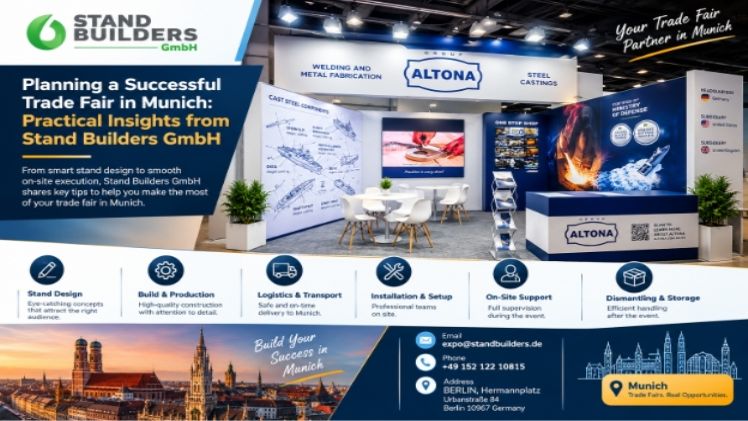

Germany is one of Europe’s most important destinations for international trade exhibitions, bringing together manufacturers, technology companies, service providers, and industry professionals. For businesses preparing to exhibit, selecting an experienced exhibition stand builder in Germany is an important part of developing a professional and functional exhibition presence. Beyond attractive designs, exhibitors need practical layouts, reliable construction, coordinated logistics, and spaces that encourage business interaction. Stand Builders GmbH, a Berlin-based exhibition stand design and construction company, provides these services for businesses participating in trade fairs across Germany, including Munich.
Why Munich Demands a Thoughtful Exhibition Strategy
Munich has established itself as a significant European exhibition destination, hosting international events across construction, technology, manufacturing, transportation, and other industries. Its exhibition environment attracts businesses looking to introduce innovations, meet potential customers, and develop international partnerships.
However, participating in a major trade fair involves more than booking exhibition space. Companies must compete for attention while communicating their products and services to visitors with different professional interests.
An effective exhibition strategy begins by identifying what the company wants to achieve. Some exhibitors prioritise product launches, while others focus on distributor meetings, brand awareness, or lead generation.
These objectives influence everything from stand dimensions and product placement to presentation technology and meeting facilities.
Understanding the Relationship Between Exhibition Space and Business Goals
Every square metre of exhibition space represents an investment. Using that space effectively requires balancing visitor accessibility, product visibility, and operational requirements.
A stand designed primarily for demonstrations will have different priorities from one intended for private business discussions.
Creating Spaces That Support Visitor Movement
Visitors should be able to understand the stand’s layout without needing directions. Clear entrances, accessible displays, and logical walking routes make the space easier to explore.
Large structures or poorly positioned furniture can create unnecessary barriers. In contrast, an open layout encourages visitors to approach products and interact with exhibition staff.
For smaller stands, careful furniture placement and vertical branding can help maintain visibility without overcrowding the available floor area.
Designing Around Meaningful Business Conversations
Trade fairs provide opportunities for direct communication between businesses and potential customers.
A successful stand should therefore support different types of conversations. Informal discussions may take place near product displays, while detailed negotiations may require quieter seating areas.
Exhibitors should also consider staff movement, storage requirements, electrical access, and presentation equipment during the initial planning stage.
These practical decisions can make the exhibition experience more comfortable for both visitors and employees.
What Makes Exhibition Stand Design in Munich Different?
Although exhibition design principles apply across Germany, each trade fair venue introduces specific technical and operational requirements.
Businesses planning to exhibit in Munich must consider the regulations established by the event organiser and exhibition venue. These may cover construction heights, permitted materials, electrical installations, fire safety, and assembly schedules.
Working with an experienced exhibition stand design company in Munich can help exhibitors coordinate their design requirements with practical construction considerations.
Stand Builders GmbH offers exhibition stand design, fabrication, logistics, installation, and on-site project management for Munich trade fairs. Its services are intended to help businesses manage the technical and operational responsibilities involved in exhibiting.
Why Venue Requirements Should Be Checked Early
A design that looks impressive in a digital presentation may require adjustments before it can be constructed inside an exhibition hall.
For example, suspended branding, elevated platforms, and multi-level structures may require additional technical documentation or approval.
Understanding these conditions early allows designers to develop practical solutions without compromising the company’s presentation objectives.
It also reduces the risk of unexpected modifications during installation.
Choosing an Exhibition Stand That Matches the Event
Not every business requires the same exhibition structure. Stand selection should reflect the company’s budget, exhibition frequency, available floor space, and communication requirements.
Stand Builders GmbH provides four principal types of exhibition stands, each suited to different exhibiting needs.
Custom Exhibition Stands
Custom stands are designed around specific branding and functional requirements. They allow exhibitors to incorporate distinctive architectural elements, specialised product displays, and individually planned meeting areas.
These solutions are useful for businesses introducing new products or seeking a presentation that closely reflects their corporate identity.
Modular Exhibition Stands
Modular stands consist of adaptable components that can be configured for different exhibition spaces.
They are particularly relevant to companies participating in several events throughout the year. Reusing compatible structural elements can support more flexible planning and potentially reduce repeated construction expenses.
Double-Decker Exhibition Stands
Double-decker stands provide an additional level within the exhibition structure.
The upper floor can accommodate meeting rooms, hospitality areas, or private discussions, while the ground floor remains available for demonstrations and visitor interaction.
Because these structures involve additional engineering and safety considerations, exhibitors must verify venue regulations and approval requirements.
Country Pavilion Exhibition Stands
Country pavilions are designed for groups of businesses exhibiting under a shared national or regional identity.
They provide coordinated branding while allowing participating organisations to present their individual products and services.
This approach is particularly relevant to international trade delegations, export promotion organisations, and industry associations.
From Initial Briefing to Exhibition Hall Installation
An exhibition stand passes through several stages before becoming a completed business environment.
Understanding these stages helps exhibitors prepare realistic schedules and communicate their requirements more effectively.
Translating Business Requirements into a Design
The process begins with a detailed project briefing. Designers need information about the exhibition, stand dimensions, target audience, products, branding guidelines, and available budget.
Stand Builders GmbH uses three-dimensional design concepts to help clients visualise their proposed exhibition spaces.
These visualisations make it easier to assess layout decisions, display positioning, and overall appearance before production begins.
Manufacturing and Preparing the Stand
Once the design is approved, construction components, graphics, and other structural elements are prepared.
Stand Builders GmbH operates in-house production facilities, allowing design and manufacturing activities to be coordinated within its project workflow.
Accurate fabrication is important because exhibition stands must be assembled within fixed venue access periods.
Packaging and transportation planning are also essential, particularly when materials must travel between cities or across international borders.
Managing Installation and Dismantling
The final stage involves transporting the stand to the exhibition venue, assembling its components, and checking that the finished structure meets the approved specifications.
On-site supervision helps coordinate installation activities and address practical issues before the event opens.
After the exhibition, dismantling and storage arrangements become important, especially when structural components will be reused.
How Sustainable Thinking Can Improve Exhibition Planning
Sustainability is becoming an increasingly relevant consideration in exhibition design.
Temporary structures can generate significant material waste when they are constructed for a single event and discarded immediately afterwards.
Businesses can address this issue by considering reusable components, adaptable layouts, durable materials, and efficient transportation arrangements.
Modular structures may be particularly useful when a company participates in several exhibitions with different floor-space requirements.
However, sustainability should be evaluated across the entire project rather than based on materials alone. Transportation distances, manufacturing processes, storage arrangements, and the number of times components are reused all influence environmental performance.
Stand Builders GmbH highlights reusable stand solutions and environmentally conscious construction practices as part of its exhibition services.
Preparing a Clear Brief Before Requesting a Quotation
A detailed project brief helps exhibition contractors understand the work involved and prepare more relevant proposals.
Exhibitors should provide the event name, venue, stand dimensions, expected budget, and exhibition dates. Information about product dimensions, branding requirements, meeting spaces, and technical equipment is equally useful.
Companies should also clarify whether they require transportation, installation, on-site supervision, dismantling, or storage.
When these details are available from the beginning, contractors can identify practical requirements and potential challenges earlier in the process.
This preparation also makes it easier to compare design proposals based on functionality, scope, and overall project value rather than appearance alone.
Conclusion
A successful trade fair appearance in Munich depends on careful preparation, purposeful design, and reliable project execution. Businesses need exhibition spaces that communicate their identity while supporting demonstrations, visitor movement, and professional conversations.
Stand Builders GmbH provides an integrated approach to exhibition stand design and construction, covering custom stands, modular solutions, double-decker structures, and country pavilions. Its project services extend from initial design development to manufacturing, installation, and dismantling.
For exhibitors, the most valuable approach is to connect every design decision with a clear business objective. When planning, construction, and visitor experience work together, an exhibition stand becomes more than a temporary display—it becomes a practical setting for building lasting business relationships.