
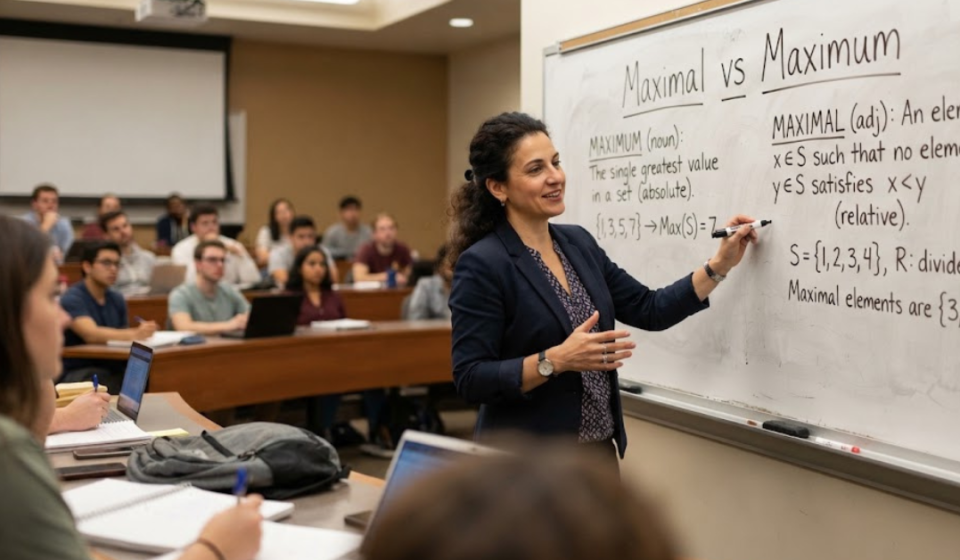

When two words look almost identical, it’s easy to assume they’re interchangeable. Maximal vs maximum is a good example: both words relate to reaching a limit or being as great as possible, but they don’t always work the same way in a sentence.
So, should you say “maximal” or “maximum”? The answer depends on what you’re trying to describe. Understanding the difference can make your writing more precise, especially in academic, technical, mathematical, and everyday contexts.
Maximal vs Maximum: The Basic Difference
The simplest way to distinguish maximal vs maximum is this:
- Maximum usually refers to the greatest possible amount, level, degree, or value.
- Maximal usually means as great as possible within particular conditions or among available alternatives.
In everyday English, maximum is far more common.
For example:
“The maximum speed is 100 mph.”
Here, “maximum” identifies the highest permitted speed.
By contrast:
“The treatment produced a maximal response.”
Here, “maximal” describes the response as reaching the greatest level possible under the relevant conditions.
The distinction can be subtle, but context makes it clearer.
What Does Maximum Mean?
Maximum can function as both a noun and an adjective.
As an adjective, it means the greatest amount or level possible.
“The maximum capacity is 50 people.”
As a noun, it refers to the highest point or value.
“The temperature reached a maximum of 40°C.”
The word is especially common when discussing:
- Limits
- Capacity
- Speed
- Numbers
- Measurements
- Scores
- Quantities
- Performance
Examples of Maximum
- “What is the maximum weight allowed?”
- “The maximum temperature was 35°C.”
- “You can stay for a maximum of two hours.”
- “The machine operates at maximum power.”
In each example, maximum identifies an upper limit or greatest value.
What Does Maximal Mean?
Maximal is an adjective meaning at or approaching the greatest possible level, particularly within a specific situation, system, or set of conditions.
It is more specialized than “maximum” and appears frequently in technical or academic writing.
For example:
“The athlete trained at maximal intensity.”
This means the athlete trained at the highest intensity relevant to the activity.
Another example:
“The experiment produced a maximal response.”
The word emphasizes the highest achievable response under the conditions being considered.
Maximum vs Maximal in Everyday English
For ordinary conversation, maximum will usually be the more natural choice.
You would normally say:
“The maximum number of guests is 20.”
rather than:
“The maximal number of guests is 20.”
Although “maximal” isn’t necessarily impossible, it sounds more technical and less natural in this sentence.
Similarly:
Natural:
“The maximum speed is 60 mph.”
Less natural in everyday speech:
“The maximal speed is 60 mph.”
So if you’re simply talking about an upper limit, maximum is usually the safer choice.
Maximal vs Maximum in Technical Writing
The difference becomes more noticeable in scientific and technical fields.
Maximal often describes a condition, response, effort, or state that reaches the highest attainable level.
For example:
“Participants were asked to exercise at maximal effort.”
Here, “maximal effort” refers to the highest effort the participant can produce in the relevant circumstances.
Meanwhile:
“The maximum exercise duration was 30 minutes.”
Here, “maximum” identifies the upper limit of duration.
This gives us a useful distinction:
Maximum = the highest value or limit.
Maximal = reaching the highest possible degree or level.
Maximal vs Maximum in Mathematics
Mathematics provides one of the clearest reasons not to treat these words as exact synonyms.
In mathematical terminology, maximum generally refers to the greatest value in a set or function when such a greatest value exists.
For example, consider the set:
{2, 4, 7, 9}
The maximum is 9, because no other element is greater.
The term maximal, however, can have a different technical meaning, particularly when dealing with partially ordered sets and related mathematical structures.
A maximal element is an element for which there is no other element in the relevant set that is strictly greater according to the specified ordering.
Importantly, a maximal element doesn’t necessarily have to be the single greatest element.
This is why mathematicians don’t simply use “maximal” and “maximum” interchangeably.
Maximal vs Maximum: A Simple Comparison
| Word | Typical Meaning | Common Use |
| Maximum | Greatest value or upper limit | Everyday, scientific, mathematical |
| Maximal | At the highest attainable level or degree | Technical, scientific, academic |
| Maximum | Can be noun or adjective | Very common |
| Maximal | Primarily an adjective | More specialized |
A quick test can help:
Are you identifying the highest number or limit?
Use maximum.
Are you describing something operating at its highest attainable level?
Maximal may be more appropriate.
Maximal or Maximum: Which One Should You Use?
When choosing between maximal or maximum, ask what you’re trying to communicate.
Use “maximum” for a limit
“The maximum speed is 80 km/h.”
The Use “maximum” for the greatest quantity
“The maximum capacity is 100 liters.”
Use “maximal” for an extreme or highest-level condition
“The patient reached maximal exercise capacity.”
Use “maximal” in specialized terminology
“The researcher identified a maximal element.”
In general writing, maximum will probably be the correct and more natural choice unless you’re describing a specific technical concept or a highest-level condition.
Common Phrases With “Maximum”
You’ll frequently encounter these expressions:
- Maximum capacity
- Maximum speed
- Maximum weight
- Maximum amount
- Maximum value
- Maximum temperature
- Maximum efficiency
- Maximum limit
- Maximum performance
- Maximum strength
For example:
“The elevator has a maximum capacity of eight people.”
These phrases are standard and natural.
Common Phrases With “Maximal”
“Maximal” tends to appear in more specialized combinations, such as:
- Maximal effort
- Maximal intensity
- Maximal response
- Maximal strength
- Maximal oxygen uptake
- Maximal capacity
- Maximal stimulation
- Maximal value
- Maximal element
For example:
“The runner maintained maximal effort during the final sprint.”
The emphasis is on the degree of effort, rather than simply stating a numerical upper limit.
Is Maximal the Same as Maximum?
Not exactly.
The two words overlap in meaning, but they have different grammatical and contextual uses.
Think of it this way:
Maximum tells you what the highest value is.
Maximal describes something reaching or operating at the highest possible level.
There are situations where either word may sound reasonable, but replacing one with the other can change the meaning or make a sentence sound unnatural.
Maximum vs Maximal in Performance
Performance-related language is a good example of the distinction.
Consider these two sentences:
“The maximum speed of the car is 200 km/h.”
This tells us the car’s upper speed limit.
Now compare:
“The driver made a maximal effort to avoid the collision.”
This describes the degree of effort rather than a numerical limit.
The first sentence is about a maximum. The second describes something as maximal.
Common Mistakes With Maximal and Maximum
One common mistake is assuming that maximal is simply a more sophisticated version of maximum.
It isn’t.
Using a longer or more technical word doesn’t automatically make a sentence more precise. In fact, using “maximal” where ordinary English calls for “maximum” can make writing sound unnecessarily complicated.
For example:
“The maximum number of attendees is 500.”
is clearer than:
“The maximal number of attendees is 500.”
Unless you’re writing within a specialized technical context, maximum is usually preferable here.
Frequently Asked Questions About Maximal vs Maximum
What is the difference between maximal vs maximum?
Maximum generally refers to the greatest value, amount, or upper limit. Maximal usually describes something reaching its highest attainable level or degree within a particular context.
Is maximal or maximum more common?
Maximum is much more common in everyday English. Maximal is more frequently used in scientific, technical, academic, and specialized contexts.
Is maximal the same as maximum?
They are related but not always interchangeable. “Maximum” commonly identifies the greatest value, while “maximal” often describes a state or condition at the highest possible level.
Should I say “maximum effort” or “maximal effort”?
Both can be found, but maximal effort is common when describing effort performed at the highest attainable intensity, particularly in technical or sports contexts. “Maximum effort” is also natural in everyday English.
Is “maximal” a proper English word?
Yes. Maximal is a standard English adjective. It means occurring at or being the greatest possible level, degree, or extent under the relevant circumstances.
What is the opposite of maximal?
Depending on the context, possible opposites include minimal, lowest, or least.
What is the opposite of maximum?
The opposite is generally minimum, referring to the smallest amount, value, or level.
Can maximum be a noun and an adjective?
Yes. For example, “The maximum is 100” uses it as a noun, while “The maximum speed is 100 km/h” uses it as an adjective.
Conclusion: Maximal vs Maximum
The key to understanding maximal vs maximum is remembering that the words overlap but aren’t identical.
Maximum usually refers to the greatest value, amount, or limit. Maximal generally describes something reaching the highest attainable level or degree, especially in technical or specialized contexts.
So, when deciding between maximum vs maximal, use maximum when you’re talking about an upper limit or greatest value. Choose maximal when you’re describing the highest possible degree of something within a particular set of circumstances.
In short: maximum is usually about the highest value; maximal is often about the highest level or degree.