
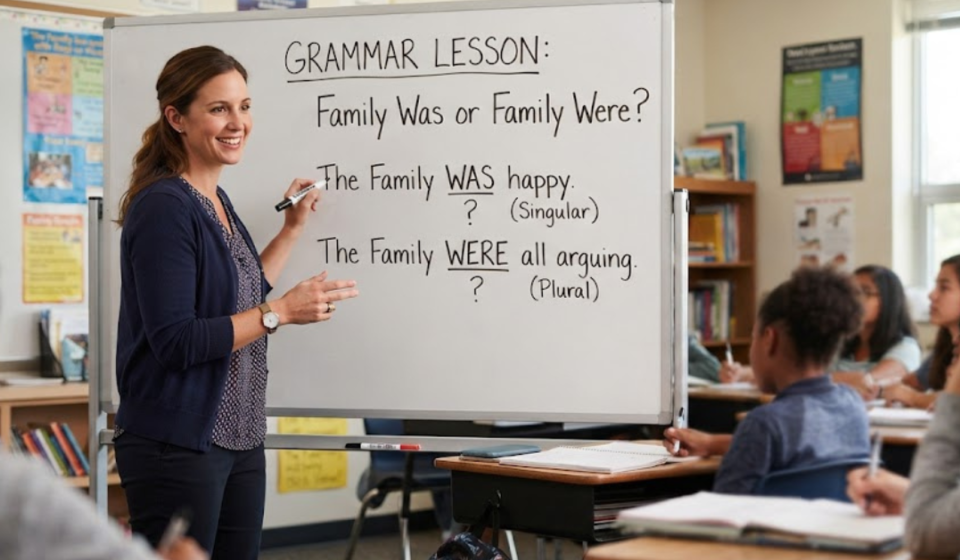

When you’re writing about relatives, one small grammar question can cause surprising confusion: family was or family were? Since a family contains several people, it may seem logical to use the plural were. But in standard English, the correct choice depends on whether you’re treating family as a single unit or as individual members.
In most cases, family was is correct in American English because family is a collective noun treated as singular. However, family were can be correct in British English when the speaker is emphasizing the individual members of the family.
Let’s break down the difference with clear examples.
Family Was or Family Were: Which Is Correct?
The word family is a collective noun. It refers to a group of people, but grammatically, it can be treated either as one unit or as several individuals depending on the context and variety of English.
Use “Family Was” for the Group as One Unit
Use was when you’re talking about the family as a single group or unit.
For example:
My family was at home last night.
The sentence describes the family collectively. You’re thinking about everyone as one group, so was is appropriate.
More examples:
- My family was very supportive.
- Her family was surprised by the news.
- The family was living in London.
- His family was well known in the community.
This construction is especially common in American English.
When Is “Family Were” Correct?
The phrase family were is also possible, particularly in British English, when the sentence focuses on the individual members of the family rather than the family as a single unit.
For example:
The family were arguing among themselves.
Here, the emphasis is on several individual people who are arguing with one another.
Another example:
My family were divided over the decision.
The sentence focuses on different family members having different opinions.
This use of a plural verb with a collective noun is known as notional agreement. The verb agrees with the idea being expressed rather than simply following the grammatical form of the noun.
My Family Was or Were?
If you’re wondering, “my family was or were?”, the safest answer depends on your variety of English and what you mean.
American English
American English generally treats collective nouns such as family as singular.
So you would normally write:
My family was happy to see me.
My family was waiting outside.
My family was together for the holidays.
British English
British English often allows collective nouns to take either singular or plural verbs depending on the intended meaning.
For example:
My family was sitting together.
This treats the family as one unit.
But:
My family were discussing different options.
This emphasizes the individual family members.
Both patterns can therefore be found in British English.
Why Does “Family” Cause Confusion?
The confusion comes from the difference between meaning and grammatical number.
Family describes more than one person, but the word itself is grammatically singular.
Compare:
My family was large.
Here, family is one collective noun.
Now compare:
My family members were excited.
Here, members is clearly plural, so were is required.
The key is that English sometimes treats collective nouns as singular groups and sometimes focuses on their individual members.
Family Was or Were: Examples
Here are some practical examples to make the difference easier to see.
Family Was or Were With Past Participles
| Sentence | Usage | Why |
| My family was happy. | Singular | Family is treated as one unit. |
| My family was at the restaurant. | Singular | The group is viewed collectively. |
| My family were arguing with one another. | Plural | Individual members are emphasized. |
| My family were divided in their opinions. | Plural | Members have different views. |
| My family members were happy. | Plural | “Members” is plural. |
The same principle applies when family appears with a past participle.
For example:
My family was invited to the wedding.
The entire family received one invitation as a group.
But in British English, you could encounter:
My family were invited to different events.
The plural form makes sense if the sentence focuses on individual members receiving separate invitations.
Context determines the best choice.
Family Was or Were in Questions
The same rule applies when forming questions.
If you treat the family as one group:
Was your family at the party?
This is the normal choice in American English.
In British English, if you’re focusing on individual members, you might hear:
Were your family happy with the arrangements?
However, many speakers would avoid this construction by saying:
Were your family members happy with the arrangements?
That version is especially clear because members is explicitly plural.
“My Family Was” Examples
Use my family was when the family is considered a single group.
Examples include:
- My family was very close.
- My family was living in California.
- My family was excited about the trip.
- My family was invited to the ceremony.
- My family was proud of my achievement.
In each example, the family is being presented as one collective entity.
“My Family Were” Examples
Use my family were when the individual members are being emphasized, particularly in British English.
For example:
- My family were arguing about where to go.
- My family were wearing different colors.
- My family were each given a separate ticket.
- My family were disagreeing with one another.
Notice that these sentences naturally suggest separate actions or opinions among the members.
Family Was or Were With “They”
Pronouns can make the difference clearer.
Consider:
My family was sitting in the living room.
You are describing the group as a whole.
But:
My family were arguing among themselves.
The phrase among themselves strongly highlights the individual members.
Another option is to rewrite the sentence:
My family members were arguing among themselves.
This removes any ambiguity and works naturally in both American and British English.
Other Collective Nouns Like Family
Family isn’t the only collective noun that can cause this question.
Other examples include:
- team
- government
- committee
- audience
- staff
- class
- company
- group
For example:
The team was ready.
This treats the team as one unit.
But in British English, you may also see:
The team were wearing different uniforms.
The plural form emphasizes individual members.
How to Choose Between “Was” and “Were”
When you’re unsure about family was or were, use this simple process:
- Ask what you’re emphasizing.
Is the family one group, or are you talking about individual members? -
Use “was” for one collective unit.
My family was together.
-
Use “were” when emphasizing individual members.
My family were disagreeing with each other.
- Consider your variety of English.
American English generally prefers singular agreement with collective nouns, while British English allows greater flexibility. -
Use “family members” if you want maximum clarity.
My family members were excited.
Common Mistakes With Family Was or Were
Mistake 1: Assuming “family” Must Always Take “were”
Because a family contains several people, some writers assume were must always follow it.
That’s not correct.
My family was happy.
is perfectly grammatical when the family is treated as one group.
Mistake 2: Assuming “family” Must Always Take “was”
The opposite is also too simplistic.
In British English, family were can be grammatical when the sentence emphasizes individual members.
My family were arguing.
The context makes the intended meaning clear.
Mistake 3: Ignoring Regional English
English grammar isn’t identical everywhere. Collective nouns are one area where British and American usage can differ noticeably.
If you’re writing for an American audience, family was is generally the safest choice. If you’re writing in British English, both forms may be appropriate depending on meaning.
Frequently Asked Questions
Is it “family was” or “family were”?
Both can be correct. Family was is generally preferred in American English when the family is treated as one unit. Family were is possible in British English when individual family members are emphasized.
Is “my family was” correct?
Yes. My family was is grammatically correct when you’re referring to your family as a single group.
My family was happy to see me.
Is “my family were” correct?
Yes, particularly in British English when you’re emphasizing individual members.
My family were arguing among themselves.
Should I say “my family was” or “my family were” in American English?
In standard American English, my family was is normally the preferred form because collective nouns are generally treated as singular.
Should I say “family was” or “family were” in British English?
Either can be correct. Use was when the family is considered one unit and were when the individual members are emphasized.
Is “my family were happy” grammatically correct?
It can be correct in British English, especially when referring to the members individually. In American English, my family was happy is generally preferred.
What is the safest alternative to “my family were”?
If you want to avoid regional differences, use my family members were.
For example:
My family members were excited about the trip.
This clearly identifies the subject as plural.
Conclusion: Family Was or Family Were?
So, family was or family were isn’t simply a matter of one form always being right and the other always being wrong.
Use family was when you’re treating the family as a single group. This is the standard choice in American English. In British English, family were can also be correct when the focus is on individual family members and their separate actions, opinions, or feelings.
The easiest rule to remember is:
One family as a unit → was.
Individual family members → were, especially in British English.
When in doubt, “my family was” is the safest choice for general and American English writing. If you want to make the plural meaning unmistakable, use “my family members were.”