
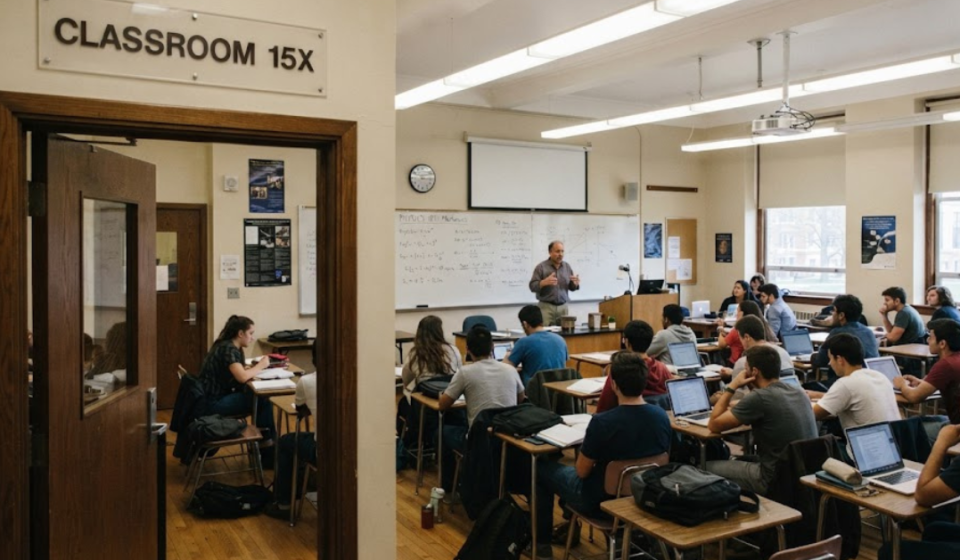

Walk into a modern classroom today and you may see something very different from the traditional rows of desks and a teacher standing at the front. Students might be working in small groups, using digital tools, moving between learning stations, or completing activities at different speeds.
This is where the term Classroom 15x comes into the conversation. But there is an important catch: Classroom 15x does not have one universally accepted definition. Current online sources use the phrase to describe several related ideas, including small-group learning, flexible classroom design, technology-supported education, and, in some cases, browser-based educational gaming.
So, what exactly does Classroom 15x mean, and why are students, teachers, and parents searching for it?
Let’s break it down.
What Is Classroom 15x?
At its broadest, Classroom 15x refers to a modern approach to learning that emphasizes flexibility, student participation, technology, personalized instruction, and more adaptable learning environments.
Some websites associate the “15” with classrooms designed around approximately 15 students. Others describe “15x” as a broader concept for dramatically improving engagement and learning through technology and innovative teaching methods.
Because these definitions differ, it is better not to treat Classroom 15x as an official educational standard.
Instead, think of it as an online term used to describe a collection of modern classroom ideas.
These ideas commonly include:
- Smaller or more manageable learning groups
- Flexible seating and classroom layouts
- Digital learning tools
- Personalized learning activities
- Project-based instruction
- Interactive lessons
- Frequent assessment and feedback
- Collaboration between students
- Technology-assisted learning
The goal is simple: make the learning environment more responsive to what students actually need.
What Does “15x” Mean?
This is one of the most confusing parts of the term.
There is no single authoritative source establishing one official meaning for “15x.” Online descriptions give different explanations. Some connect the number 15 with a small class of approximately 15 students, while others use “15x” as branding for a major improvement in educational effectiveness.
That distinction matters.
A claim that a classroom produces 15 times better results should not automatically be treated as a scientifically established finding. In fact, evidence on class-size reduction is considerably more nuanced.
The Education Endowment Foundation’s current evidence review finds that reducing class size has a small average impact and that the evidence is limited. It also notes that simply having fewer students is unlikely to produce substantial benefits unless teachers actually change how they teach.
So when you see “15x,” look at the context rather than assuming it represents a verified 15-fold improvement.
Classroom 15x as a Flexible Learning Model
One common interpretation of Classroom 15x focuses on the physical and instructional environment.
Instead of keeping desks permanently arranged in rows, the room can be reorganized depending on the activity.
For example, students might use:
- Individual desks for independent work
- Tables of four for collaboration
- A circle for discussion
- Open space for demonstrations
- A quiet area for reading
- Learning stations for rotating activities
The idea isn’t to make a classroom look trendy. The layout should serve the lesson.
Research on flexible classroom design suggests that flexibility and students’ sense of ownership can contribute to better learning environments, although the research base is still developing. A large UK study examined 153 classrooms and 3,766 primary-school children, finding that several aspects of classroom design were associated with academic performance.
Why Flexible Spaces Matter
Imagine teaching a science experiment while every student is sitting behind a fixed desk.
Now imagine the same lesson with tables that can quickly be pushed together, equipment placed at stations, and enough open space for students to move safely.
The second environment gives the teacher more options.
That flexibility can also support different types of learning, including independent study, group discussion, practical activities, and presentations.
However, furniture alone isn’t the magic ingredient. Research and educational commentary consistently emphasize that the teaching approach has to change along with the physical environment.
Classroom 15x and Small-Group Learning
Another interpretation connects Classroom 15x with smaller classes.
There is a straightforward reason this idea is attractive: when fewer students are in a room, a teacher may have more opportunities to interact with individual learners.
A smaller group can make it easier to:
- Ask every student questions
- Identify misunderstandings
- Give individualized feedback
- Encourage quieter students to participate
- Organize collaborative activities
- Monitor student progress
But smaller doesn’t automatically mean better.
The Education Endowment Foundation reports that class-size reduction has a relatively small average impact and very high implementation costs. Its review also emphasizes that the benefits depend on teachers using smaller groups differently rather than simply putting fewer students in the same traditional lesson.
That is an important distinction for anyone researching classroom 15x.
Technology in Classroom 15x
Technology is another major part of many online descriptions of Classroom 15x.
Depending on the setting, technology might include:
- Interactive displays
- Student tablets or laptops
- Learning management systems
- Digital textbooks
- Educational games
- Online quizzes
- Interactive simulations
- Adaptive learning software
- Digital collaboration tools
The important question isn’t how much technology a classroom contains.
It is what the technology actually does.
A tablet that simply replaces a worksheet doesn’t necessarily transform learning. On the other hand, an interactive simulation may allow students to explore concepts that would otherwise be difficult to demonstrate.
Good classroom technology should support the learning objective rather than distract from it.
Personalized Learning in Classroom 15x
Students rarely learn at exactly the same speed.
One student may understand a mathematics concept immediately, while another may need additional examples and practice. A third student might be ready for a more challenging problem.
Personalized learning attempts to account for those differences.
In a Classroom 15x-style environment, personalization might involve:
- Assessing what students already understand.
- Identifying areas where additional support is needed.
- Giving students appropriately challenging activities.
- Monitoring progress.
- Adjusting instruction based on the results.
This can be done with technology, but it doesn’t require sophisticated software.
A teacher who changes groups, provides different practice materials, or gives targeted feedback is already using elements of personalized instruction.
Interactive and Project-Based Learning
Traditional lessons often rely heavily on explanation followed by individual practice.
Classroom 15x-style approaches can place greater emphasis on students doing something with the information.
For example, instead of simply reading about renewable energy, students might design a small model solar system.
Instead of memorizing business vocabulary, students might create a mock company.
Instead of studying geometry entirely from a textbook, students might measure and redesign part of the classroom.
These activities can combine several skills at once:
- Research
- Communication
- Problem-solving
- Collaboration
- Creativity
- Critical thinking
- Presentation
That makes learning more active rather than purely passive.
Does Classroom 15x Improve Learning?
This question needs a careful answer.
There is not enough reliable evidence to say that a standardized educational system called Classroom 15x produces a specific level of improvement. The term itself is not a universally defined research intervention.
However, some individual ideas associated with the term have been studied.
For example, evidence on smaller classes suggests potential benefits under certain conditions, while evidence on flexible classroom environments is described as promising but still limited.
The lesson is important:
Don’t judge an educational approach by its label. Look at the specific teaching practices being used.
A well-designed small class with effective instruction may work very differently from a small class that simply copies a traditional lecture format.
Potential Benefits of Classroom 15x
When its principles are implemented thoughtfully, a Classroom 15x-style environment may offer several potential advantages.
1. More Student Participation
Smaller groups and interactive activities can create more opportunities for students to speak, ask questions, and contribute.
2. Greater Flexibility
Teachers can reorganize the classroom based on the lesson instead of being locked into one seating arrangement.
3. More Individual Attention
A manageable student-to-teacher ratio can make it easier to identify students who need additional support.
4. Stronger Collaboration
Group projects and shared learning activities give students opportunities to practice communication and teamwork.
5. Better Use of Technology
Technology can provide additional resources, simulations, exercises, and feedback when it is connected to clear learning goals.
6. Greater Student Independence
Allowing students to make choices about activities, resources, or learning strategies can encourage responsibility for their own work.
What Are the Challenges?
Classroom 15x isn’t a magic solution.
Schools considering a similar model have practical issues to address.
Cost
Smaller classes require additional teachers and classroom space. Flexible furniture, devices, software, and infrastructure can add further expenses.
The Education Endowment Foundation specifically rates reducing class size as a high-cost approach and notes that additional space and staffing can be significant requirements.
Teacher Training
Changing the furniture isn’t enough.
Teachers may need support in areas such as:
- Collaborative learning
- Classroom management
- Technology integration
- Differentiated instruction
- Project-based learning
- Student assessment
Technology Access
A technology-heavy classroom can create problems when students don’t have equal access to reliable devices or internet connections.
Schools also have to consider technical support, privacy, accessibility, and maintenance.
Classroom Management
Flexible classrooms give students more movement and choice.
That can be useful, but without clear expectations, movement can also become distracting.
Students need to understand when they can move, where they should work, and what behavior is expected.
Classroom 15x vs. a Traditional Classroom
The difference is easier to understand when the two approaches are placed side by side.
| Feature | Traditional Classroom | Classroom 15x-Style Approach |
| Seating | Often fixed rows | More flexible arrangements |
| Teacher role | Primarily instructor | Instructor, facilitator, and coach |
| Learning | Often lecture and individual work | Mix of individual and collaborative work |
| Technology | May be supplementary | More intentionally integrated |
| Student choice | Often limited | Potentially greater |
| Assessment | Periodic tests and assignments | More frequent feedback and checks |
| Classroom layout | Relatively fixed | Adapted to activities |
| Group work | Occasional | More deliberately integrated |
This doesn’t mean traditional classrooms are automatically ineffective.
In fact, some lessons work extremely well with direct instruction and structured seating. The useful question is whether the classroom design matches the learning objective.
What About “Classroom 15x” Games?
There is another reason the term can be confusing.
Some websites use Classroom 15x to describe browser-based games or an online gaming platform. One current guide explicitly says the term is used online for both a gaming platform and a classroom-learning concept.
Other Classroom 15x pages promote browser-based games, including games categorized for different genres.
That means someone searching for “classroom 15” or “classroom 15 x” may actually be looking for games rather than an educational classroom model.
Before using any such site at school, students and teachers should check their school’s acceptable-use rules. A website being described online as “unblocked” does not automatically mean that it is permitted on a particular school’s network.
How Teachers Can Apply Classroom 15x Ideas
You don’t need to rebuild an entire school to introduce some of these principles.
Start small.
Step 1: Identify the Learning Goal
Decide exactly what students should know or be able to do by the end of the lesson.
Step 2: Choose the Appropriate Layout
Use rows for focused instruction, groups for collaboration, or a circle for discussion.
Step 3: Create Learning Zones
If space allows, designate areas for independent work, collaboration, reading, or teacher support.
Step 4: Add Technology Purposefully
Use a digital tool only when it adds something valuable to the lesson.
Step 5: Encourage Student Participation
Ask questions, use peer discussion, and give students opportunities to explain their reasoning.
Step 6: Assess and Adjust
Use short quizzes, observations, student work, or exit tickets to determine whether the approach is working.
The process doesn’t need to be expensive.
Even moving desks into small groups and changing how students interact with the lesson can introduce elements of flexible learning.
Is Classroom 15x Suitable for Every School?
Not necessarily.
Schools differ dramatically in their buildings, budgets, curriculum, technology access, teacher staffing, and student populations.
A flexible classroom might work beautifully in one environment but require substantial modification in another.
The same principle applies to class size. Evidence suggests that simply reducing student numbers isn’t enough; the smaller group needs to enable meaningful changes in teaching and interaction.
That’s why implementation matters as much as the idea itself.
How to Evaluate a Classroom 15x Program or Website
If you encounter a website or product calling itself Classroom 15x, don’t assume every claim is independently verified.
Before relying on it, check:
- Who operates the website?
- Is there an identifiable organization behind it?
- Are educational claims supported by credible research?
- Does it clearly explain its features?
- Is there a privacy policy?
- What information does it collect?
- Is the service free, paid, or supported by advertising?
- Does the school permit its use?
- Are claims about learning outcomes backed by independent evidence?
This is particularly important because the term currently appears across multiple unrelated websites and contexts.
Frequently Asked Questions About Classroom 15x
What is Classroom 15x?
Classroom 15x is an ambiguous term used online for several educational concepts, including small-group learning, flexible classroom design, technology-supported education, and, in some cases, browser-based gaming. It is not currently a universally standardized educational framework.
Does Classroom 15x mean 15 students?
Not necessarily. Some online descriptions connect “15” with approximately 15 students, but there is no universally accepted definition requiring a Classroom 15x class to contain exactly 15 students.
Is Classroom 15x an official educational program?
There is no clear evidence that Classroom 15x is a universally recognized educational standard or official program. Different websites use the term differently.
Does a smaller classroom automatically improve grades?
No. Research suggests that reducing class size can have benefits under certain conditions, but the Education Endowment Foundation notes that the average impact is relatively small and that teachers need to change their approach for smaller classes to make a meaningful difference.
What is a flexible classroom?
A flexible classroom is a learning space that can be rearranged for different activities. Students may use individual seating, small groups, circles, stations, or open areas depending on the lesson.
Does Classroom 15x require expensive technology?
No. Many of its commonly described principles can be implemented without expensive technology. Flexible seating, group work, targeted feedback, project-based activities, and student participation can all be introduced with relatively simple resources.
Is Classroom 15x the same as an online gaming website?
Not necessarily. Some websites use the term for browser-based games, while others use it to describe a modern classroom or educational model. The context and specific website matter.
Final Thoughts on Classroom 15x
The biggest thing to understand about Classroom 15x is that the phrase doesn’t currently have one fixed meaning.
Depending on where you encounter it, classroom 15x, classroom 15, or classroom 15 x may refer to a small-group learning environment, a flexible classroom design concept, technology-supported education, or an online gaming site.
The educational ideas behind the term are more useful when separated from the branding. Smaller groups can create opportunities for closer teacher interaction, while flexible classroom design can support different activities and teaching methods. But neither smaller classes nor fancy furniture automatically produces better learning. Evidence points to the importance of how teachers actually use the environment.
If you’re researching Classroom 15x for a school, teaching project, or online platform, start by identifying which version of the term you’re looking at. Then check the organization behind it, its specific claims, privacy practices, and supporting evidence.
That simple step can save you from confusing several very different things that happen to share the same name.