
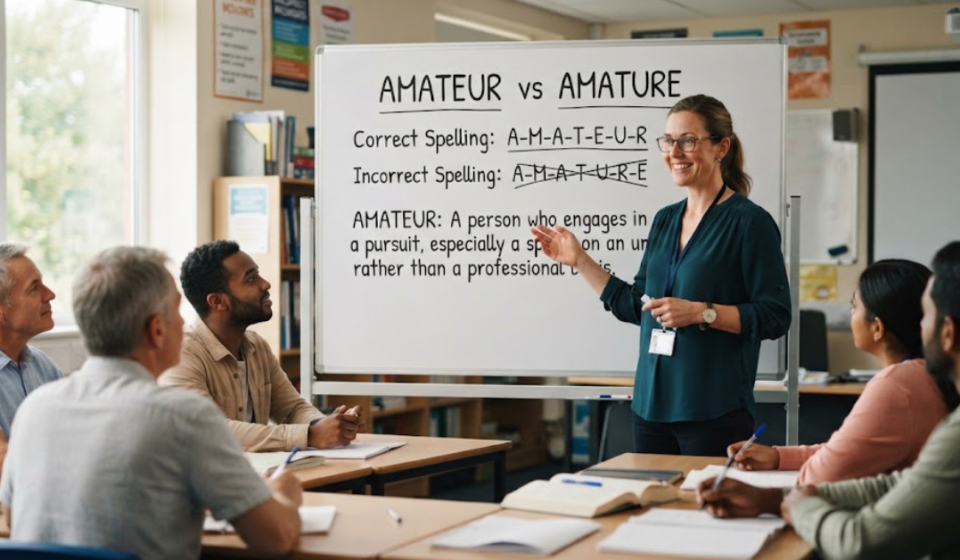

It is easy to hesitate over a word when its pronunciation does not clearly reveal its spelling. Amature vs amateur is a common example. You may have seen amature, amatuer, or even other variations online and wondered which one is correct.
The answer is straightforward: amateur is the correct spelling in standard English. Amature and amatuer are common misspellings.
But there is more to the word than simply remembering a sequence of letters. Understanding what amateur means, how to pronounce it, and why the spelling is so often confused can make it much easier to use correctly.
Amature vs Amateur at a Glance
| Spelling | Correct? | Meaning |
| Amateur | Yes | A person who participates in an activity without being a professional |
| Amature | No | Common misspelling of amateur |
| Amatuer | No | Common misspelling caused by rearranging the letters |
If you’re writing an email, article, school assignment, résumé, or professional document, amateur is the spelling you should use.
How Do You Spell Amateur?
If you’re asking, “How do you spell amateur?”, the correct spelling is:
A-M-A-T-E-U-R
Amateur
A useful way to break it down is:
am-a-teur
The final -eur is particularly important because it is where many spelling mistakes occur.
Common incorrect versions include:
- Amature
- Amatuer
- Amatur
- Amaturee
The standard English spelling is always amateur when referring to a person or activity that is not professional.
What Does Amateur Mean?
An amateur is generally someone who takes part in an activity without doing it as a professional occupation.
For example:
She is an amateur photographer who takes beautiful landscape pictures.
This does not necessarily mean she is bad at photography. In fact, an amateur can be highly skilled.
The word can describe people involved in many different activities, including:
- Sports
- Photography
- Music
- Painting
- Writing
- Cooking
- Acting
- Gardening
- Astronomy
- Collecting
The key idea is usually that the activity is pursued for enjoyment, personal interest, or experience rather than as a professional career.
Amateur Does Not Always Mean “Bad”
One of the most important things to understand about amateur is that it does not automatically mean inexperienced or incompetent.
Consider this sentence:
He is an amateur astronomer.
That simply means astronomy is a personal interest rather than his professional occupation. He could still have years of knowledge and experience.
In some contexts, however, amateur can be used negatively:
The project looked amateur.
Here, the word suggests that something appears poorly made or lacks professional quality.
So the meaning depends heavily on context.
Why Is “Amature” a Common Misspelling?
The amature spelling is especially common because of pronunciation.
When people hear amateur, the middle and final sounds can make the word seem as though it should be spelled amature. The familiar ending -ature also appears in many English words, which can make amature feel natural even though it is incorrect.
For example:
- Creature
- Nature
- Furniture
- Temperature
Because English spelling is full of patterns like these, it is easy to unconsciously apply the wrong one to amateur.
But amateur follows a different spelling pattern.
Amatuer vs Amateur: Why Do People Mix Them Up?
Another common error is amatuer.
The problem here is usually the placement of the e and u.
Correct:
ama-teur
Incorrect:
ama-tuer
In the correct spelling, the ending is:
-teur
not:
-tuer
This is one of those spelling mistakes that can happen even when someone knows the word perfectly well. The letters are simply easy to put in the wrong order when typing quickly.
Amature vs Amateur Examples
Seeing the correct spelling in context is one of the easiest ways to remember it.
Correct examples
He entered an amateur boxing tournament.
She is an amateur photographer.
The club welcomes both professional and amateur players.
I enjoy amateur astronomy in my spare time.
His first film was made with an amateur cast.
Incorrect examples
He entered an amature boxing tournament.
She is an amatuer photographer.
In standard English, replace both misspellings with amateur.
Amateur as a Noun and Adjective
Amateur can function as both a noun and an adjective.
Amateur as a noun
It can refer to a person who participates in an activity without being a professional.
He is an amateur musician.
Here, amateur describes the person’s status as a musician.
Amateur as an adjective
It can describe something associated with non-professional participation.
She joined an amateur theater group.
Here, amateur modifies theater group.
The same spelling is used in both cases.
Amateur vs Professional
The easiest way to understand the word is to compare it with professional.
| Amateur | Professional |
| Usually participates for interest or enjoyment | Usually works in the field as a career |
| May not earn income from the activity | Typically earns income from the activity |
| Can have considerable skill | Usually has professional training or experience |
| Often participates recreationally | Often participates as an occupation |
These categories are not always rigid. Someone can begin as an amateur and eventually become a professional.
For example:
She started photography as an amateur and eventually became a professional photographer.
How to Remember the Spelling of Amateur
If amature keeps tempting you, try a simple memory trick.
Think:
AMA + TEUR
The important part to remember is TEUR at the end.
You can also associate it with the phrase:
An amateur photographer
Repeat the phrase mentally a few times while paying attention to the spelling.
Another useful approach is to remember that amature looks like it contains the ending -ature, but the correct word ends in -teur.
Quick memory check
When you’re unsure, ask yourself:
Is it “amature” or “amateur”?
The answer is:
Amateur
And if you are considering amatuer, remember that the e comes before the u in the final part:
-teur
Pronunciation of Amateur
The pronunciation can vary depending on regional English.
In American English, amateur is commonly pronounced approximately:
AM-uh-tur
or with a slightly different final sound depending on the speaker.
British English often preserves a pronunciation closer to the French origin, with the ending pronounced more distinctly.
This variation in pronunciation may contribute to spelling confusion. English speakers do not always pronounce every letter in a word exactly as it appears in writing.
That is why relying entirely on pronunciation can be risky when spelling amateur.
The Origin of the Word Amateur
The spelling becomes easier to understand when you look at the word’s history.
Amateur comes from French amateur, which in turn comes from Latin amator, meaning “lover” or “one who loves.”
The original idea was someone who loves or takes an interest in an activity.
That history also explains why amateur does not follow the spelling pattern that many English words ending in -ature use.
Common Questions About Amateur
How do you spell amateur?
The correct spelling is amateur.
It is spelled:
A-M-A-T-E-U-R
Is “amature” correct?
No. Amature is a common misspelling of amateur in standard modern English.
Is “amatuer” correct?
No. Amatuer is also a misspelling. The correct form is amateur, with e before u in the final syllable.
Why is amateur so difficult to spell?
Its pronunciation does not always make the spelling obvious, and the ending can be confused with more familiar English patterns such as -ature. The unusual -teur sequence is another reason people make mistakes.
Does amateur mean bad?
Not necessarily. An amateur is generally someone who participates in an activity without being a professional. An amateur can be highly talented and experienced.
What is the opposite of amateur?
The most common contrast is professional.
For example:
He is an amateur photographer.
She is a professional photographer.
Can amateur be used as an adjective?
Yes. For example:
They entered an amateur competition.
Here, amateur is an adjective describing the competition.
Is amateur a noun?
Yes. For example:
He is an amateur.
It can also describe someone who participates in a particular activity without doing it professionally:
She is an amateur painter.
Final Answer: Amature vs Amateur
When it comes to amature vs amateur, there is one spelling you should remember: amateur.
Amature is a common misspelling, while amatuer is another frequent error caused by switching the order of letters. The correct spelling is A-M-A-T-E-U-R.
The word generally describes someone who participates in an activity without being a professional, but it does not necessarily mean that person lacks skill. An amateur photographer, musician, athlete, or writer can be extremely talented.
So, the next time you wonder how do you spell amateur, remember the ending: -teur. Write amateur, and you’ll have the standard spelling right.