
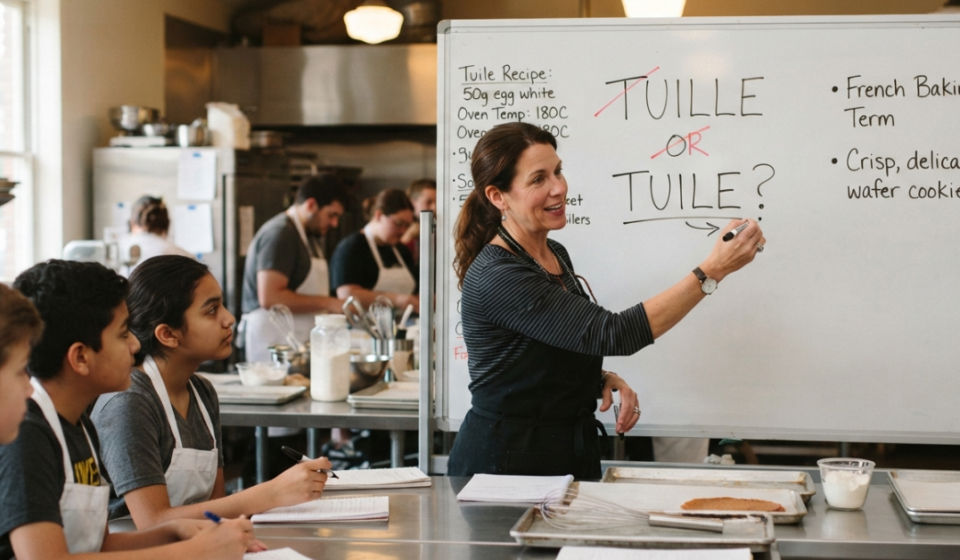
Tuille or Tuile: Which Spelling Is Correct?

A tiny, crisp cookie can make a dessert look like it came straight out of a professional pastry kitchen. But when you’re trying to write its name, one question often causes confusion: tuille or tuile?
If you’ve seen both spellings, you’re not alone. The correct French culinary term is tuile, while tuille is generally a misspelling or mistaken variation. In this guide, we’ll explain the tuille meaning, the correct spelling, pronunciation, and how tuiles are used in cooking and pastry-making.
Tuille or Tuile: Which One Is Correct?
The correct spelling is tuile.
Tuille is commonly seen as a misspelling, likely because the word’s pronunciation can make the spelling less obvious to English speakers.
In French, tuile literally means “tile.” In the culinary world, it refers to a thin, crisp cookie that is traditionally shaped to resemble the curved form of a roof tile.
So:
- Tuile = correct culinary spelling
- Tuille = common misspelling
- Tuiles = plural form in French
If you’re writing a recipe, menu, or food article, tuile is the spelling to use.
What Does Tuile Mean?
The tuille meaning is easiest to understand by looking at the French word itself.
Tuile means “tile” in French. A traditional tuile cookie gets its name from its curved shape, which resembles the curved tiles traditionally used on roofs.
In pastry-making, a tuile is typically a very thin, crisp biscuit made from a simple mixture of ingredients such as:
- Butter
- Sugar
- Flour
- Egg whites
- Sometimes nuts, almonds, or other flavorings
The batter is spread very thinly and baked until crisp. While the cookie is still warm and flexible, it can be shaped over a curved surface.
Why Is It Called a Tuile?
The name comes from the cookie’s appearance.
Traditional roof tiles aren’t always completely flat. Many have a gentle curve, and pastry chefs traditionally shaped these thin cookies to imitate that form.
That connection explains why the French word tuile, meaning “tile,” became the name of the dessert.
It’s a good example of how culinary vocabulary can describe not just what’s in a dish, but what it looks like.
What Is a Tuile Cookie?
A tuile cookie is a delicate, thin, crisp pastry that is often used as both a dessert and a decorative element.
Unlike a thick chocolate chip cookie, a tuile is usually:
- Very thin
- Light and crisp
- Delicate
- Slightly sweet
- Easy to shape while warm
Tuiles can be made in several forms. Some are curved like traditional roof tiles, while others are shaped into cones, baskets, tubes, or decorative pieces.
Pastry chefs often use them to add texture, height, and visual interest to plated desserts.
How Is Tuile Used in Desserts?
Tuiles are particularly popular in professional pastry because they’re useful for more than simply eating on their own.
A chef might place a tuile alongside:
- Ice cream
- Sorbet
- Mousse
- Panna cotta
- Custard
- Fruit desserts
- Cakes
- Chocolate desserts
The contrast is part of the appeal. A soft dessert paired with a crisp tuile creates a much more interesting bite.
For example, a creamy vanilla ice cream might be served with a curved almond tuile. The ice cream provides richness and softness, while the tuile adds crunch.
How Do You Pronounce Tuile?
For English speakers, tuile can be tricky because the French pronunciation doesn’t follow typical English spelling rules.
The French pronunciation is approximately “tweel,” although the exact pronunciation includes French vowel sounds that don’t have a perfect English equivalent.
The important point is that it is not normally pronounced as “too-ill.”
If you’re ordering the dessert or discussing it with someone familiar with French cuisine, the French-style pronunciation is the safer choice.
Tuille vs. Tuile: Why the Confusion?
The spelling confusion is understandable.
English speakers may instinctively add another l because words with similar sounds sometimes use doubled consonants. But French spelling doesn’t work that way here.
The culinary word is:
T-U-I-L-E
Not:
T-U-I-L-L-E
This is similar to many French culinary terms that look unfamiliar when written in English. Once you know that tuile is connected to the French word for “tile,” the spelling becomes easier to remember.
A Simple Memory Trick
Think:
One tile = tuile.
That can help you remember that tuile has only one “l” before the final “e.”
Is Tuille Ever Correct?
If you’re referring to the French pastry, tuile is the standard spelling.
You may encounter tuille in recipes, restaurant menus, blogs, social media posts, or other informal writing, but that doesn’t make it the preferred spelling of the pastry term.
When accuracy matters, use tuile.
What Are Tuiles Made Of?
There isn’t just one recipe for tuiles. Different versions use different ingredients and flavor combinations.
A basic tuile recipe commonly includes:
- Butter for richness and crispness.
- Sugar for sweetness and caramelization.
- Flour to provide structure.
- Egg whites to help create the thin, delicate texture.
Almonds are also frequently associated with tuiles. Thinly sliced almonds can be incorporated into the batter or sprinkled over the surface before baking.
Other versions may include citrus zest, cocoa, spices, sesame seeds, or other flavorings.
How Are Tuiles Shaped?
One of the most interesting things about a tuile is that it can be shaped while warm.
The basic process is:
- Spread the batter very thinly on a baking sheet.
- Bake until the edges and surface become golden and crisp.
- Remove the cookie while it’s still warm.
- Quickly shape it over a rolling pin, mold, or another curved surface.
- Allow it to cool and become crisp.
Timing matters. Once the cookie cools, it becomes much harder and more brittle, so there’s only a short window for shaping.
Tuile vs. Other Crisp Cookies
A tuile isn’t exactly the same as every other thin, crisp cookie.
| Type | Main characteristic |
| Tuile | Very thin, crisp, often curved |
| Biscotti | Thick, firm, twice-baked cookie |
| Wafer | Thin and crisp, often used with desserts |
| Brandy snap | Thin, crisp, often rolled or shaped |
| Florentine | Thin, caramelized, often made with nuts |
There can be overlap between these categories, especially because pastry terminology varies between recipes and culinary traditions.
Are Tuiles Sweet or Savory?
Most people associate tuiles with sweet desserts, but the basic concept can be adapted for savory dishes as well.
Sweet tuiles might contain:
- Sugar
- Almonds
- Vanilla
- Citrus zest
- Chocolate
- Spices
Savory versions can use ingredients such as:
- Cheese
- Herbs
- Seeds
- Spices
- Vegetable powders
A savory tuile can be used as a garnish for soups, salads, appetizers, or main courses.
Frequently Asked Questions About Tuille or Tuile
Is it tuille or tuile?
Tuile is the correct spelling for the French pastry. Tuille is generally a misspelling or variant spelling found in informal writing.
What does tuile mean?
In French, tuile means “tile.” In cooking, it refers to a thin, crisp cookie traditionally shaped like a curved roof tile.
What is the tuille meaning?
If you’re referring to the pastry, the intended word is almost certainly tuile. It means a thin, crisp cookie, with the name coming from the French word for “tile.”
Is tuile a cookie?
Yes. A tuile is generally considered a thin, crisp cookie or biscuit, particularly in French pastry.
How do you pronounce tuile?
The French pronunciation is approximately “tweel.” The exact French pronunciation has vowel sounds that don’t map perfectly onto English.
Why are tuiles curved?
Traditional tuiles are curved to resemble roof tiles, which is where the French name comes from.
Are tuiles always made with almonds?
No. Almonds are common, but they’re not required. Tuiles can be flavored with chocolate, citrus, spices, cheese, herbs, seeds, and other ingredients.
Can tuiles be savory?
Yes. Although sweet versions are more common, savory tuiles can be made with ingredients such as cheese and herbs and used as decorative garnishes.
What is the plural of tuile?
In French, the plural is tuiles. In English culinary writing, you’ll also commonly see tuiles used as the plural.
Conclusion: Tuille or Tuile?
When you’re choosing between tuille or tuile, the answer is straightforward: tuile is the correct spelling for the French pastry.
A tuile is a thin, crisp cookie named after the French word for “tile,” thanks to its traditional curved shape. It’s especially popular in pastry because it adds a satisfying crunch and an elegant visual element to desserts.
So the next time you see “tuille” on a menu or recipe, remember the simpler spelling: tuile. One “l,” and you have the correct culinary term.