
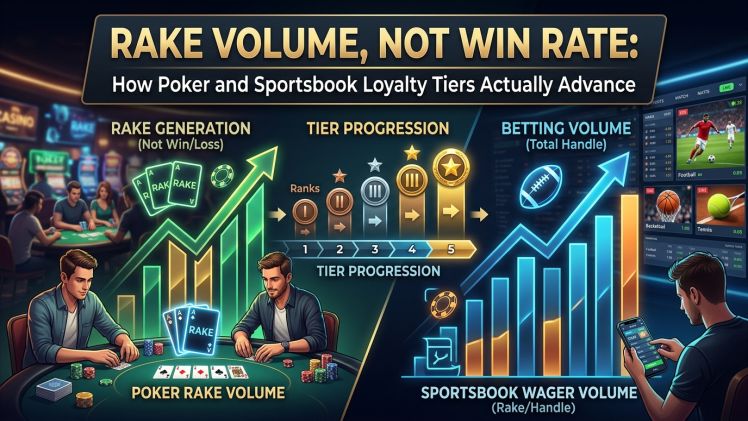
Rake Volume, Not Win Rate: How Poker and Sportsbook Loyalty Tiers Actually Advance

Both poker loyalty programs and sportsbook rewards advance players through tiers by measuring total handle over a time window, not whether the player wins. That single structural fact reshapes how a serious player should think about either system. The player who understands it climbs faster.
The Core Mechanic Both Systems Share
Sportsbook programs like BetPoints use a three-tier structure where points accumulate per wager placed. Status advances when cumulative wagering crosses a threshold within the measurement period.
A bettor who places many moderate wagers advances faster than one who places fewer, larger bets at the same total stake. More frequent wagers mean more accrual events.
Poker works the same way. Rake paid per hand is the unit of measure. A player folding most hands for four hours still generates rake on every contested pot.
Win rate plays no part in the formula.
For anyone playing online poker, GGPoker’s Ocean Rewards program makes this explicit. Players earn Tide Points and GEMs by paying rake. Tier progression tracks that accrual directly.
Rakeback scales upward by tier, from Fish toward Shark. The reward for volume compounds as volume grows.
Where the Two Systems Diverge: Transparency
Sportsbooks tend to present their tier math openly. A player can calculate exactly how many wagers at a given stake move them to the next level. The BetPoints model states point-per-wager rates and tier thresholds in plain terms.
Poker operators often obscure the equivalent calculation behind dual-currency systems. GGPoker’s Ocean Rewards issues both Tide Points and GEMs:
- Tide Points track tier progress.
- GEMs convert to cashback at a defined rate.
These two currencies serve different functions. Optimize each one independently rather than treating them as the same thing.
One practical risk: converting GEMs to cash too early may affect tier-relevant accrual if the two pools are not fully independent. Read the program mechanics before you play, not after.
The Structural Gap That Separates Poker Grinders From Sports Bettors
Sports betting loyalty programs penalize hedgers. A bettor placing offsetting wagers generates handle but absorbs the margin on both sides. Tier advancement still occurs, but the cost per tier point rises.
Poker has no equivalent penalty for risk management. A player who folds often and limits variance still pays rake on every pot entered. Rake is proportional to the pot, not to aggression level.
A conservative player and an aggressive one at the same stakes, playing the same hands per hour, generate similar rake and similar tier velocity.
Poker loyalty advancement is a purer frequency play than its sportsbook equivalent. Sports betting rewards volume too, but the structure quietly disadvantages the risk-averse bettor who hedges to protect their bankroll.
Tier Velocity: The Metric Worth Tracking
Tier velocity is the rate at which a player accumulates status points per unit of time – not per unit of stake. Divide total handle by the length of the measurement window. This lets you project when you cross the next threshold.
For cash sessions on GGPoker, Rush & Cash is the format most relevant here. The instant seat-change mechanic means more hands per hour than at a standard table.
More hands per hour means more rake events – faster tier advancement at identical stake levels. Treat hands-per-hour as a variable you control, not a fixed number.
The same logic applies to poker with friends sessions: choosing a faster format directly affects how quickly status accrues.
Casino Loyalty Accounting: A Structural Note
Casino operators must account for outstanding loyalty points as liabilities on their balance sheets. That gives them a financial incentive to build redemption friction into their programs – making points harder to convert than to earn.
A player who accumulates points without a clear redemption plan is effectively extending an interest-free loan to the operator.
The fix is simple: know the conversion rate before you play. For players on online poker real money platforms, that means converting GEMs to cashback on a regular schedule rather than letting them pile up.
What This Means in Practice
- Track rake paid, not sessions won. Tier progress is a function of volume, not results.
- Separate the two currencies. In dual-currency systems, tier points and cashback tokens serve different functions and should be optimized separately.
- Use fast-format tables to compress the time window. Hands per hour is a variable you control.
- Redeem periodically. Unredeemed points carry operator-side accounting risk that does not benefit the player.
Both systems reward the same behavior: consistent, high-frequency action within the measurement window. Treat tier advancement as a volume-management problem – not a side effect of running well – and you extract more value from either program.



[…] an unsupported network or to an incorrect address may result in funds that cannot be recovered. A successful blockchain confirmation also does not prove that the receiving betting account has […]