
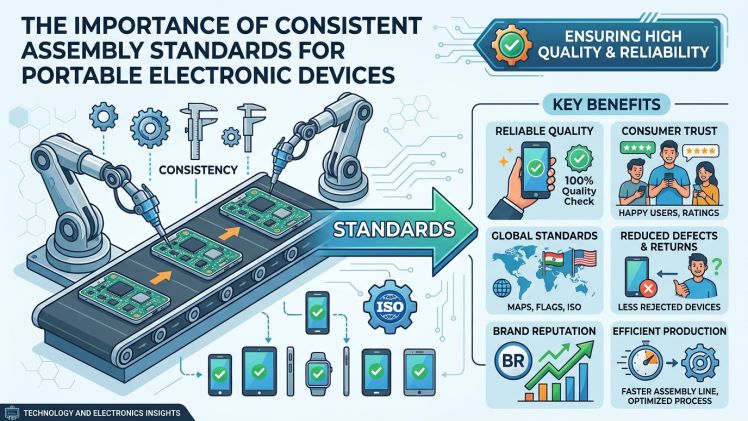
The Importance of Consistent Assembly Standards for Portable Electronic Devices

Have you ever bought two similar electronic devices and noticed that one feels different from the other? Small differences in fit, button response, or overall construction can raise questions about product quality. In many cases, these differences are linked to how consistently a product is assembled.
Portable electronic devices contain several connected parts, and each component must fit and function as intended. When assembly standards are unclear or applied inconsistently, manufacturers may face defects, rework, and customer complaints. Consistent assembly practices help reduce these problems and support reliable production.
As compact electronics become part of everyday life, manufacturers need processes that balance efficient production with careful quality control. The goal is not simply to assemble products quickly, but to ensure that each finished unit meets the same defined requirements.
Why Consistent Assembly Standards Matter
Assembly standards describe how components should be fitted, connected, inspected, and tested during manufacturing. They provide workers with clear instructions and help quality-control teams assess whether a finished product meets established specifications.
Without these standards, different workers or production lines may approach the same task in different ways. One unit might have a properly fitted seal, while another may have a loose connection or a poorly aligned component.
Even small inconsistencies can create larger problems when production volumes increase. Identifying defects after assembly can require extra labor, additional testing, and replacement parts. A consistent process helps manufacturers catch issues earlier and reduce avoidable variation.
1. Maintaining Consistent Product Quality
Portable electronics often combine plastic housings, metal contacts, circuit boards, batteries, switches, and small mechanical components. Each part has a specific role, and incorrect assembly can affect how the complete device performs.
For example, a poorly aligned housing may leave gaps, while an incorrectly fitted connector can interfere with electrical contact. In devices containing liquids, an improperly installed seal may also increase the risk of leakage.
Standardized assembly procedures help prevent these issues by defining the correct sequence and requirements for each task.
Important elements include:
- Clear assembly instructions for every production stage
- Defined component specifications and tolerances
- Consistent methods for fitting and securing parts
- Inspection points for identifying defects
- Documented procedures for handling faulty units
These measures make quality less dependent on individual habits and more dependent on a repeatable process.
2. Reducing Errors and Manufacturing Waste
Inconsistent assembly can affect both product quality and production efficiency. When workers must guess how a component should fit or discover instructions are incomplete, mistakes become more likely.
The resulting problems can include rejected units, repeated work, wasted materials, and delays. These costs may appear small in individual cases, but they can add up across large production runs.
A well-designed assembly process reduces uncertainty. Workers understand what to do, supervisors can identify problems more quickly, and quality-control teams can compare results against the same requirements.
Manufacturers can improve consistency by using illustrated work instructions, suitable assembly tools, employee training, and routine process checks. When a defect occurs, recording its cause helps teams determine whether the issue comes from a component, a procedure, or equipment.
How Assembly Standards Support Portable Device Manufacturing
Consistency becomes particularly important as devices become smaller and more complex. Compact designs leave limited space for components, wires, connectors, and seals. This makes accurate placement and careful handling essential.
Manufacturers need standards that cover the entire production process, from incoming component inspection to final product testing. These standards should also be reviewed when a design or supplier changes.
3. Applying Quality Checks to Compact Electronics
A reliable quality-control system checks more than the external appearance of a finished device. It verifies that important components are correctly installed and that the product meets its defined requirements.
Depending on the device, inspections may include checking dimensions, examining joints, verifying electrical connections, and testing controls. Battery-powered products also require appropriate battery safety procedures and testing.
Product examples such as the North Stellar Dark Moon Edition should not be assumed to share identical assembly methods with other devices simply because they look similar. Actual construction requirements depend on the product’s verified design and manufacturing documentation.
The same principle applies to products associated with Mr fog vape flavors or the Fifty Bar V2. Flavor names and product branding do not establish how a device is assembled or whether its quality controls are effective.
Manufacturers should use documented inspection criteria and appropriate test methods rather than relying on appearance alone.
4. Training Teams and Improving Processes
Even detailed assembly instructions are only effective when employees understand and follow them. Training helps workers recognize component differences, use tools correctly, and identify problems that require attention.
Regular reviews are also important because production conditions can change. New suppliers, revised components, and updated equipment may introduce risks that were not present in earlier production runs.
Manufacturers can strengthen their processes by:
- Training workers before assigning new assembly tasks
- Keeping instructions current and easy to access
- Recording inspection results and recurring defects
- Reviewing supplier quality and component consistency
- Investigating failures and documenting corrective actions
These practices create a feedback loop. Instead of repeatedly correcting the same problem, teams can use production data to improve the process that caused it.
Conclusion
Consistent assembly standards help manufacturers produce portable electronic devices that meet defined quality requirements. They reduce avoidable errors, improve inspection, limit waste, and make production processes easier to manage.
For compact electronics, the details matter. A correctly fitted connector, properly installed seal, or accurately positioned component can affect the performance and reliability of the complete device.
By combining clear instructions, employee training, documented inspections, and ongoing process improvement, manufacturers can maintain greater consistency across production batches. Ultimately, reliable assembly depends on repeatable methods, verified requirements, and a willingness to correct problems before they become recurring defects.