
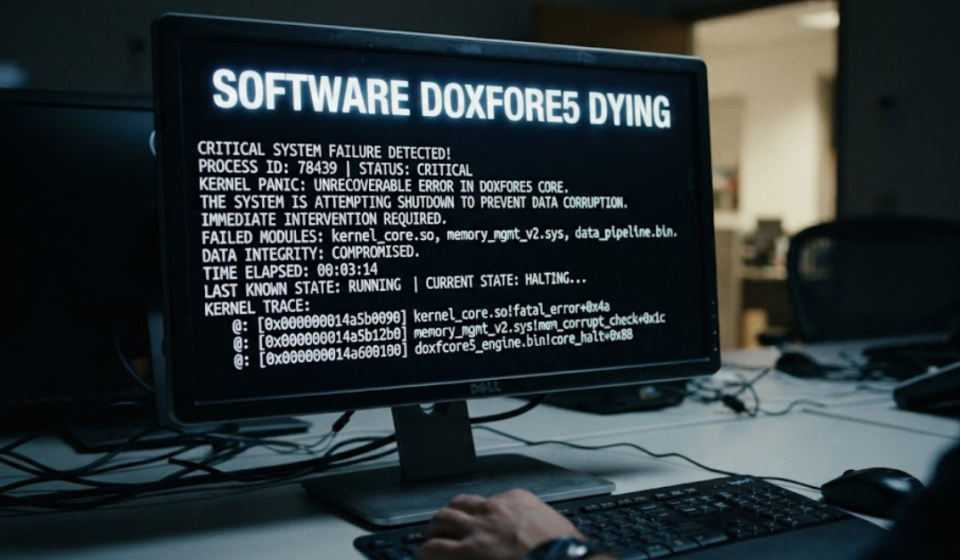

A piece of software doesn’t have to disappear overnight to be considered “dying.” Sometimes the warning signs are much quieter: fewer updates, unresolved bugs, compatibility problems, outdated integrations, or support that becomes increasingly difficult to reach.
That’s why the search for software Doxfore5 dying has attracted attention. People encountering the term are generally trying to answer a simple question: Is Doxfore5 actually being discontinued, or are users simply dealing with an aging and unreliable application?
The problem is that public information about Doxfore5 is surprisingly inconsistent. Some websites describe it as legacy document-management and workflow software, while others make much stronger claims about end-of-life status. There does not appear to be a clearly identifiable official developer announcement confirming a shutdown date, so those stronger claims need to be treated carefully.
Let’s separate the facts from the speculation and look at what the software Doxfore5 dying discussion actually means for users.
Is Software Doxfore5 Dying?
The short answer is possibly declining, but not conclusively confirmed as discontinued.
Several third-party articles describe Doxfore5 as older software that may be struggling with development, compatibility, support, and modern integration requirements. Some characterize it as legacy software entering maintenance mode, while others go as far as calling it obsolete or end-of-life.
However, these claims aren’t all backed by an identifiable official announcement from a Doxfore5 developer.
That’s an important distinction.
A software product can be:
- Still operational
- Poorly maintained
- No longer actively developed
- Difficult to support
- Technically outdated
- Or officially discontinued
Those are not the same thing.
Based on the publicly available information, it’s more responsible to describe Doxfore5 as a product surrounded by significant questions about maintenance and long-term viability rather than confidently declaring that it has been shut down.
What Does “Dying Software” Actually Mean?
The phrase software Doxfore5 dying can sound dramatic, but “dying” has a fairly practical meaning in the technology world.
It usually refers to software that is gradually becoming less viable.
Imagine a program that still launches every morning. At first, everything seems fine. Then a Windows update causes a compatibility problem. A plugin stops working. An integration breaks. A bug appears, but the fix takes months.
Eventually, the software still exists—but depending on it becomes increasingly uncomfortable.
Common Signs of Declining Software
Watch for these warning signs:
- Updates become increasingly rare.
- Security patches are difficult to verify.
- Bugs remain unresolved for long periods.
- Third-party integrations stop working.
- New operating systems create compatibility problems.
- Technical documentation becomes outdated.
- Community activity declines.
- Customer support becomes difficult to reach.
- Modern competitors offer substantially better functionality.
One warning sign isn’t necessarily enough to justify abandoning a platform.
Several appearing together are much more significant.
Why Are People Searching “Software Doxfore5 Dying”?
The exact origin of the search phrase is difficult to establish, but the current web discussion repeatedly connects Doxfore5 with concerns about aging software, limited development, compatibility, and support.
One recent guide describes Doxfore5 as a legacy document and workflow tool and argues that changing expectations around cloud collaboration, mobile access, integrations, and compliance have made older systems harder to maintain competitively.
Another 2026 article claims users have encountered issues involving slow dashboards, search problems, and specific error messages. However, because these reports come from third-party publications rather than clearly identified vendor documentation, they should be treated as reported claims rather than established facts.
This explains why the keyword has become interesting.
People aren’t necessarily asking whether the software has literally vanished.
They’re asking whether it’s still safe and sensible to depend on it.
Software Doxfore5 Dying: The Biggest Warning Signs
If you’re still using Doxfore5, don’t focus solely on whether the application opens.
Instead, examine the health of the entire software environment.
1. Slow or Infrequent Updates
Active software normally evolves.
That doesn’t mean every update needs to introduce a flashy new feature. Sometimes the most valuable releases are security fixes, compatibility patches, performance improvements, and bug corrections.
If updates become increasingly difficult to verify, that’s worth investigating.
2. Compatibility Problems
Modern operating systems, browsers, databases, and cloud services constantly change.
Legacy software can eventually struggle to keep up.
A program might work perfectly on the computer where it was originally installed but behave differently after an operating-system or infrastructure upgrade.
That’s one reason compatibility should be monitored before making major IT changes.
3. Broken Integrations
Modern businesses rarely operate with a single application.
A document or workflow system might need to communicate with:
- Accounting software
- Customer relationship management systems
- Cloud storage
- Email platforms
- Databases
- Authentication services
- Reporting tools
- Internal applications
When integrations start breaking more frequently, an aging platform can become expensive to maintain.
4. Declining Support
Support is often more important than features.
If something goes wrong with software that stores important business information, you need to know where to turn.
Long response times, outdated documentation, unanswered support requests, or unclear ownership can become major operational risks.
Several third-party articles discussing Doxfore5 specifically identify support and maintenance as areas of concern.
Is Doxfore5 Officially Discontinued?
This is where you should be especially cautious.
Some websites state that Doxfore5 is already obsolete or officially in an end-of-life stage.
But other recent sources explicitly acknowledge that an official discontinuation cannot be confidently confirmed from publicly available information.
Without a verifiable announcement from the software’s actual developer or owner, it’s not responsible to present an exact shutdown date as fact.
Why This Matters
Suppose you read:
“Doxfore5 is officially dead.”
That sounds definitive.
But if the statement comes from a random technology blog rather than the developer, it doesn’t establish official end-of-life status.
A stronger confirmation would come from:
- The official developer website
- Official release notes
- A vendor support announcement
- An official customer communication
- A documented end-of-support policy
- An authoritative software distribution page
Until evidence like that is available, users should distinguish online speculation from confirmed product status.
What Problems Can Aging Software Cause?
Even if Doxfore5 continues working today, outdated software can create problems over time.
Security Risk
Old applications may eventually fail to receive security fixes.
That’s particularly concerning when the software handles sensitive documents, customer information, credentials, or business records.
Compatibility Risk
An operating-system update could introduce a problem that didn’t exist when the software was originally developed.
Integration Risk
Third-party services change their APIs, authentication systems, and technical requirements.
An old application may not adapt quickly enough.
Operational Risk
If only one person understands how an old system works, that person effectively becomes a single point of failure.
This is sometimes called legacy-system knowledge risk.
Migration Risk
The longer an organization waits to understand its data-export options, the harder a future migration can become.
That’s why preparing for a possible replacement is often smarter than waiting for a complete failure.
How to Check Whether Your Doxfore5 Installation Is Still Healthy
If you’re currently using Doxfore5, you don’t need to panic.
Start with a simple health check.
Step 1: Check the Current Version
Find the exact version installed in your environment.
Write it down.
You can’t properly investigate compatibility or support without knowing which version you’re actually running.
Step 2: Look for Recent Updates
Determine when the last official update or patch was released.
Don’t rely solely on a random blog post. Try to find an authoritative release history or vendor communication.
Step 3: Test Your Integrations
Check every important connection.
For example:
- Does data transfer correctly?
- Are scheduled workflows completing?
- Are authentication tokens still valid?
- Are exports working?
- Are notifications arriving?
- Are backups completing?
Step 4: Test Your Backups
A backup that has never been restored is only a theory.
Perform a controlled restoration test if your environment allows it.
Step 5: Check Data Export
Find out exactly how your information can be exported.
Ideally, you should know this before an emergency forces you to migrate.
Step 6: Document the Environment
Record:
- Software version
- Operating system
- Database
- Integrations
- Plugins
- Scheduled jobs
- Administrators
- Backup location
- Export format
- Critical workflows
This information can save enormous amounts of time if the platform eventually needs to be replaced.
Should You Replace Doxfore5?
Not necessarily.
Replacing software simply because people online are calling it “dying” isn’t a good enough reason.
Instead, consider your actual business risk.
You May Be Able to Keep Using It If:
- It still performs its core job reliably.
- Your operating environment is supported.
- You have working backups.
- Your integrations remain stable.
- You can export your data.
- You have adequate internal knowledge.
- You can verify security and maintenance status.
Start Planning a Replacement If:
- Critical features frequently fail.
- Updates are no longer available.
- Security support is unclear.
- Integrations keep breaking.
- Your operating system is no longer compatible.
- Documentation is disappearing.
- You cannot easily export your data.
- Nobody internally understands how the system works.
The key idea is planned migration rather than emergency migration.
Best Strategy If Software Doxfore5 Is Declining
If your organization is worried about Doxfore5, don’t immediately uninstall everything.
A phased approach is safer.
1. Audit
Identify exactly what Doxfore5 does for your organization.
2. Protect
Create verified backups and make sure critical information can be recovered.
3. Document
Record workflows, integrations, dependencies, and administrative procedures.
4. Evaluate Alternatives
Look for modern software that provides the functionality you actually need.
Don’t choose a replacement based solely on marketing claims.
Compare:
- Features
- Security
- Integration support
- Data migration
- Pricing
- Scalability
- Vendor reputation
- Technical support
5. Test Before Migrating
Use a small non-critical dataset first.
Make sure the replacement handles your real workflow rather than simply looking good in a product demonstration.
6. Migrate Gradually
If possible, move workloads in stages.
That gives your team time to discover problems before the old system disappears from the process entirely.
Don’t Fall for Unsupported Doxfore5 Claims
The current search results contain some extremely specific claims about Doxfore5.
For example, individual websites mention particular error codes, technical dependencies, integrations, user incidents, and infrastructure failures. Some even provide highly detailed technical instructions.
Those details may sound authoritative.
But there is a major problem: the sources are not consistent, and many claims cannot be independently verified through an identifiable official Doxfore5 source.
For that reason, don’t blindly run commands, modify databases, remove dependencies, or migrate production data simply because an article tells you to.
Before making a technical change:
- Back up your data.
- Confirm the source.
- Understand what the command does.
- Test it in a non-production environment.
- Involve your IT administrator when necessary.
Good troubleshooting should reduce risk—not introduce another one.
What Are the Best Alternatives to Doxfore5?
There isn’t one universal “best alternative” because the right replacement depends on what Doxfore5 actually does in your environment.
If you’re replacing document-management functionality, look for a platform with:
- Reliable document storage
- Version control
- Permission management
- Search
- Workflow automation
- Audit trails
- Data export
- Modern integrations
If workflow automation is your main requirement, prioritize:
- Visual workflow design
- API support
- Webhooks
- Authentication
- Error handling
- Monitoring
- Integration availability
If collaboration is the priority, focus on:
- Cloud access
- Real-time collaboration
- Mobile support
- Sharing controls
- Notifications
- Version history
The goal isn’t to find the software with the longest feature list.
It’s to find the one that solves your actual problem with the least long-term risk.
A Simple Doxfore5 Risk Checklist
Use this quick checklist to judge your situation:
| Question | Low Risk | Higher Risk |
| Recent updates? | Clearly available | Unknown or absent |
| Security support? | Documented | Unclear |
| Technical support? | Responsive | Difficult to reach |
| Compatibility? | Current | Problems appearing |
| Integrations? | Stable | Frequently failing |
| Backups? | Tested | Uncertain |
| Data export? | Easy | Difficult |
| Documentation? | Current | Outdated |
| Replacement plan? | Prepared | None |
You don’t need every box to be perfect.
But if most of your answers fall into the right-hand column, it’s time to take the situation seriously.
FAQs About Software Doxfore5 Dying
Is software Doxfore5 dying?
There are multiple third-party articles describing Doxfore5 as declining, aging, or approaching end-of-life. However, available public evidence does not clearly establish an official shutdown announcement, so it is safer to describe its status as uncertain rather than definitively “dead.”
Why are people searching for “software Doxfore5 dying”?
The phrase appears to be associated with concerns about software maintenance, compatibility, support, performance, and the long-term viability of Doxfore5. Several recent articles frame it as legacy software facing challenges from newer platforms.
Is Doxfore5 officially discontinued?
An official discontinuation cannot be confidently established from the publicly available sources reviewed for this article. Some third-party pages claim end-of-life status, but those claims should be verified against an official developer or vendor announcement before being treated as fact.
Should I stop using Doxfore5 immediately?
Not necessarily. If the software is still functioning, start by checking its maintenance status, security support, compatibility, integrations, backups, and data-export options. If several of those areas are problematic, begin planning a controlled migration.
What are the biggest warning signs of dying software?
The most important signs include disappearing updates, unresolved bugs, poor support, compatibility problems, broken integrations, outdated documentation, and difficulty exporting data.
Can old software still be useful?
Absolutely. Age alone doesn’t make software unusable. A mature application can remain valuable if it is secure, stable, supported, compatible with its environment, and capable of meeting current requirements.
What should I do if Doxfore5 suddenly stops working?
Don’t immediately delete or reinstall everything. First preserve your data, record the exact error, check recent system changes, verify backups, and determine whether the problem is caused by Doxfore5 itself or by an operating-system, network, database, or integration change.
Should businesses create a Doxfore5 migration plan?
If Doxfore5 is important to business operations and its long-term support status is uncertain, having a migration plan is sensible. Planning doesn’t mean abandoning the software tomorrow; it means avoiding an emergency migration later.
Conclusion: Is Software Doxfore5 Really Dying?
The software Doxfore5 dying question doesn’t have a simple yes-or-no answer.
There are plenty of online claims that Doxfore5 is declining, outdated, poorly supported, or approaching end-of-life. But the public evidence is inconsistent, and a clearly identifiable official announcement confirming that Doxfore5 has been permanently discontinued is difficult to establish.
So don’t make an important technology decision based on the word “dying” alone.
Instead, look at the things that actually matter: updates, security, compatibility, support, integrations, backups, documentation, and data portability.
If Doxfore5 still performs reliably and your risks are manageable, you may not need to replace it today. But if several warning signs are already appearing, start researching alternatives and building a migration plan before a small problem becomes a business-critical outage.
In other words, you don’t have to panic about software Doxfore5 dying.
You just shouldn’t wait until it fails completely to find out what comes next.