
Seamless vs Seemless: Which Spelling Is Correct?

Have you ever typed “seemless” only to have your spell checker flag it as an error? If so, you’re not alone. The confusion between seamless vs seemless is incredibly common because the two words sound almost identical when spoken. However, only one is correct in standard English.
The correct spelling is seamless. The word seemless is a misspelling and is not recognized in dictionaries. Whether you’re writing an email, creating marketing content, or describing a smooth customer experience, knowing the correct spelling helps your writing look polished and professional.
In this guide, we’ll explain the difference between seamless vs seemless, explore the meaning of seamless, discuss why the mistake happens so often, provide practical examples, and answer the most common questions people ask.
Seamless vs Seemless: Which One Is Correct?
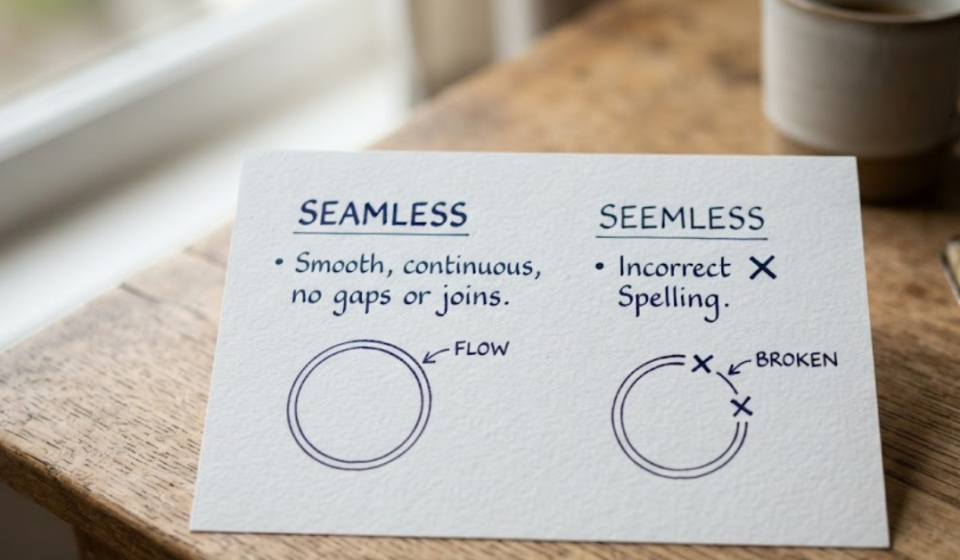
If you’re wondering “seamless vs seemless?”, here’s the answer:
Seamless — Correct
Seemless — Incorrect
For example:
- The software provides a seamless user experience.
- Their customer support made the transition seamless.
- The dress features seamless construction.
The spelling “seemless” is considered a spelling error and should be avoided in both formal and informal writing.
What Does “Seamless” Mean?
The adjective seamless originally described something made without visible seams or stitches. Over time, its meaning expanded and is now commonly used to describe anything that works smoothly, continuously, or without interruption.
Today, seamless is widely used in fields such as:
- Technology
- Business
- Marketing
- Customer service
- Fashion
- Design
In each case, it suggests that something functions so smoothly that you hardly notice the transitions or effort involved.
Examples:
- The app offers a seamless login experience.
- The project moved from planning to execution in a seamless way.
- These leggings have a seamless design for added comfort.
Why Do People Spell It “Seemless”?
The confusion behind seamless vs seemless comes down to pronunciation.
The words seam and seem sound exactly alike in most English accents. Because of this, many people assume that seamless should be spelled with “seem.”
However, the word actually comes from the noun seam, meaning the line where two pieces of material are joined together.
Breaking it down:
- Seam = A line where pieces are stitched or joined.
- -less = Without.
So, seamless literally means “without seams.”
The spelling has nothing to do with the verb seem, which means “to appear.”
The Origin of the Word “Seamless”
Understanding the word’s origin makes it much easier to remember.
The word is formed by combining:
- Seam
- Less
Together, they create:
Seam + Less = Seamless
Originally, the word described clothing made without visible stitching. Today, it’s also used metaphorically to describe processes, experiences, and systems that feel effortless.
Common Uses of “Seamless”
The word seamless appears in many everyday contexts.
Technology
Technology companies frequently use seamless to describe products that work smoothly.
Examples:
- Seamless integration
- Seamless updates
- Seamless connectivity
- Seamless synchronization
Example sentence:
“The software allows seamless communication across multiple devices.”
Business
Businesses often promise a seamless customer experience.
Examples include:
- Seamless onboarding
- Seamless payment process
- Seamless checkout
- Seamless workflow
Fashion
In clothing, seamless refers to garments made with minimal or no visible seams.
Examples:
- Seamless leggings
- Seamless bras
- Seamless underwear
- Seamless sportswear
These designs often improve comfort by reducing friction against the skin.
Interior Design
Designers may describe transitions between spaces as seamless.
Example:
“The kitchen flows seamlessly into the dining area.”
Examples of Correct Usage
Here are some examples of seamless used correctly.
Correct
- The software installation was seamless.
- We enjoyed a seamless shopping experience.
- Her presentation transitioned seamlessly between topics.
- The company offers seamless cloud integration.
- The athlete wore seamless compression clothing.
Incorrect
- The software installation was seemless.
- We had a seemless experience.
- The system provides seemless integration.
Whenever you mean “smooth,” “continuous,” or “without interruption,” seamless is the correct spelling.
Why “Seemless” Is Incorrect
Although seemless looks logical, it isn’t a recognized English word.
The mistake usually happens because:
- “Seam” and “seem” are pronounced the same.
- Spellings based on pronunciation are common in English.
- People associate the word with “seems smooth” rather than “without seams.”
Modern dictionaries, grammar guides, and spell checkers all recognize seamless as the standard spelling.
Synonyms for Seamless
If you’re looking to avoid repetition in your writing, consider these alternatives depending on the context:
- Smooth
- Effortless
- Continuous
- Flawless
- Integrated
- Uninterrupted
- Streamlined
- Cohesive
- Efficient
- Connected
While these words have slightly different meanings, they can often replace seamless in appropriate situations.
Tips to Remember the Correct Spelling
Remembering seamless is easier than it seems.
Think About Clothing
A seam is where two pieces of fabric are stitched together.
If there are no seams, the item is seamless.
Break the Word Apart
Visualize it like this:
Seam + Less = Seamless
This simple breakdown reinforces the correct spelling.
Ignore the Pronunciation
Although seam and seem sound the same, only seam is part of the word seamless.
Trust Your Spell Checker
Most writing tools will automatically underline seemless and suggest seamless.
Common Phrases Using “Seamless”
You’ll often encounter seamless in these expressions:
- Seamless integration
- Seamless experience
- Seamless communication
- Seamless transition
- Seamless workflow
- Seamless connectivity
- Seamless collaboration
- Seamless checkout
- Seamless process
- Seamless design
Frequently Asked Questions
Is it seamless or seemless?
The correct spelling is seamless. “Seemless” is a common misspelling and is not accepted in standard English.
Why is “seemless” incorrect?
The word comes from seam, meaning a line where materials are joined, plus the suffix -less, meaning “without.” It is unrelated to the verb seem.
What does seamless mean?
Seamless means smooth, continuous, or without noticeable interruptions. It can also describe clothing made without visible seams.
Is “seemless” in the dictionary?
No. Major English dictionaries recognize seamless, not seemless.
How do you remember the correct spelling?
Think of the phrase:
No seams = seamless
This simple association helps reinforce the correct spelling.
Can seamless describe technology?
Yes. In technology, seamless often describes software, devices, or systems that work together smoothly without requiring extra effort from the user.
What is a seamless experience?
A seamless experience is one that feels smooth, efficient, and free from disruptions. Customers often use this term to describe easy online shopping, intuitive apps, or well-organized services.
Is seamless a positive word?
Yes. It usually has a positive meaning because it suggests quality, efficiency, and ease of use.
Conclusion
When comparing seamless vs seemless, the correct choice is always seamless. Although the two words sound alike, only seamless is recognized in standard English. The word comes from seam, meaning a line where two pieces are joined, combined with -less, meaning “without.” As a result, seamless literally means “without seams” and has evolved to describe anything that works smoothly or without interruption.
Whether you’re writing about technology, business, fashion, or customer experiences, using the correct spelling helps your content appear more professional and credible. Keep the simple memory trick in mind—“No seams = seamless”—and you’ll avoid this common spelling mistake every time. If you’re interested in improving your English further, explore more guides on commonly confused words, grammar rules, and spelling tips to strengthen your writing skills.