
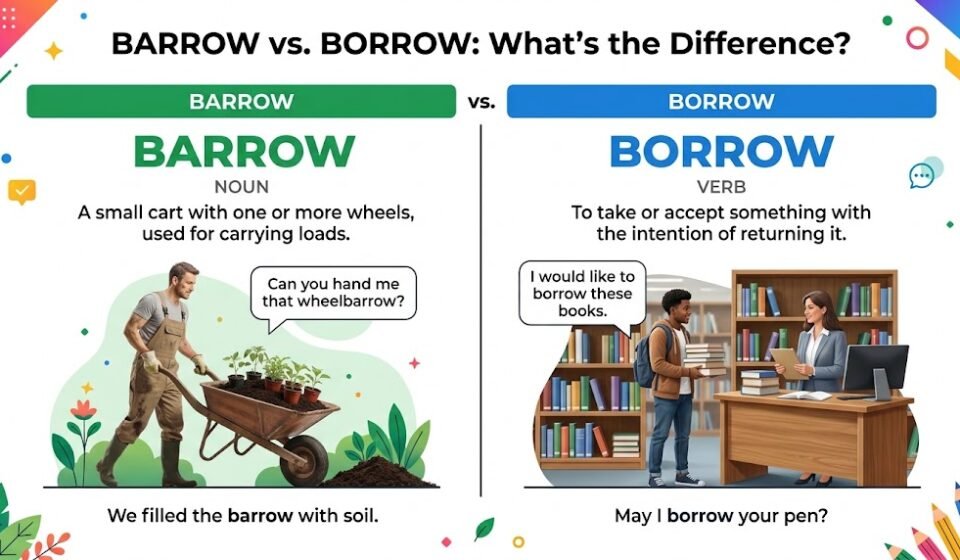

Have you ever written a sentence and suddenly wondered whether you need barrow or borrow? You are not alone. These two words look and sound similar, but they have completely different meanings and uses.
The easiest way to remember the difference is this: borrow is about taking something temporarily, while barrow usually refers to a small cart or, in some contexts, a burial mound. Once you understand that basic distinction, choosing the right word becomes much easier.
Barrow vs Borrow: The Main Difference
The biggest difference between barrow and borrow is their meaning and grammatical use.
Borrow is a verb. It means to take or receive something from another person with the intention of returning it later.
For example:
Can I borrow your pen?
Here, the person wants to use the pen temporarily and return it.
Barrow, on the other hand, is generally a noun. It can mean a small handcart or wheelbarrow used for carrying things. It can also refer to an ancient burial mound, especially in historical or archaeological contexts.
For example:
He pushed the heavy load in a barrow.
So, although the words are close in pronunciation, they should not be used interchangeably.
Quick comparison
| Word | Part of speech | Common meaning | Example |
|---|---|---|---|
| Borrow | Verb | Take something temporarily and return it | Can I borrow your book? |
| Barrow | Noun | A small cart or burial mound | He moved the soil with a barrow. |
What Does Borrow Mean?
Borrow means to receive or use something that belongs to someone else, usually with the expectation that you will give it back.
It is commonly used when talking about money, books, clothes, tools, vehicles, and other items.
Examples of borrow
- Can I borrow your phone?
- She borrowed some money from her brother.
- I need to borrow a book from the library.
- They borrowed a car for the weekend.
- He asked if he could borrow my laptop.
Notice that borrow describes an action. Someone is taking temporary possession of something.
Borrow and lend are different
One common mistake is confusing borrow with lend.
If you take something from another person, you borrow it.
If you give something to another person temporarily, you lend it.
For example:
I borrowed $20 from Sarah.
Sarah lent me $20.
A simple way to remember this is:
Borrow = receive
Lend = give
What Does Barrow Mean?
Barrow has several dictionary meanings, but it is much less common in everyday conversation than borrow.
One meaning is a small cart used for transporting materials. In British English, a barrow can refer to a wheelbarrow or similar handcart.
For example:
The gardener loaded leaves into a barrow.
Another meaning appears in history and archaeology. A barrow can be a mound of earth or stones built over a burial site.
For example:
Archaeologists discovered an ancient burial barrow.
This second meaning is particularly common when discussing prehistoric Britain and archaeological sites.
Barrow vs Borrow in Sentences
Seeing the words in context can make the difference much clearer.
Sentences with borrow
- May I borrow your umbrella?
- I borrowed a jacket because it was cold.
- She often borrows books from the library.
- Can I borrow your charger?
- They borrowed money to buy a house.
In each sentence, something is temporarily being taken or used.
Sentences with barrow
- The farmer pushed a barrow across the field.
- He filled the barrow with soil.
- The workers used a barrow to transport bricks.
- The ancient barrow contained human remains.
- Researchers examined the Bronze Age barrow.
Here, barrow refers to a physical object or archaeological feature.
Why Are Barrow and Borrow Confused?
The confusion mainly comes from pronunciation.
In many varieties of English, barrow and borrow sound very similar, particularly in ordinary conversation. Their spellings, however, are different.
There is also a major difference in how frequently they appear.
Borrow is a common everyday verb. You might use it when asking for a pen, phone charger, book, or some money.
Barrow is comparatively uncommon unless you are talking about gardening, farming, construction, transportation, or archaeology.
That means if you are writing a normal sentence about temporarily taking someone’s belongings, borrow is almost certainly the word you need.
Common Mistakes With Barrow and Borrow
Mistake 1: Using barrow when you mean borrow
Incorrect:
Can I barrow your pen?
Correct:
Can I borrow your pen?
The action of temporarily using someone else’s pen requires borrow.
Mistake 2: Using borrow for a cart
Incorrect:
He pushed the borrow through the garden.
Correct:
He pushed the barrow through the garden.
Here, barrow refers to the cart.
Mistake 3: Confusing borrow with lend
Incorrect:
Can you borrow me your car?
In standard English, it is better to say:
Can you lend me your car?
Or:
Can I borrow your car?
The first sentence focuses on the person giving the car. The second focuses on the person receiving it.
Barrow vs Borrow: An Easy Memory Trick
If you regularly confuse these words, try connecting borrow with borrowing.
When you borrow something, you take it temporarily.
Think:
Borrow = take and return.
For barrow, think of a wheelbarrow.
A wheelbarrow carries soil, plants, tools, or other materials.
So:
Barrow → cart
Borrow → take temporarily
This simple association can help you remember the spelling.
How to Use Borrow Correctly
Borrow can be used in several common grammatical forms.
Present tense
I borrow books from the library.
Third-person singular
She borrows my notes.
Past tense
He borrowed my bicycle yesterday.
Present participle
They are borrowing equipment from the school.
The word usually takes an object—the thing being borrowed.
For example:
I borrowed a book.
She borrowed some money.
We borrowed his car.
How to Use Barrow Correctly
Barrow is usually used as a noun.
For example:
The gardener pushed the barrow.
The workers filled the barrow with sand.
When referring to archaeology:
The ancient barrow dates back thousands of years.
The exact meaning depends on the context.
Barrow vs Borrow Pronunciation
Although pronunciation varies between English accents, the words are often pronounced similarly enough to cause confusion.
Borrow is commonly pronounced approximately like “BOR-oh.”
Barrow is also commonly pronounced approximately like “BAR-oh.”
The vowel sound can differ depending on the speaker’s accent. This is one reason the distinction is much easier to recognize in writing than in speech.
If you hear someone use one of these words, the surrounding sentence usually tells you which meaning they intend.
When Should You Use Borrow?
Use borrow when someone temporarily takes or uses something belonging to another person.
Common situations include:
- Borrowing money
- Borrowing books
- Borrowing clothes
- Borrowing tools
- Borrowing a car
- Borrowing someone’s phone
- Borrowing equipment
For example:
I need to borrow a screwdriver.
This means you want to use someone else’s screwdriver and presumably return it afterward.
When Should You Use Barrow?
Use barrow when referring to a cart or, in historical contexts, a burial mound.
The word may appear in discussions about:
- Gardening
- Farming
- Construction
- Transportation
- Archaeology
- Ancient burial sites
For everyday writing, however, you will probably encounter borrow much more often.
Frequently Asked Questions
Is it barrow or borrow money?
The correct word is borrow.
You borrow money from someone or an institution.
Example:
She borrowed money from her parents.
You can also say that a bank lends money to a customer.
Is it borrow or barrow a book?
The correct phrase is borrow a book.
Example:
I borrowed a book from the library.
Barrow a book is incorrect when you mean temporarily taking a book.
What is the difference between barrow and borrow?
Borrow is a verb meaning to take or use something temporarily and return it later. Barrow is usually a noun referring to a small cart or, in archaeology, a burial mound.
Is a barrow the same as a wheelbarrow?
A wheelbarrow is a type of barrow. In British English, barrow can be used for a small handcart used to carry materials.
What is the opposite of borrow?
The most direct opposite in everyday use is lend.
If you borrow something, you receive it temporarily. If you lend something, you give it temporarily to someone else.
Can barrow be a verb?
Barrow is primarily used as a noun in modern English. However, rare or specialized verb uses can appear in historical or dialectal contexts. In ordinary writing, it is safest to use barrow as a noun.
Final Thoughts on Barrow vs Borrow
The difference between barrow and borrow is simple once you connect each word with its meaning. Borrow is the word you need when you take something temporarily and plan to return it. Barrow generally describes a small cart or an ancient burial mound.
If you are unsure, ask yourself what the sentence is describing. If someone wants to use your phone, book, money, or car temporarily, they want to borrow it. If you are talking about a cart carrying soil or an ancient burial mound, barrow is the right choice.
Learning small word differences like this can make your English clearer and more accurate.