
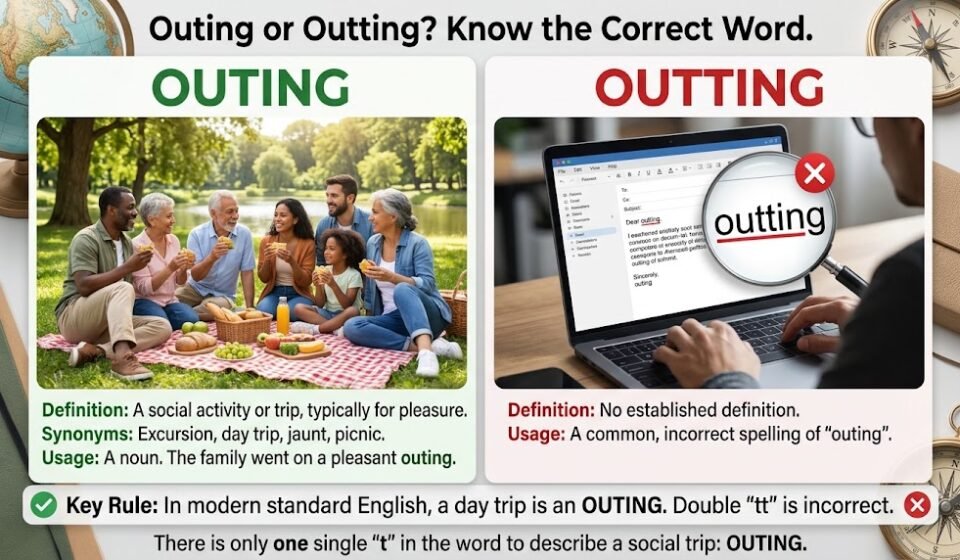

Have you ever typed “outting or outing” and stopped because you were not sure which spelling was correct? It is an easy mistake to make, especially because the word outing comes from the verb go out. You might naturally expect the spelling to double the “t,” but English does not work that way here.
The correct spelling is outing.
An outing is a short trip or activity away from home, usually done for relaxation, entertainment, socializing, or spending time with family and friends. It can be something simple, such as going to a park, or a more organized activity, such as visiting a museum or taking a day trip.
Let’s look at the spelling, meaning, examples, and different ways to use the word correctly.
Outting or Outing: Which Spelling Is Correct?
If you are wondering whether to write outting or outing, the correct form is outing, with only one “t” after the “u.”
Correct: outing
Incorrect: outting
For example:
We are planning a family outing this weekend.
You would not write:
We are planning a family outting this weekend.
The extra “t” makes outting a spelling error.
Why Is “Outing” Spelled With One T?
The word outing is formed from the verb out with the suffix -ing. Although some English words double their final consonant before adding -ing, that rule does not apply to out.
For example:
- run → running
- sit → sitting
- swim → swimming
- out → outing
The word out ends with a consonant sound, but it does not follow the same spelling pattern as short verbs such as run or sit. Therefore, there is no need to add another “t.”
What Does Outing Mean?
An outing is an occasion when someone leaves home to spend time somewhere else, usually for enjoyment or a particular activity.
The word can describe a few hours away from home or a full-day trip.
For example:
- A family visiting a zoo can be a family outing.
- Employees going to a restaurant together can have a company outing.
- Students visiting a historical site can go on a school outing.
- Friends spending the afternoon at the beach can enjoy a group outing.
The main idea is that people are going somewhere away from their usual surroundings for an activity or experience.
Common Types of Outings
Outings can be casual or carefully planned. They also vary depending on age, interests, budget, and location.
Family Outings
Family outings are a popular way to spend quality time together without the usual distractions of home.
A family might visit a park, amusement centre, zoo, museum, beach, or restaurant. Even a simple picnic can turn into a memorable outing when everyone gets involved.
School Outings
Schools often organise outings to give students learning experiences outside the classroom.
A school outing might involve visiting:
- Museums
- Historical landmarks
- Science centres
- Zoos
- Libraries
- Parks
- Cultural attractions
These trips can combine education with recreation.
Friends’ Outings
An outing with friends does not need to involve an elaborate plan. Meeting for coffee, watching a film, shopping, hiking, or trying a new restaurant can all count.
Sometimes the simplest plans are the most enjoyable because they leave room for conversation and spontaneity.
Work or Corporate Outings
Companies sometimes organise outings to encourage employees to socialise outside the workplace.
These can include team lunches, outdoor activities, recreational games, dinners, or day trips. A relaxed setting can give colleagues an opportunity to interact in a less formal environment.
How to Use “Outing” in a Sentence
Understanding the spelling is useful, but knowing how to use the word naturally is just as important.
Here are some examples:
- We planned a family outing for Saturday.
- The children enjoyed their school outing to the museum.
- Our weekend outing was cancelled because of heavy rain.
- The company organised an outing for its employees.
- We went on a short outing after lunch.
- The beach was perfect for a relaxing afternoon outing.
Notice that outing is normally used as a noun.
You can also use related expressions such as go on an outing, plan an outing, enjoy an outing, or family outing.
Outing vs. Trip: Are They the Same?
The words outing and trip are related, but they are not always interchangeable.
An outing usually suggests a relatively short activity away from home. It often has a recreational or social purpose.
A trip can be much broader. It may last several days, involve long-distance travel, or be taken for business, education, or personal reasons.
For example:
We went on a family outing to the local park.
This suggests a short recreational activity.
On the other hand:
We took a trip to another country.
This normally suggests a longer journey.
There is some overlap, but outing generally feels more casual and short-term.
Fun Outing Ideas for Families and Friends
If you are planning an outing, you do not necessarily need a large budget. The best activity depends on what the group enjoys.
Here are some ideas:
1. Visit a Local Park
A park can be a great choice for a low-cost outing. You can walk, play games, have a picnic, or simply sit outside and talk.
2. Plan a Picnic
A picnic turns an ordinary afternoon into a small event. Pack sandwiches, fruit, drinks, and a few snacks, then find a comfortable outdoor spot.
3. Explore a Museum
Museums are useful when you want an outing that combines entertainment and learning. They can also be a good option when the weather is not suitable for outdoor activities.
4. Go to the Beach
A beach outing can include swimming, walking, photography, games, or simply relaxing by the water.
Always check local conditions and follow safety advice when planning water-based activities.
5. Try a New Restaurant
Food can easily become the centre of a social outing. Pick a restaurant that nobody in the group has tried before and make the meal part of the experience.
6. Take a Nature Walk
A short hike or nature walk offers a change of scenery without requiring a complicated travel plan. Choose a route that matches the group’s fitness level and experience.
How to Plan a Successful Outing
A good outing does not have to be complicated. A little planning can prevent common problems.
Choose the Right Activity
Start by considering who is coming. An activity that works for teenagers may not be suitable for young children or older family members.
Think about:
- Age groups
- Interests
- Mobility
- Weather
- Travel time
- Budget
- Available facilities
Check the Weather
Outdoor plans can quickly change because of rain, extreme heat, or strong winds. Check the forecast before leaving and have a backup plan when necessary.
Set a Realistic Budget
Decide how much everyone is comfortable spending. Remember to account for transportation, food, entrance fees, parking, and other small expenses.
Keep the Schedule Flexible
It is tempting to fill every minute with activities, but that can make an outing stressful. Leave some free time so people can relax and enjoy themselves.
Common Spelling Mistakes With “Outing”
The most common mistake is adding an unnecessary second t.
Wrong: outting
Right: outing
Another common issue is confusing outing with similar-looking words. When writing professionally, academically, or for online content, it is worth checking the spelling before publishing.
A simple memory trick is to remember:
out + ing = outing
There is no need to double the “t.”
Is “Outing” Formal or Informal?
The word outing is common in everyday English and works in both casual and reasonably formal contexts.
For example, you can use it in a casual conversation:
We had a great outing yesterday.
It can also appear in more formal writing:
The school arranged an educational outing for the students.
The exact tone depends more on the surrounding sentence than on the word itself.
Frequently Asked Questions About Outting or Outing
Is “outting” a correct word?
No. Outting is generally considered a spelling mistake. The correct spelling is outing, with one “t.”
What is the meaning of outing?
An outing is a short trip or activity away from home, usually for recreation, socializing, entertainment, or education.
How do you spell outing?
The correct spelling is outing: O-U-T-I-N-G.
Why is outing not spelled outting?
The word is formed as out + ing, and the final “t” is not doubled. Therefore, outing is the standard spelling.
What is an example of an outing?
A family spending an afternoon at a zoo, a group of friends going to the beach, or students visiting a museum can all be examples of outings.
Is an outing the same as a trip?
Not exactly. An outing usually refers to a shorter recreational or social activity, while a trip can involve longer travel and many different purposes.
Final Thoughts
If you have been searching for “outting or outing,” the answer is simple: outing is the correct spelling. The word describes a short trip or activity away from home and is commonly used for family activities, school visits, social plans, workplace events, and recreational experiences.
Remember the simple spelling: out + ing = outing.
Whether you are writing an email, planning a family outing, preparing a school notice, or simply checking your English, using the correct spelling helps your writing look clear and polished. When planning your next outing, choose an activity that suits the group, check practical details in advance, and leave enough room to simply enjoy the day.