
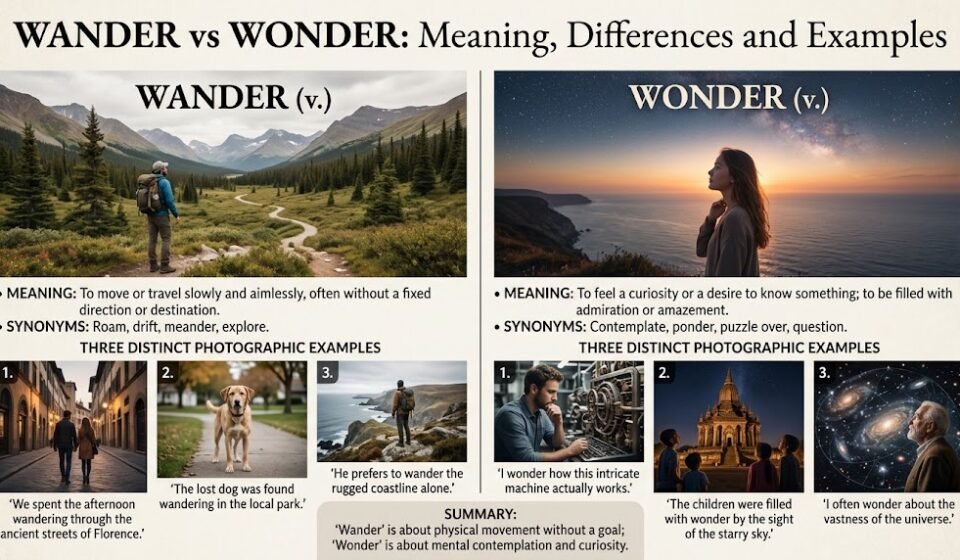

Have you ever written a sentence and suddenly stopped because you could not decide between wander vs wonder? You are not alone. These two words look almost identical, sound similar in everyday speech, and are easy to mix up when writing.
The good news is that their meanings are quite different once you know what to look for. Wander is mainly connected with moving without a clear direction or purpose. Wonder, on the other hand, usually describes curiosity, doubt, surprise, or amazement.
The easiest way to remember the difference is simple: you wander with your feet, but you wonder with your mind.
Let’s break it down.
Wander vs Wonder: What Is the Difference?
The main difference between wander and wonder is what they describe.
Wander usually means to move around without a fixed destination, direction, or purpose. It can also describe someone’s thoughts losing focus.
For example:
- We wandered through the old streets for hours.
- She wandered around the park after lunch.
- My mind started to wander during the long meeting.
Merriam-Webster defines wander as moving without a fixed course, aim, or goal. It can also mean following a winding course or straying from a particular path.
Wonder is different. As a verb, it often means to feel curious, uncertain, surprised, or amazed about something.
For example:
- I wonder what happened.
- She wondered why he left early.
- We wondered whether the shop was still open.
- He looked at the huge building in wonder.
Merriam-Webster lists curiosity, doubt, surprise, and amazement among the meanings associated with wonder.
A Quick Comparison
| Word | Main meaning | Example |
|---|---|---|
| Wander | Move without a clear direction | We wandered around the city. |
| Wonder | Feel curious or uncertain | I wonder where she went. |
| Wander | Lose focus mentally | My mind began to wander. |
| Wonder | Feel amazement | The children watched in wonder. |
So, although the words look similar, they belong to different ideas.
What Does Wander Mean?
Wander is primarily a verb. It describes movement that does not follow a fixed route or destination.
Imagine walking through a new town without checking a map. You turn down one street, then another, stopping whenever something catches your attention. You are wandering.
For example:
We wandered through the market until we found a small café.
The sentence suggests that you were not following a strict route.
Wander can also suggest that someone has moved away from the correct path.
The hikers wandered away from the trail.
There is another interesting use: your mind can wander.
I tried to concentrate, but my mind kept wandering.
Here, no physical movement is involved. The word describes your attention drifting away from what you should be focusing on.
Common Uses of Wander
You will often see wander used with:
- around
- through
- along
- away
- off
- into
Examples include:
- They wandered around the village.
- We wandered through the forest.
- He wandered along the beach.
- The child wandered away from her parents.
- My thoughts wandered off during the lecture.
- She wandered into the wrong room.
The exact preposition can change the picture slightly, but the basic idea remains movement without a clear or fixed course.
What Does Wonder Mean?
Wonder has several related meanings, but the most common one as a verb involves curiosity or uncertainty.
When you say, “I wonder where he is,” you are thinking about something you do not know.
For example:
I wonder why Sarah hasn’t called yet.
You are curious about the reason.
You can also use wonder when you are considering a possibility:
I wonder if it will rain tomorrow.
The speaker does not know whether it will rain and is thinking about the possibility.
Wonder can also describe amazement or admiration. As a noun, it can refer to a feeling of surprise or admiration caused by something extraordinary or mysterious.
For example:
The children stared at the fireworks in wonder.
Here, wonder is not about asking a question. It describes a feeling of amazement.
Wander vs Wonder Pronunciation
Pronunciation is one reason these words can cause confusion.
They are close in sound, but the vowel sound in the first syllable is different in standard English pronunciation.
Cambridge Dictionary gives wander as /ˈwɒn.dər/ in British English and /ˈwɑːn.dɚ/ in American English. Wonder is pronounced /ˈwʌn.dər/ in British English and /ˈwʌn.dɚ/ in American English.
A simple pronunciation guide is:
- Wander: WAN-der
- Wonder: WUN-der
The distinction can be subtle, particularly depending on your accent. That is why context becomes especially important when listening to someone speak.
When writing, however, the difference is much easier to spot: wander has “a,” while wonder has “o.”
How to Remember Wander vs Wonder
If you keep confusing these words, try connecting each one to a simple idea.
Wander = Walking
Think about walking somewhere without a plan.
You wander through a city.
You wander around a store.
You wander along a beach.
You can also let your mind wander.
Wonder = Thinking
Think about thinking or asking yourself a question.
You wonder what happened.
You wonder why someone is late.
You wonder whether something is true.
You can also feel wonder when something amazes you.
A useful memory trick is:
Wander = roam.
Wonder = question.
That is not a complete explanation of every use, but it works well for everyday writing.
Wander vs Wonder in Sentences
Seeing the words side by side makes the distinction much clearer.
Examples With Wander
- We wandered around the city after dinner.
- The tourists wandered through the historic district.
- He wandered away from the group.
- She wandered along the beach for an hour.
- My mind started to wander during the presentation.
In each example, the idea involves movement or drifting away from a fixed point of attention.
Examples With Wonder
- I wonder where they went.
- She wondered why the door was open.
- Do you ever wonder what happens behind the scenes?
- He wondered whether he had made the right decision.
- The audience watched the performance in wonder.
Here, wonder relates to curiosity, uncertainty, questioning, or amazement.
When to Use “Wander”
Use wander when you are talking about movement without a definite destination or route.
For example, if someone says:
“We had no plans, so we wandered around town.”
The meaning is that you walked around casually without following a specific itinerary.
You can also use wander figuratively.
“Her attention wandered during the discussion.”
This means that she stopped concentrating and her thoughts moved elsewhere.
Other useful expressions include wander off, wander around, and wander through.
Wander Off
“Wander off” means to move away from a person, place, or group, often without realizing it.
The child wandered off while his parents were shopping.
Wander Around
“Wander around” means to move casually from place to place.
We wandered around the museum for two hours.
Wander Through
“Wander through” suggests moving casually through a particular place.
They wandered through the narrow streets of the old town.
When to Use “Wonder”
Use wonder when you are thinking about something because you are curious, uncertain, or interested.
A very common structure is:
wonder + question word
For example:
- I wonder why she left.
- I wonder where he lives.
- I wonder when they will arrive.
- I wonder how this works.
- I wonder what happened.
You can also use:
wonder + if/whether
Examples:
- I wonder if he will come.
- She wondered whether the decision was final.
This is one of the most common everyday uses of wonder.
Common Mistakes With Wander and Wonder
Because the words look so similar, spelling mistakes are common.
Mistake 1: “I wander why…”
Incorrect:
I wander why she left.
Correct:
I wonder why she left.
You are expressing curiosity, so wonder is the right word.
Mistake 2: “We wondered through the park.”
Incorrect:
We wondered through the park.
Correct:
We wandered through the park.
You are describing physical movement, so wandered is correct.
Mistake 3: “My mind wondered.”
Usually incorrect:
My mind wondered during the lecture.
Better:
My mind wandered during the lecture.
The expression is mind wandered, because the idea is that your thoughts drifted away.
Mistake 4: Confusing “wonder” With “wander” Because They Sound Similar
This often happens when writing from memory. Instead of thinking about pronunciation, ask yourself what the sentence actually means.
Is someone moving?
Use wander.
Is someone thinking, questioning, doubting, or feeling amazed?
Use wonder.
That quick test can prevent most mistakes.
Wander vs Wonder: A Simple Trick
Here is a trick you can remember whenever you get stuck:
Wander = Where are you going?
The word relates to movement.
Wonder = What are you thinking?
The word relates to curiosity or amazement.
For example:
I wandered through the neighborhood.
Where are you going? You are moving around.
I wonder where she is.
What are you thinking? You are curious about her location.
The distinction becomes much easier once you connect the words with their basic concepts instead of trying to memorize dictionary definitions.
Are Wander and Wonder Related Words?
Although the two words look and sound similar, they have different meanings and different histories.
Merriam-Webster traces wander to Middle English wandren and Old English wandrian. Wonder comes through Middle English from Old English wundor.
So their similarity in modern English should not be taken as evidence that they mean roughly the same thing.
They simply happen to have developed into words that look remarkably alike.
Wander vs Wonder in Everyday English
Both words are common in everyday conversation and writing.
You might wander through a bookstore when you have plenty of time and no particular book in mind.
At the same time, you might wonder whether you should buy a book you have just discovered.
Consider this sentence:
I wandered through the bookstore, wondering which novel to buy.
This is a perfect example of the difference.
Wandered describes what your body was doing.
Wondering describes what your mind was doing.
That one sentence captures the distinction beautifully.
Frequently Asked Questions About Wander vs Wonder
Is it “I wonder” or “I wander”?
It is “I wonder” when you mean that you are curious, uncertain, or thinking about something.
For example:
I wonder where John is.
Use wander when you mean moving without a clear direction:
I wandered around the neighborhood.
What is the easiest way to remember wander and wonder?
Remember wander = roam and wonder = question.
If the sentence is about moving around without a fixed destination, choose wander. If it is about curiosity, uncertainty, or amazement, choose wonder.
Is “my mind wandered” correct?
Yes. “My mind wandered” is a standard expression. It means that your thoughts drifted away from what you were supposed to be concentrating on. (Merriam-Webster)
For example:
My mind wandered during the long meeting.
Is “I wonder why” correct?
Yes. “I wonder why” is a very common construction used when someone is curious about a reason.
For example:
I wonder why she hasn’t arrived yet.
What is the difference between wandering and wondering?
Wandering usually describes moving without a fixed direction or letting your attention drift. Wondering generally describes thinking about something with curiosity or uncertainty.
For example:
We were wandering through the city.
We were wondering where to eat.
Can wonder mean amazement?
Yes. Wonder can describe a feeling of amazement, admiration, or surprise. For example:
The children looked at the enormous aquarium in wonder.
This is different from the curiosity meaning of wonder.
Do wander and wonder sound the same?
They are very similar in pronunciation, but they are not exactly the same. Cambridge Dictionary lists different vowel sounds for the first syllable of the two words in its British and American pronunciation guides.
Final Thoughts on Wander vs Wonder
The difference between wander vs wonder is easier than it first appears.
Wander is about moving without a fixed course, direction, or purpose. It can describe physical movement, such as wandering through a city, or mental drifting, such as when your mind wanders.
Wonder is about curiosity, uncertainty, surprise, or amazement. When you say, “I wonder what happened,” you are thinking about something you do not know. When you watch something extraordinary “in wonder,” you are experiencing amazement.
When you’re unsure which word to choose, ask yourself one question: Is this sentence about moving or thinking?
Moving or drifting? Choose wander.
Thinking, questioning, or feeling amazed? Choose wonder.
Once that distinction becomes familiar, these two easily confused words become much simpler to use correctly.
If you want, I can also make this 1,500–2,000 words, add a stronger SEO/AEO structure with featured-snippet answers, or make it more conversational and less textbook-like.