
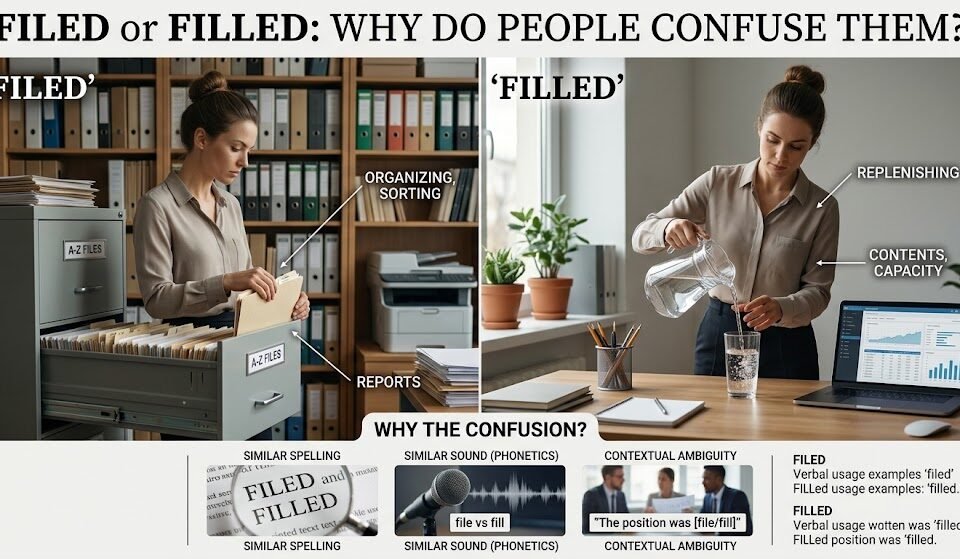

A single letter can completely change the meaning of a sentence. Filed or filled is a good example. These two words sound similar, especially when spoken quickly, but they have very different meanings.
“Filed” usually relates to putting something in an organized place, submitting an official document, or smoothing something with a file. “Filled,” on the other hand, means making something full or putting something into an empty space.
Knowing the difference matters because using the wrong word can change the meaning of your sentence. Whether you are writing an email, completing paperwork, or simply trying to improve your English, this small distinction is worth understanding.
What Does “Filed” Mean?
Filed is the past tense and past participle of the verb file.
The word can have several meanings, depending on the context. One of the most common is to place documents or records in an organized system so they can be found later.
For example:
- She filed the documents in the correct folder.
- The lawyer filed a complaint with the court.
- I filed the report after reviewing it.
In these examples, “filed” has nothing to do with making something full. It refers to organizing, submitting, or officially recording something.
Filed as an Official Submission
“Filed” is often used in legal, administrative, and business situations.
When someone files a document, they formally submit it to an organization, court, government department, or another authority.
For example:
The company filed its annual report on Monday.
Here, “filed” means the company officially submitted the report.
You may also hear phrases such as:
- filed a lawsuit
- filed a complaint
- filed an application
- filed a tax return
- filed a report
- filed a claim
The exact meaning depends on the situation, but the idea is usually connected with formally submitting or recording information.
What Does “Filled” Mean?
Filled is the past tense and past participle of fill.
It means to make something full or to put something into an empty space.
For example:
- She filled the glass with water.
- He filled out the application form.
- The room was filled with people.
- I filled the box with books.
In each case, something is being made complete, occupied, or full.
Filled Can Also Mean Completed
One common use of “filled” may cause additional confusion.
We often say that someone filled out a form. In this expression, “filled” means that the person entered the required information.
For example:
Please fill out this application before the interview.
This does not mean putting the physical form somewhere. It means completing the blank sections with the necessary information.
Filed vs. Filled: The Main Difference
The easiest way to remember the distinction is to focus on the basic verbs.
| Word | Comes From | Main Meaning | Example |
|---|---|---|---|
| Filed | File | Organized, submitted, or recorded | She filed the documents. |
| Filled | Fill | Made full or completed | She filled the box with books. |
A simple memory trick is:
File = organize or submit
Fill = make full or complete
If you are putting paperwork into a filing system, you probably need filed.
If you are putting something into an empty space, you probably need filled.
Filed or Filled in Common Sentences
Sometimes the surrounding words make the correct choice obvious.
“I filed the paperwork.”
This means you organized or officially submitted the paperwork.
“I filled out the paperwork.”
This means you completed the paperwork by entering information.
Notice how changing just one word creates a different meaning.
Filed the paperwork → organized or submitted it.
Filled out the paperwork → completed it.
Both sentences can be grammatically correct, but they describe different actions.
Filed a Form vs. Filled Out a Form
This is one of the most useful distinctions to learn.
If you fill out a form, you write the required information in the blank spaces.
Maria filled out the registration form.
If you file a form, you submit or officially record it.
Maria filed the registration form with the office.
In some situations, the same document can be both filled out and filed.
For example, you might first complete an application and then submit it to an organization.
The process would be:
- Fill out the application.
- Check the information.
- File or submit the application.
That small difference can help prevent many everyday English mistakes.
When Should You Use “Filed”?
Use filed when the action involves organizing, storing, submitting, or officially recording something.
Common examples include:
- The documents were filed alphabetically.
- She filed the invoice in the accounting folder.
- The attorney filed a legal motion.
- He filed a complaint against the company.
- We filed the paperwork yesterday.
“Filed” can also describe the action of using a file tool to smooth or shape a material.
For example:
The technician filed the rough edge of the metal.
Here, “filed” refers to using a tool called a file.
When Should You Use “Filled”?
Use filled when something becomes full, occupied, or complete.
For example:
- He filled the bottle with water.
- She filled the basket with clothes.
- The stadium was filled with spectators.
- I filled the empty space with a small table.
- They filled out the required forms.
The word can describe physical objects, spaces, forms, or even abstract things.
For example:
Her heart was filled with happiness.
Here, “filled” is being used figuratively. It does not mean that happiness was physically placed inside her heart.
Common Mistakes With Filed and Filled
Because the words are pronounced similarly, mistakes are easy to make, particularly in informal writing.
Mistake 1: “I filed out the form.”
This is incorrect if you mean that you completed the form.
The correct sentence is:
I filled out the form.
Mistake 2: “The documents were filled in the cabinet.”
This sounds as though the documents were made full inside the cabinet.
If you mean that the documents were organized and placed in the cabinet, use:
The documents were filed in the cabinet.
Mistake 3: “She filled a complaint.”
This is incorrect when you mean that she officially submitted a complaint.
The correct phrase is:
She filed a complaint.
Mistake 4: “He filed the glass with water.”
If you mean that he put water into the glass, the correct sentence is:
He filled the glass with water.
These examples show why context is important. The pronunciation may be close, but the meanings are not interchangeable.
Filed vs. Filled in American and British English
The meanings of filed and filled remain essentially the same in both American and British English.
There can, however, be differences in how people talk about completing forms.
In American English, fill out a form is very common.
In British English, fill in a form is also widely used.
For example:
- American English: “Please fill out this form.”
- British English: “Please fill in this form.”
Both expressions refer to completing a form.
Importantly, neither should normally be replaced with “filed” when you mean entering information.
A Quick Way to Remember the Difference
If you keep mixing these words up, try this simple test.
Ask yourself:
Am I making something full or completing blank spaces?
If yes, use filled.
She filled the bottle.
He filled out the form.
Now ask:
Am I organizing, submitting, or officially recording something?
If yes, use filed.
She filed the documents.
He filed a complaint.
This quick question can help you choose the right word without having to think about complicated grammar rules.
Filed or Filled: Examples to Practice
Here are some examples. Try choosing the correct word before looking at the answers.
- She ___ the application form with her personal details.
- The manager ___ the reports in the cabinet.
- He ___ a complaint with the authorities.
- They ___ the room with chairs.
- I ___ out the registration form.
- The assistant ___ the documents by date.
Answers
- filled
- filed
- filed
- filled
- filled
- filed
The key is to look at the action being described rather than how the words sound.
Why Context Matters in English
English has many words that sound alike or almost alike but have different meanings. These are sometimes called homophones or near-homophones, depending on the particular words and pronunciation.
The best way to handle them is not to memories isolated definitions. Instead, learn them alongside common phrases.
For example:
Filed
- filed a complaint
- filed a report
- filed documents
- filed paperwork
- filed a claim
Filled
- filled a glass
- filled a box
- filled a room
- filled out a form
- filled in the blanks
Learning these combinations makes the distinction much easier to remember.
FAQ About Filed or Filled
Is it “filed out” or “filled out”?
The correct expression is “filled out” when you mean completed a form.
I filled out the application.
“Filed out” is incorrect in this context.
Is it “filed a form” or “filled a form”?
Both can be possible depending on what you mean, but they describe different actions. Filled a form means completed it, while filed a form means formally submitted or organized it.
What is the difference between filed and filled?
Filed generally means organized, stored, submitted, or officially recorded. Filled means made full, occupied, or completed.
Is “filled in” the same as “filled out”?
Usually, yes, when talking about forms. “Fill in a form” is especially common in British English, while “fill out a form” is particularly common in American English.
How can I remember filed and filled?
Think of filed as connected with a file used to organize documents, while filled means making something full or completing empty spaces.
Final Thoughts
The difference between filed or filled is simple once you focus on the action.
Use filed when you are organizing, submitting, or officially recording something. Use filled when you are making something full or completing information in a form.
So, you file documents, but you fill out a form. You file a complaint, but you fill a bottle with water.
Once you learn these common patterns, choosing the right word becomes much more natural. When in doubt, look at what the sentence is actually describing: organizing or submitting means filed; making full or completing means filled.