
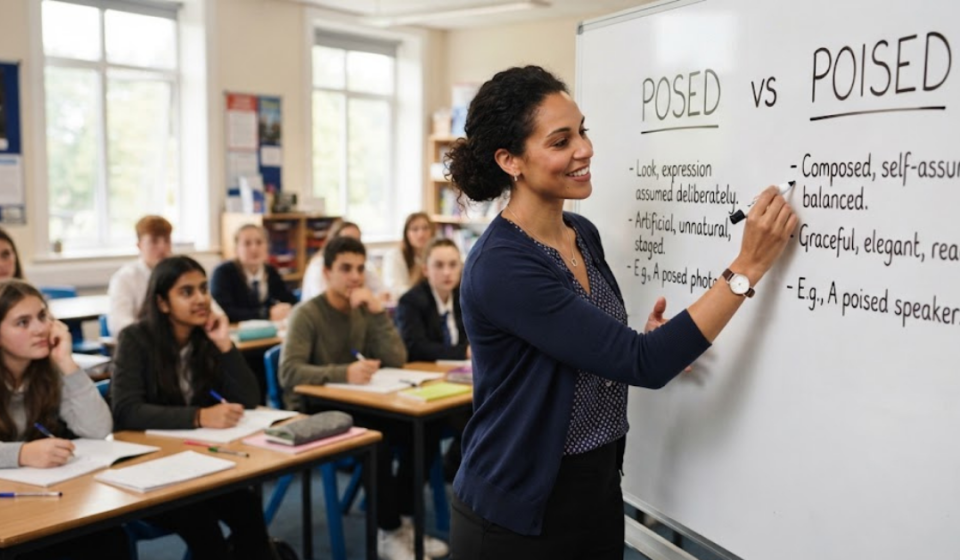

A single letter can completely change the meaning of an English word. That is exactly what happens with posed vs poised. The two words look and sound similar, but they are used in very different situations.
Posed is usually the past tense of pose, meaning to position yourself, present a question, or create a particular situation. Poised generally means calm, confident, balanced, or ready for something.
So, if you’re wondering whether to write posed or poised, the right choice depends on what you are trying to say.
Posed vs Poised: Quick Difference
The easiest way to understand posed vs poised is to remember their core meanings:
| Word | Meaning | Example |
| Posed | Positioned, presented, or asked | She posed for a photograph. |
| Poised | Calm, confident, balanced, or ready | She was poised to begin. |
In simple terms:
Posed = positioned or presented
Poised = calm, ready, or well-balanced
Although the words are closely spelled, they should not normally be used interchangeably.
What Does Posed Mean?
Posed is the past tense and past participle of the verb pose.
The word pose has several meanings, so posed can be used in different contexts.
Posed as “positioned”
One common meaning is to deliberately position your body, often for a photograph, painting, or other visual representation.
She posed for the photographer.
This means she deliberately adopted a particular position.
Another example:
The children posed for a group photo.
Here, they positioned themselves for the photograph.
Posed as “asked”
Posed can also mean that someone presented or asked a question.
The journalist posed an important question.
This means the journalist asked or presented the question.
For example:
The professor posed a difficult problem to the class.
The professor presented a problem for the students to consider.
Posed as “created a problem or threat”
The word can also describe something that presents a difficulty, danger, or challenge.
The storm posed a serious threat to the town.
Here, “posed” means presented or created a potential threat.
So, depending on context, posed can mean:
- Positioned
- Presented
- Asked
- Created a potential problem or threat
What Does Poised Mean?
Poised is an adjective with several related meanings.
It can describe someone who is calm, composed, confident, and controlled, particularly in a situation where nervousness might otherwise be expected.
For example:
She remained poised during the interview.
This suggests that she appeared calm and self-controlled.
Another example:
The speaker looked poised and confident.
Here, “poised” describes the person’s manner.
Poised can also mean “ready”
Another very common construction is:
Poised to + verb
This means someone or something is ready or likely to do something.
For example:
The company is poised to expand internationally.
This means the company is in a position where expansion is likely or expected.
Similarly:
The athlete is poised to win the competition.
This means the athlete is in a strong position to win.
Poised can mean balanced
The word can also describe something physically balanced or positioned.
For example:
The bird was poised on the edge of the branch.
Here, “poised” suggests that the bird was balanced in a particular position, often with a sense of readiness to move.
Posed vs Poised in Sentences
Comparing the words side by side makes the distinction much clearer.
Examples with posed
She posed for a magazine cover.
He posed an interesting question.
The new regulations posed a challenge for small businesses.
The children posed together for a photograph.
In each case, posed comes from the verb pose.
Examples with poised
She looked poised during the presentation.
He was poised to answer the question.
The company is poised for rapid growth.
The cat was poised to jump.
Here, poised describes a state of readiness, composure, or balance.
Posed vs Poised: Why Are They Confused?
The confusion largely comes from their similar spelling and pronunciation.
Compare:
POSED
POISED
The difference is small visually, but the meanings are quite different.
There is also some overlap in the idea of physical positioning. Someone can pose for a photograph, while someone can be poised in a particular position. That slight conceptual connection can make the words even easier to mix up.
The best solution is to focus on the meaning rather than the spelling.
Posed or Poised: Which One Should You Use?
Use posed when you’re talking about something that someone:
- Positioned themselves for
- Asked or presented
- Created or presented as a problem
- Did as an action related to pose
For example:
The reporter posed several questions.
Use poised when you’re describing someone or something as:
- Calm
- Composed
- Confident
- Balanced
- Ready
- Likely to do something
For example:
The team is poised to win.
The Phrase “Poised to”
One of the most useful clues when choosing between posed vs poised is the phrase “poised to.”
If your sentence means ready or likely to do something, you almost certainly want poised.
Examples:
The company is poised to launch a new product.
The team is poised to take first place.
She was poised to respond.
The market appears poised to recover.
You would not normally use posed to in these sentences.
Poised for
You may also see:
Poised for + noun
Examples:
The business is poised for growth.
The industry is poised for change.
The athlete is poised for success.
Both poised to and poised for are common constructions.
The Phrase “Posed a Question”
Another useful clue is the phrase “posed a question.”
If someone asks or presents a question, use posed.
For example:
The interviewer posed a difficult question.
The teacher posed a question about the reading.
Similarly, you can say:
The problem posed a serious challenge.
This is different from:
The student was poised to answer.
The first sentence describes something being presented; the second describes someone being ready.
Posed vs Poised: Pronunciation
The words are also pronounced differently.
Posed generally sounds like “poʊzd.”
Poised generally sounds like “pɔɪzd,” similar to the vowel sound in “boy.”
This difference can be useful when listening, although regional accents and connected speech can make the distinction less obvious.
When writing, however, meaning is the more reliable guide.
Posed vs Poised in Professional Writing
Both words are useful in professional and academic writing, but they appear in different contexts.
Posed is common when discussing:
- Questions
- Challenges
- Risks
- Problems
- Photographs
- Situations
Examples:
The study posed several important questions.
The new policy posed a challenge for employers.
Poised is common when describing:
- Business growth
- Market conditions
- Readiness
- Leadership
- Confidence
- Future developments
Examples:
The company is poised for expansion.
The executive remained poised during the interview.
Using the correct word makes professional writing much clearer.
Common Mistakes With Posed vs Poised
Mistake 1: “The company is posed to grow”
This is generally incorrect if you mean the company is ready or likely to grow.
Better:
The company is poised to grow.
Mistake 2: “She poised for a photograph”
If you mean that she deliberately positioned herself for a photograph, use posed.
Correct:
She posed for a photograph.
Mistake 3: “He poised a question”
When someone asks or presents a question, use posed.
Correct:
He posed a question to the speaker.
Mistake 4: “She was posed and confident”
If you mean she was calm and self-controlled, poised is the better word.
Correct:
She was poised and confident.
A Simple Memory Trick for Posed vs Poised
Here’s an easy way to remember the difference:
Posed = pose
Think:
Posed for a picture.
Posed a question.
Posed a threat.
All three come from the verb pose.
Poised = ready
Think:
Poised to win.
Poised to act.
Poised for success.
If the idea is ready, calm, balanced, or confident, choose poised.
Posed vs Poised: Quick Test
When you’re unsure, ask yourself what the sentence means.
Does it mean “asked,” “presented,” or “positioned”?
→ Use posed.
Does it mean “ready,” “calm,” “confident,” or “balanced”?
→ Use poised.
For example:
The manager ___ an important question.
The manager posed the question.
Now:
The manager was ___ to respond.
The manager was poised to respond.
This simple test works in most everyday situations.
Frequently Asked Questions
What is the difference between posed and poised?
Posed is usually the past tense of pose and can mean positioned, asked, presented, or created a potential problem. Poised usually means calm, confident, balanced, or ready.
Is it “posed to” or “poised to”?
Use poised to when you mean ready or likely to do something.
The company is poised to expand.
“Posed to” generally does not have this meaning.
Is it “posed for a picture” or “poised for a picture”?
The usual expression is posed for a picture because it means deliberately positioning yourself for a photograph.
She posed for a picture.
Is “poised” a synonym for “ready”?
In many contexts, yes. Poised to can mean ready or in a strong position to do something.
The team is poised to win.
Does posed mean asked?
It can. Posed can mean presented or asked, especially when referring to a question.
The reporter posed a difficult question.
Does poised mean confident?
It can imply confidence and composure. Someone who is poised is generally calm, self-controlled, and composed.
What does “poised for success” mean?
Poised for success means being in a favorable position to succeed or having circumstances that make success likely.
What does “posed a threat” mean?
Posed a threat means presented or created a potential danger.
The storm posed a threat to nearby communities.
Are posed and poised pronounced the same?
No. They have different vowel sounds. Posed generally has the “oh” sound, while poised has the “oy” sound.
Conclusion: Posed vs Poised
The difference between posed vs poised becomes easy once you connect each word with its main idea.
Posed comes from pose and can mean positioned, asked, presented, or created a potential problem. Poised describes someone or something that is calm, balanced, confident, or ready for what comes next.
Remember the shortcut:
Posed = positioned or presented.
Poised = ready or composed.
So, if someone posed for a photograph, that’s correct. If someone is poised to succeed, that’s correct too. Once you recognize these patterns, choosing between posed and poised becomes much more natural.