
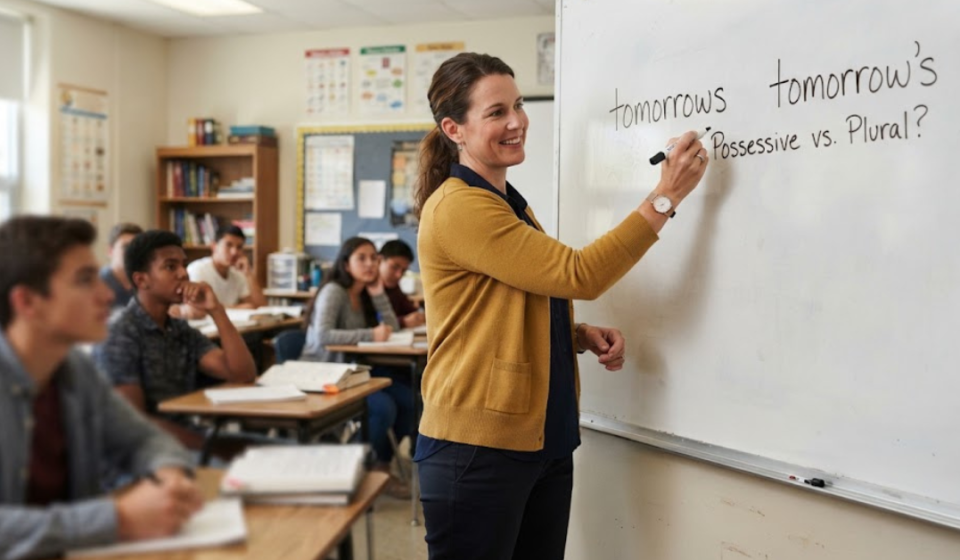

One tiny apostrophe can completely change the meaning of a word. If you’ve ever wondered whether it should be tomorrows or tomorrow’s, you’re dealing with one of the most common punctuation questions in everyday English.
The correct choice depends on what you’re trying to say. Tomorrow refers to the day after today, tomorrow’s is usually the possessive form or a contraction of “tomorrow is,” while tomorrows is the plural form and is much less common.
So, when you’re asking tomorrow’s or tomorrows, the apostrophe isn’t optional—it can change the grammatical function of the word.
Tomorrows or Tomorrow’s: Which One Is Correct?
Both tomorrows and tomorrow’s can be grammatically correct, but they are used in different situations.
| Form | Meaning | Example |
| Tomorrow | The day after today | I’ll see you tomorrow. |
| Tomorrow’s | Belonging to or associated with tomorrow | Tomorrow’s meeting starts at nine. |
| Tomorrow’s | Short for “tomorrow is” | Tomorrow’s going to be busy. |
| Tomorrows | More than one “tomorrow” | We can’t keep worrying about future tomorrows. |
For most everyday sentences, you’ll probably need tomorrow or tomorrow’s, not tomorrows.
The easiest way to choose is to ask yourself what role the word is playing in the sentence.
How Do You Spell Tomorrow?
The correct spelling is:
T-O-M-O-R-R-O-W — tomorrow
The word contains two r’s and ends with -orrow.
A common mistake is leaving out one of the r’s or adding unnecessary letters. If you’re unsure how to spell tomorrow, breaking it into smaller parts can help:
to + morrow = tomorrow
The word is normally written as one word.
Common spelling mistakes
You may occasionally see errors such as:
- Tommorow
- Tomorow
- Tommorrow
- Tommorow’s
The standard spelling is tomorrow, and its possessive form is tomorrow’s.
What Does Tomorrow Mean?
Tomorrow is a noun or adverb referring to the day immediately following today.
For example:
I have a doctor’s appointment tomorrow.
Here, tomorrow tells us when the appointment will happen.
It can also function as a noun:
Tomorrow is another day.
In everyday English, however, the word most often appears as an adverb indicating when something will happen.
What Does Tomorrow’s Mean?
Tomorrow’s has two main uses.
1. Tomorrow’s as a possessive
The apostrophe and s can indicate that something belongs to, relates to, or is associated with tomorrow.
For example:
Tomorrow’s weather should be warmer.
Here, tomorrow’s means “the weather of tomorrow” or “the weather expected tomorrow.”
Other examples include:
- Tomorrow’s meeting has been postponed.
- I need to prepare for tomorrow’s exam.
- Tomorrow’s schedule looks busy.
- Have you seen tomorrow’s forecast?
In these examples, the apostrophe is important because tomorrow’s modifies a noun.
2. Tomorrow’s as a contraction
Tomorrow’s can also be a shortened form of tomorrow is.
For example:
Tomorrow’s going to be busy.
This means:
Tomorrow is going to be busy.
Another example:
Tomorrow’s the big day.
This means:
Tomorrow is the big day.
One quick way to check this use is to replace tomorrow’s with tomorrow is. If the sentence still makes sense, you’re using the contraction correctly.
Tomorrow’s vs Tomorrows: What’s the Difference?
The difference between tomorrow’s and tomorrows is mainly grammatical.
Tomorrow’s
The apostrophe indicates either possession or a contraction.
Tomorrow’s meeting is at 10 a.m.
Or:
Tomorrow’s going to be exciting.
Tomorrows
Without an apostrophe, tomorrows is the plural of tomorrow.
It refers to multiple future days.
For example:
We spend too much time worrying about our tomorrows.
This usage is possible, but it is relatively uncommon in ordinary conversation.
You might encounter tomorrows more often in literature, motivational writing, poetry, or philosophical discussions about the future.
When Should You Use Tomorrows?
Use tomorrows when you’re genuinely talking about multiple future days or multiple possible futures.
For example:
We cannot predict all the tomorrows ahead of us.
Here, tomorrows refers to several future days.
Another example:
The choices we make today can shape our tomorrows.
The word is plural because the sentence refers to multiple future days.
However, don’t use tomorrows simply because you’re talking about something happening tomorrow.
For example:
Incorrect:
Tomorrows meeting is at noon.
Correct:
Tomorrow’s meeting is at noon.
The first sentence needs an apostrophe because the meeting is associated with tomorrow.
When Should You Use Tomorrow’s?
Use tomorrow’s when you’re talking about something associated with tomorrow or when tomorrow is can be shortened to tomorrow’s.
Possessive examples
I need to finish tomorrow’s assignment.
Did you check tomorrow’s schedule?
Tomorrow’s forecast predicts rain.
Contraction examples
Tomorrow’s going to be a long day.
Tomorrow’s the deadline.
Tomorrow’s going to be better.
The context usually makes the intended meaning clear.
A Simple Trick for Choosing the Right Form
If you’re stuck between tomorrows or tomorrow’s, try these two tests.
Test 1: Can you replace it with “tomorrow is”?
If yes, use tomorrow’s.
Tomorrow’s going to be sunny.
Becomes:
Tomorrow is going to be sunny.
The sentence works, so tomorrow’s is correct.
Test 2: Is something associated with tomorrow?
If the word describes something happening on or belonging to tomorrow, use tomorrow’s.
Tomorrow’s appointment is at three.
The appointment is associated with tomorrow.
Test 3: Are you talking about multiple future days?
If yes, tomorrows may be appropriate.
We should focus on creating better tomorrows.
Here, the plural makes sense.
Tomorrow vs Tomorrow’s in Sentences
Seeing the forms side by side makes the difference easier to understand.
Tomorrow
I’ll call you tomorrow.
This simply identifies when the action will happen.
Tomorrow’s
I’ll call you after tomorrow’s meeting.
The meeting is associated with tomorrow.
Tomorrow’s as a contraction
Tomorrow’s going to be busy.
This means “Tomorrow is going to be busy.”
Tomorrows
We have many tomorrows ahead of us.
This refers to multiple future days.
Common Mistakes With Tomorrow’s
Mistake 1: Leaving Out the Apostrophe
Tomorrows meeting starts at nine.
This is incorrect when you mean the meeting associated with tomorrow.
Write:
Tomorrow’s meeting starts at nine.
Mistake 2: Adding an Apostrophe to a Simple Time Reference
You don’t need an apostrophe when tomorrow simply tells you when something happens.
Correct:
I’ll finish the project tomorrow.
Not:
I’ll finish the project tomorrow’s.
Mistake 3: Using Tomorrows When You Mean Tomorrow’s
If you’re talking about one event associated with tomorrow, use tomorrow’s.
Tomorrow’s class starts early.
Not:
Tomorrows class starts early.
Mistake 4: Confusing Possession With a Plural
The apostrophe in tomorrow’s isn’t making tomorrow plural. It indicates possession or forms a contraction.
The plural is tomorrows.
Is “Tomorrows” a Real Word?
Yes. Tomorrows can be the plural form of tomorrow.
However, it is much less common than the singular tomorrow or possessive tomorrow’s.
You might see it in phrases such as:
Better tomorrows are possible.
Or:
We shouldn’t sacrifice all our tomorrows for today.
In everyday writing, though, most people don’t need the plural form very often.
Is “Tomorrow’s” Always Possessive?
No.
This is an important distinction. Tomorrow’s can be either:
- A possessive form
- A contraction of “tomorrow is”
For example:
Tomorrow’s meeting is important.
Here, tomorrow’s is possessive.
But:
Tomorrow’s going to be interesting.
Here, tomorrow’s means “tomorrow is.”
Knowing this makes it much easier to understand why the apostrophe appears.
Why Does the Apostrophe Matter?
Apostrophes can signal possession or omitted letters.
Compare:
- Tomorrows = plural
- Tomorrow’s = possessive or contraction
This is similar to other English words:
- Dogs = more than one dog
- Dog’s = belonging to one dog or “dog is”
- Books = more than one book
- Book’s = belonging to one book or “book is”
The same basic principle helps explain tomorrows vs tomorrow’s.
Frequently Asked Questions
Is it tomorrows or tomorrow’s?
Both can be correct, depending on the sentence. Tomorrow’s is used for possession or as a contraction of “tomorrow is,” while tomorrows is the plural form.
How do you spell tomorrow?
The correct spelling is tomorrow:
T-O-M-O-R-R-O-W
Remember that it has two r’s.
Is “tomorrow’s” grammatically correct?
Yes. Tomorrow’s is grammatically correct when it indicates possession or when it is a contraction of “tomorrow is.”
Is “tomorrows” a word?
Yes. Tomorrows is the plural form of tomorrow, although it is relatively uncommon in everyday English.
What is the difference between tomorrow and tomorrow’s?
Tomorrow refers to the day after today. Tomorrow’s can describe something associated with that day or serve as a contraction of “tomorrow is.”
What is the difference between tomorrow’s and tomorrows?
Tomorrow’s has an apostrophe and indicates possession or a contraction. Tomorrows has no apostrophe and is simply the plural form.
Is “tomorrow’s” possessive?
It can be. For example, tomorrow’s meeting uses the possessive form to show that the meeting is associated with tomorrow. But tomorrow’s can also mean “tomorrow is.”
Should I write “tomorrows meeting” or “tomorrow’s meeting”?
Write “tomorrow’s meeting.” The apostrophe is needed because the meeting is associated with tomorrow.
Is “tomorrow’s” a contraction?
Yes, when it means “tomorrow is.”
For example:
Tomorrow’s going to be difficult.
means:
Tomorrow is going to be difficult.
Is “tomorrow” one word?
Yes. The standard spelling is tomorrow, written as one word.
Conclusion: Tomorrows or Tomorrow’s?
When choosing between tomorrows or tomorrow’s, the correct form depends on what you mean.
Use tomorrow when you’re simply referring to the day after today. Use tomorrow’s when something is associated with tomorrow or when you mean “tomorrow is.” Use tomorrows only when you’re talking about multiple future days.
The easiest rule to remember is simple: an apostrophe in “tomorrow’s” can signal possession or a contraction; “tomorrows” without an apostrophe is plural.
And if you’re ever wondering how do you spell tomorrow, remember the standard form: T-O-M-O-R-R-O-W.