
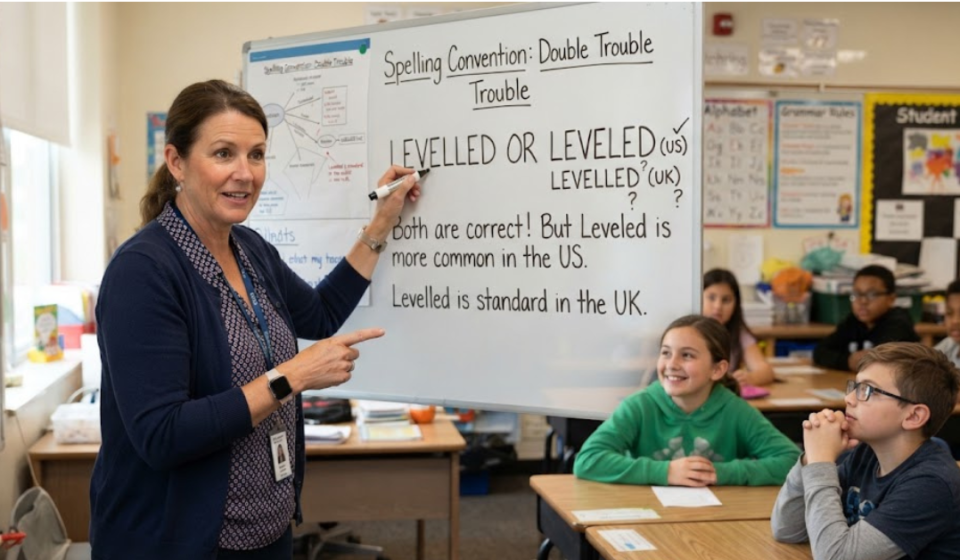

Have you ever written levelled or leveled and stopped to wonder whether one of them is wrong? You’re not alone. The spelling changes depending on which variety of English you’re using, so both forms can be correct.
The key difference is simple: leveled is the standard spelling in American English, while levelled is preferred in British English and many other varieties of English. The same pattern applies to leveling and levelling.
In this guide, we’ll explain the difference between leveled or levelled, show when to use each form, and give you examples that make the distinction easy to remember.
Levelled or Leveled: Which One Is Correct?
Both levelled and leveled are correct spellings.
| Spelling | Common usage | Example |
| Leveled | American English | The workers leveled the ground. |
| Levelled | British English | The workers levelled the ground. |
The choice depends primarily on the variety of English you’re writing in.
So, if you’re writing for an American audience, use leveled. If you’re following British English conventions, levelled is generally preferred.
Neither spelling is inherently incorrect.
Leveled or Levelled: What’s the Difference?
The difference comes from the way American and British English handle words ending in a consonant followed by -l.
The base word is:
level
When adding -ed or -ing, American English usually keeps one l:
- level → leveled
- level → leveling
British English commonly doubles the final l:
- level → levelled
- level → levelling
This is a spelling convention rather than a difference in pronunciation or meaning.
Why Does American English Use “Leveled”?
American English generally uses leveled and leveling.
This follows a broader tendency in American spelling to avoid doubling the final consonant l in certain words when suffixes are added.
For example:
- level → leveled
- travel → traveled
- cancel → canceled
- label → labeled
British English often doubles the l in these forms:
- level → levelled
- travel → travelled
- cancel → cancelled
- label → labelled
There are exceptions and additional spelling rules, but this pattern explains why American and British dictionaries may show different forms.
When Should You Use “Levelled”?
Use levelled when you’re following British English spelling conventions.
This is common in:
- The United Kingdom
- Ireland
- Australia
- New Zealand
- Other contexts influenced by British English
For example:
The construction crew levelled the site before building began.
You may also see:
She levelled the table by adjusting the legs.
The meaning is exactly the same as leveled.
When Should You Use “Leveled”?
Use leveled when writing in American English.
For example:
The construction crew leveled the site before building began.
Other examples include:
- The team leveled the playing field.
- He leveled the shelf.
- The bulldozer leveled the ground.
- She leveled the camera before taking the photograph.
For an American audience, leveled will generally look more natural.
Leveling or Levelling: Which Is Correct?
The same spelling difference appears with the present participle or gerund.
Both forms are correct:
leveling American English
levelling British English
For example:
American English:
The workers are leveling the floor.
British English:
The workers are levelling the floor.
Again, the meaning and pronunciation are essentially the same. The spelling reflects the regional convention you’re following.
Level, Leveled, and Leveling
It helps to look at the entire word family.
| Base word | American English | British English |
| Level | level | level |
| Past tense | leveled | levelled |
| Present participle | leveling | levelling |
| Past participle | leveled | levelled |
The base word level does not change.
The difference appears when -ed or -ing is added.
What Does “Level” Mean?
The word level has several meanings, which is why leveled and levelled appear in many different contexts.
As a verb, level can mean to make something flat, even, or equal.
For example:
The workers leveled the ground.
It can also mean to aim something directly at a target:
He leveled the camera at the stage.
In another context, level can mean to make something equal or comparable:
The new rules leveled the playing field.
The spelling doesn’t change based on the meaning. The American form remains leveled, while the British form remains levelled.
Examples of “Leveled” in American English
Here are several examples using the American spelling:
- The crew leveled the land before construction began.
- She leveled the picture frame on the wall.
- The new policy leveled the playing field for smaller companies.
- He leveled the camera before taking the photograph.
- The machine leveled the surface automatically.
- The teams were leveled by the end of the second half.
In each example, leveled follows American spelling conventions.
Examples of “Levelled” in British English
Here are equivalent examples using the British spelling:
- The crew levelled the land before construction began.
- She levelled the picture frame on the wall.
- The new policy levelled the playing field for smaller companies.
- He levelled the camera before taking the photograph.
- The machine levelled the surface automatically.
- The teams were levelled by the end of the second half.
The meaning is unchanged. Only the spelling differs.
Why Do Americans and British Writers Spell It Differently?
The difference is part of a much broader history of English spelling.
American English developed its own conventions over time, with spelling reforms associated particularly with efforts to make written English more consistent and distinct from British usage.
British English retained many traditional spelling patterns, including the doubled l in forms such as levelled and levelling.
Neither system is simply a “better” version of English. They’re established varieties with their own conventions.
That’s why it’s important to be consistent rather than mixing spelling systems randomly.
Levelled vs Leveled in Formal Writing
Both forms are acceptable in formal writing as long as they match the variety of English you’re using.
For example, an American academic paper would normally use:
The researchers leveled the experimental surface.
A British publication might use:
The researchers levelled the experimental surface.
The important thing is consistency.
If your document otherwise uses American spellings such as color, center, and analyze, then leveled is the natural choice.
If it uses British forms such as colour, centre, and analyse, then levelled is more appropriate.
Common Mistakes With Levelled and Leveled
Mistake 1: Thinking One Spelling Is Always Wrong
Neither spelling is universally wrong. The correct choice depends on the English variety.
Mistake 2: Mixing Spelling Conventions
A document can look inconsistent if it uses leveled in one paragraph and levelled in another without a reason.
Choose one style and stick with it.
Mistake 3: Forgetting the “-ing” Form
The same distinction applies to leveling and levelling.
American:
leveling
British:
levelling
Mistake 4: Assuming Pronunciation Changes
The spelling difference generally doesn’t create a meaningful difference in pronunciation.
The distinction is primarily written.
How to Remember Levelled or Leveled
A simple trick is to associate the spelling with the variety of English.
American English
Think:
One L: leveled, leveling
British English
Think:
Double L: levelled, levelling
You can also remember the pattern through familiar examples:
American:
- traveled
- canceled
- labeled
- leveled
British:
- travelled
- cancelled
- labelled
- levelled
This makes the spelling pattern easier to recognize.
Frequently Asked Questions
Is it levelled or leveled?
Both are correct. Leveled is the standard American English spelling, while levelled is commonly used in British English and other varieties that follow British spelling conventions.
Is leveled American or British?
Leveled is the standard American English form.
Is levelled British spelling?
Yes. Levelled is the conventional British English spelling.
Is leveling or levelling correct?
Both are correct. Leveling is standard in American English, while levelling is standard in British English.
Does levelled mean something different from leveled?
No. They have the same meaning. The difference is primarily a regional spelling convention.
Can I use leveled in British English?
You may encounter leveled in British contexts, particularly in international or American-influenced writing, but levelled is the conventional British spelling.
Can I use levelled in American English?
People will generally understand it, but leveled is the standard American spelling and will look more natural to a U.S. audience.
Why does British English double the L?
British spelling conventions commonly double a final l when certain suffixes are added, producing forms such as levelled and levelling. American English generally uses one l in these forms.
Which spelling should I use in an essay?
Follow the spelling convention required by your school, institution, publisher, or target audience. For American English, use leveled; for British English, use levelled.
Conclusion: Levelled or Leveled?
So, when choosing between levelled or leveled, there isn’t a single spelling that’s correct everywhere.
Leveled is the standard American English form, while levelled is the conventional British English form. The same distinction applies to leveling and levelling.
The best approach is simple: identify which variety of English you’re using and stay consistent throughout your writing. Once you know that leveled = American and levelled = British, the choice becomes much easier.