
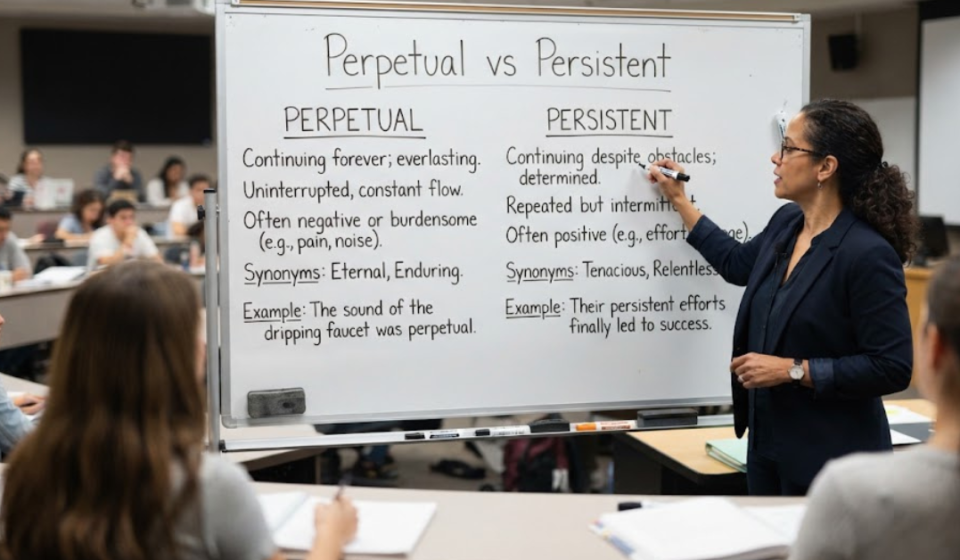

Some words look like perfect substitutes until you put them into a sentence. Perpetual vs persistent is one of those comparisons. Both words describe something that continues, but they emphasize different ideas.
Perpetual usually describes something that continues indefinitely or seems never to end. Persistent, on the other hand, describes something that continues despite difficulty, resistance, interruption, or attempts to stop it.
Knowing this distinction can make your writing more precise, especially when you’re describing behavior, problems, conditions, or events.
Perpetual vs Persistent: The Quick Answer
The simplest way to remember the difference is:
- Perpetual = continuing indefinitely or seemingly without end.
- Persistent = continuing despite resistance, difficulty, or attempts to stop it.
For example:
The machine makes a perpetual humming sound.
This suggests the sound continues endlessly.
She was persistent in trying to solve the problem.
This emphasizes her determination to keep trying despite obstacles.
In some contexts, the words can overlap, but they don’t always carry the same meaning or tone.
What Does Perpetual Mean?
Perpetual is an adjective meaning continuing forever, indefinitely, or for an apparently endless period.
It often emphasizes duration.
For example:
They seemed to be caught in a cycle of perpetual disagreement.
The idea is that the disagreement appears to continue without reaching an end.
Other examples include:
- perpetual motion
- perpetual change
- perpetual conflict
- perpetual uncertainty
- perpetual renewal
- perpetual growth
The word can describe something literally indefinite, but it is also frequently used figuratively.
Perpetual in Everyday Language
Consider this sentence:
He complained about the perpetual noise from the construction site.
The speaker isn’t necessarily claiming that the noise will literally continue forever. Instead, perpetual emphasizes that it seems constant or never-ending.
This gives the word a sense of continuity without a clear endpoint.
What Does Persistent Mean?
Persistent describes something that continues for a long time or keeps happening despite attempts to stop, remove, or overcome it.
It can describe both people and things.
For example:
She was persistent and eventually finished the project.
Here, persistence is a positive quality. It suggests determination and continued effort.
But persistent can also describe an unwanted condition:
He has a persistent cough.
In this case, the cough continues for a long time and hasn’t gone away.
So, unlike perpetual, persistent often carries the idea of resistance or repeated continuation.
Perpetual vs Persistent: The Main Difference
The key difference is what each word emphasizes.
| Word | Main idea | Typical emphasis |
| Perpetual | Continues indefinitely | Duration |
| Persistent | Keeps continuing despite obstacles | Resistance or determination |
Think of it this way:
Perpetual asks: “Does it seem to have an end?”
Persistent asks: “Why does it keep going despite attempts to stop it?”
That distinction makes the words easier to choose correctly.
Perpetual vs Persistent Examples
Example 1: Noise
The factory created perpetual noise.
This suggests the noise seems constant or never-ending.
The factory created persistent noise.
This suggests the noise continued for a prolonged period and remained noticeable despite efforts to reduce it.
Both sentences can work, but the emphasis changes.
Example 2: Problems
The company faced perpetual financial uncertainty.
This suggests uncertainty was an ongoing condition.
The company faced persistent financial problems.
This suggests the problems repeatedly continued or resisted attempts to solve them.
Example 3: Behavior
His perpetual complaints became exhausting.
This emphasizes the seemingly endless nature of the complaints.
His persistent complaints eventually led to a formal investigation.
This emphasizes that he continued complaining despite circumstances that might have discouraged him.
Perpetual vs Persistent for People
The distinction becomes particularly noticeable when describing people.
Persistent is commonly used as a positive quality.
She was persistent enough to finish the difficult course.
Here, persistence means determination and refusal to give up.
Perpetual usually isn’t used to praise someone’s determination.
You might say:
He was a perpetual optimist.
This means he was consistently or habitually optimistic.
But you wouldn’t normally say:
He was a perpetual worker.
if you simply mean he kept working despite difficulties. Persistent or hardworking would usually be more appropriate.
When to Use Perpetual
Use perpetual when you want to emphasize something that:
- appears endless;
- continues indefinitely;
- happens repeatedly over an extended period;
- has no obvious endpoint;
- is a continuing state or cycle.
Examples:
The region experienced perpetual political instability.
The two departments were involved in perpetual negotiations.
She seemed trapped in a perpetual cycle of stress.
The system requires perpetual maintenance.
In each case, the emphasis is on continuing or recurring duration.
When to Use Persistent
Use persistent when something:
- refuses to disappear;
- continues despite attempts to stop it;
- repeatedly occurs;
- lasts longer than expected;
- describes someone who doesn’t give up.
Examples:
We have a persistent technical problem.
His persistent efforts finally paid off.
The region has experienced persistent drought.
She remained persistent despite several setbacks.
Here, the sense of resistance or determination is important.
Perpetual vs Persistent in Different Contexts
In Medicine
Persistent is much more common when describing symptoms or conditions.
The patient reported a persistent headache.
This means the headache has continued rather than disappearing as expected.
Perpetual headache would sound unusual and overly absolute.
In Business
Both words can be useful.
The company faces persistent supply-chain problems.
This suggests the problems continue despite efforts to resolve them.
The company operates under perpetual pressure to reduce costs.
This emphasizes an ongoing or seemingly endless condition.
In Technology
Persistent is often used for problems, data, or processes.
The application has a persistent error.
In computing, persistent can also have a technical meaning: something that remains stored or survives beyond a particular process or session.
Perpetual is less common in technical writing unless something is intended to continue indefinitely.
In Everyday Conversation
Both words appear naturally, but persistent is generally more common.
For example:
That’s a persistent problem.
He is a persistent person.
Meanwhile:
That’s a perpetual problem.
sounds stronger and may suggest the problem seems never-ending.
Perpetual vs Persistent: Similar Words
Understanding synonyms can help clarify the difference.
Words Related to Perpetual
- endless
- eternal
- everlasting
- continual
- constant
- unending
- never-ending
Words Related to Persistent
- determined
- tenacious
- relentless
- enduring
- stubborn
- continual
- recurring
Notice that some words, such as continual, can overlap with both groups.
The exact meaning depends on context.
Perpetual and Persistent Are Not Always Interchangeable
It’s tempting to replace one word with the other because both involve continuation. However, doing so can change the meaning.
Compare:
She made a persistent effort to improve.
This sounds natural because persistent describes determination.
She made a perpetual effort to improve.
This sounds unusual because perpetual focuses on endless duration rather than determination.
Now consider:
The company entered a perpetual cycle of restructuring.
This suggests an apparently endless cycle.
The company entered a persistent cycle of restructuring.
This can work, but it focuses more on the recurring nature of the problem.
A Simple Trick to Remember the Difference
Try connecting each word with a different idea.
Perpetual = Never Ending
Think:
Perpetual → forever
If the main idea is that something continues indefinitely, perpetual is often the better choice.
Persistent = Doesn’t Give Up
Think:
Persistent → keeps going despite obstacles
If something continues because it won’t disappear, or someone keeps trying despite difficulty, persistent is usually the better choice.
Frequently Asked Questions
What is the difference between perpetual and persistent?
Perpetual emphasizes something continuing indefinitely or seemingly without end. Persistent emphasizes something continuing despite resistance, difficulty, or attempts to stop it.
Are perpetual and persistent synonyms?
They can overlap in some contexts because both describe continuation, but they are not exact synonyms. Perpetual focuses more on endless duration, while persistent often suggests resistance or determination.
Is persistent positive or negative?
It can be either. A persistent person may be determined and admirable, while a persistent problem is usually unwanted.
Is perpetual always negative?
No. Perpetual can be positive, negative, or neutral.
For example:
She had a perpetual smile.
Here, it can suggest she was almost always smiling.
Can you say “persistent problem”?
Yes. Persistent problem is a very common phrase. It means a problem that continues or keeps returning despite attempts to resolve it.
Can you say “perpetual problem”?
Yes. Perpetual problem is also grammatically correct. It suggests a problem that appears endless or continually present.
Which word means “never-ending”?
Perpetual is generally the closer choice for “never-ending.”
Which word means “refusing to give up”?
Persistent is the better choice. It describes continued effort despite difficulty or resistance.
Is “persistent” the same as “constant”?
Not exactly. Constant emphasizes something that remains unchanged or happens continuously, while persistent often suggests something continues despite attempts to stop it.
Conclusion: Perpetual vs Persistent
The difference between perpetual vs persistent becomes much easier once you focus on what each word emphasizes.
Perpetual describes something that continues indefinitely or appears never-ending. Persistent describes something that continues despite obstacles, resistance, or attempts to make it stop—and it can also describe someone who refuses to give up.
A quick rule can help:
Perpetual = seemingly endless.
Persistent = keeps going despite resistance.
When you’re choosing between the two, consider whether you’re emphasizing duration or determination/resistance. That small distinction can make your writing more accurate, natural, and precise.