
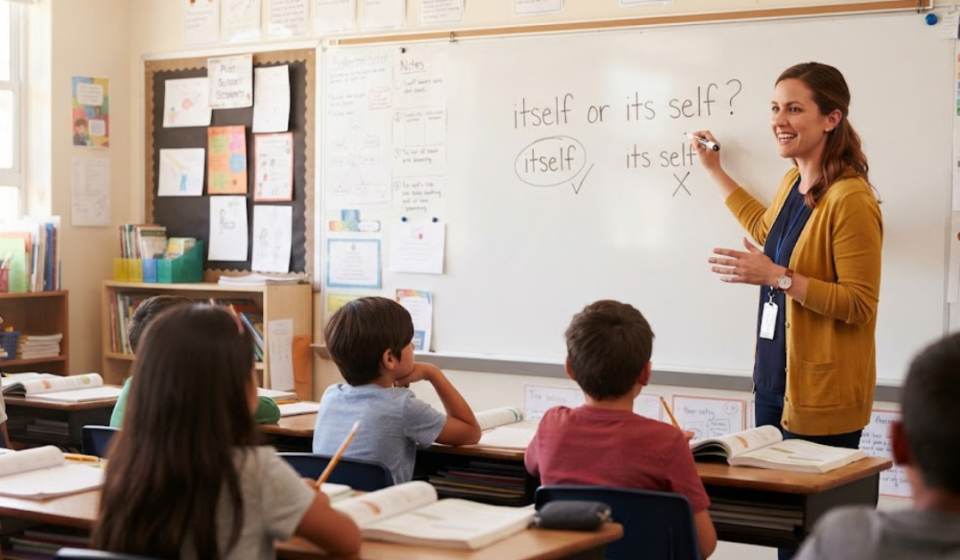

Sometimes English spelling questions come down to something as simple as a space. Itself or its self is one of those confusing pairs. If you’ve ever stopped while writing and wondered whether “itself” should be written as one word or two, you’re not alone.
In standard English, itself is the correct spelling when you are using the reflexive pronoun. Its self can occasionally appear as two separate words, but only when its is functioning as a possessive determiner and self is being used as a noun. That distinction is uncommon in everyday writing.
For most sentences, the answer is simple: use itself.
Itself or Its Self: The Quick Answer
When you’re using the reflexive pronoun referring to a thing, animal, organization, or other non-human entity, write itself as one word.
Correct: The machine turned itself off.
Usually incorrect: The machine turned its self off.
The word itself is a standard English reflexive pronoun. It is the equivalent of himself or herself when referring to something represented by it.
The Basic Rule
Use itself when:
- it is the subject of the sentence.
- The action comes back to the subject.
- You want to emphasize it.
For example:
- The dog scratched itself.
- The company has reinvented itself.
- The computer restarted itself.
- The door opened by itself.
- The device itself is surprisingly small.
What Does “Itself” Mean?
Itself is a reflexive pronoun. It generally refers back to something previously mentioned and can also be used for emphasis.
Consider this sentence:
The cat cleaned itself.
The word itself refers back to the cat. The cat is both the subject performing the action and the thing receiving the action.
Another example:
The software updated itself.
Here, itself refers to the software.
The word can also provide emphasis:
The building itself is worth visiting.
In this sentence, itself emphasizes the building rather than referring to an action performed on the building.
Itself vs Its Self: What’s the Difference?
The difference between itself vs its self is primarily grammatical.
Itself
Itself is one word and functions as a reflexive or emphatic pronoun.
Examples:
- The bird injured itself.
- The program can repair itself.
- The idea itself isn’t bad.
- The company introduced itself to customers.
Its self
Its self consists of two separate words:
- its — a possessive determiner
- self — a noun
This construction is uncommon and usually appears in specialized, philosophical, psychological, or highly literary writing.
For ordinary English, itself is almost always what you want.
Why “Its Self” Can Be Confusing
The confusion comes partly from the fact that its and self are both legitimate English words.
For example:
The company needs to understand its customers.
Here, its shows possession.
And:
He needs to take care of his self.
This second construction would normally be written differently in standard English: himself would usually be the appropriate reflexive pronoun.
Because self can function as a noun, however, you may occasionally encounter phrases such as:
the self
or:
its own self
These are different from the ordinary reflexive pronoun itself.
It Self or Itself: Which Is Correct?
If you’re wondering about it self or itself, the standard answer is itself.
Correct:
The machine can clean itself.
Incorrect in standard usage:
The machine can clean it self.
The pronoun is written as a single word.
This is similar to other English reflexive pronouns:
- myself
- yourself
- himself
- herself
- itself
- ourselves
- yourselves
- themselves
These forms are normally written as single words.
How to Use “Itself” Correctly
There are two particularly common uses of itself.
1. Reflexive Use
In reflexive use, itself refers back to the subject.
Examples:
The dog hurt itself.
The computer restarted itself.
The organization blamed itself for the mistake.
The subject and the object refer to the same thing.
2. Emphatic Use
Itself can also emphasize a noun.
Examples:
The book itself is fascinating.
The plan itself isn’t complicated.
The software itself is free.
Here, itself doesn’t mean that the noun performed an action on itself. Instead, it adds emphasis.
A useful test is to remove the word. If the sentence still makes sense but loses some emphasis, itself is probably being used emphatically.
For example:
The product itself is excellent.
Without itself:
The product is excellent.
The meaning remains basically the same, but the emphasis changes.
Itself or Its Self in Example Sentences
Seeing the difference in context makes the rule much easier to remember.
Correct Uses of Itself
- The robot repaired itself.
- The company has established itself as a market leader.
- The door closed by itself.
- The website itself is easy to navigate.
- The animal protected itself from danger.
- The problem will eventually resolve itself.
- The application updates itself automatically.
In every example, itself is functioning as a single pronoun.
When “Its Self” Might Appear
The two-word construction may appear when self is deliberately being treated as a noun.
For example:
The philosopher explored the relationship between the individual and its self.
This is a very different grammatical construction from:
The machine switched itself off.
The first sentence discusses self as a concept or entity. The second uses itself as a reflexive pronoun.
For everyday writing, however, you will rarely need its self.
Is “Its Self” Ever Correct?
Yes, but it is important to understand the context.
Its self can technically be correct when self is being used as a separate noun and its modifies it.
For example:
The animal’s behavior reflected its own self.
Even here, a writer would often choose a more natural expression depending on the intended meaning.
You might also encounter the construction in philosophical or academic discussions involving concepts such as:
- the self
- identity
- consciousness
- personal identity
- the individual self
So it would be inaccurate to say that its self can never occur. The important point is that it is not the normal alternative spelling of itself.
Common Mistakes With Itself
Here are a few mistakes worth avoiding.
Mistake 1: Writing “it self”
The program fixed it self.
Correct:
The program fixed itself.
Mistake 2: Writing “its self” as the reflexive pronoun
The machine turned its self off.
Correct:
The machine turned itself off.
Mistake 3: Confusing “its” and “it’s”
Remember:
- its = shows possession
- it’s = contraction of it is or it has
- itself = reflexive or emphatic pronoun
For example:
The company changed its policy.
It’s changing its policy.
The company changed itself.
These three forms have completely different grammatical functions.
Itself vs Its: A Simple Comparison
It can help to compare the words directly.
| Word | Function | Example |
| its | Possessive determiner | The dog wagged its tail. |
| it’s | It is / it has | It’s getting late. |
| itself | Reflexive/emphatic pronoun | The dog cleaned itself. |
| its self | Its + noun “self” | The discussion focused on its self. |
The first three are common in everyday English. Its self is much less common and has a different grammatical structure.
A Quick Trick to Remember “Itself”
When you’re unsure whether to write itself or its self, ask yourself:
Am I using a reflexive pronoun?
If the answer is yes, write itself.
You can also substitute another reflexive pronoun mentally.
For example:
The child hurt itself.
You wouldn’t write his self or her self in a normal sentence. You would use himself or herself.
Likewise:
The machine repaired itself.
The reflexive form is one word.
Frequently Asked Questions
Is it itself or its self?
For normal use as a reflexive pronoun, the correct form is itself, written as one word. Its self is only appropriate when its modifies self as a separate noun.
Is “its self” grammatically correct?
It can be grammatically possible in specific contexts, particularly when self is being used as a noun. However, it is not the standard alternative spelling of itself.
Is “it self” one word?
Yes, when you mean the reflexive pronoun, it should be written as itself, not it self.
What does itself mean?
Itself is a reflexive or emphatic pronoun referring to something previously mentioned. For example, in “The computer restarted itself,” itself refers to the computer.
What is the difference between itself and its?
Its shows possession, while itself is a reflexive or emphatic pronoun.
Compare:
The company changed its logo.
The company changed itself.
What is the difference between itself and it’s?
Itself is a pronoun. It’s is a contraction meaning either it is or it has.
For example:
The machine repaired itself.
It’s working again.
Can “itself” be used for people?
Generally, itself is used for things, animals, organizations, ideas, and other entities referred to with it. For people, reflexive pronouns such as himself, herself, or themselves are normally used.
Is “itself” a pronoun?
Yes. Itself is a reflexive pronoun and can also be used as an emphatic pronoun.
Conclusion: Itself or Its Self?
When choosing between itself or its self, the correct form for almost every ordinary sentence is itself.
Use itself when you need the reflexive pronoun referring to something:
The machine repaired itself.
Use its self only when its and self are functioning as separate words, which is relatively uncommon and usually depends on a specialized context.
And if you’re deciding between it self or itself, remember the simple rule: the reflexive pronoun is always written as one word — itself.
Once you recognize how the word functions grammatically, this particular spelling question becomes much easier to handle.