
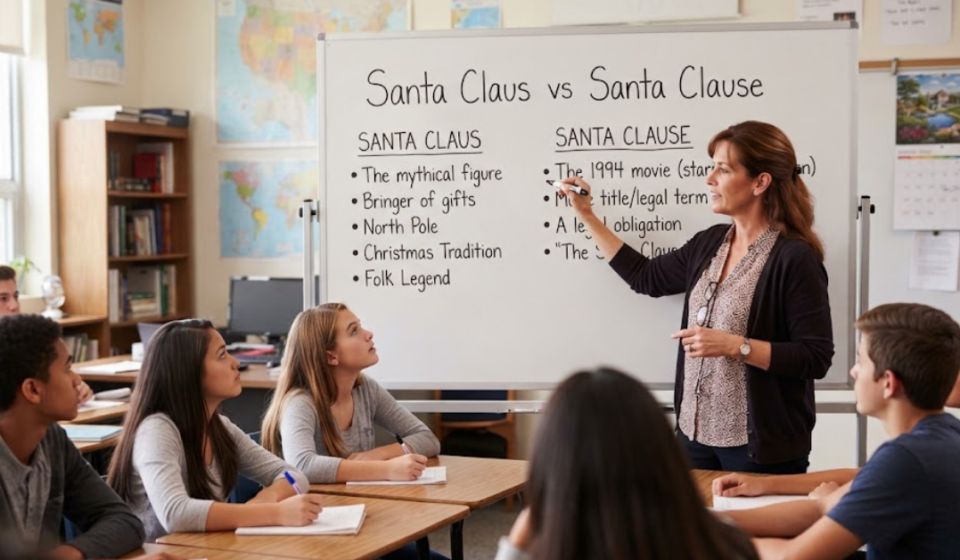

One tiny letter can turn a beloved Christmas figure into a completely different word. If you’ve ever searched Santa Claus vs Santa Clause, you’re not alone. The two spellings look almost identical, but only one is the standard name for the legendary Christmas gift-giver.
So, how do you spell Santa Claus? The correct spelling is Santa Claus. “Santa Clause” is a common spelling mistake, although “clause” is a real English word with a completely different meaning.
Let’s clear up the confusion and look at where the name came from, how to spell it, and why the mistake happens so often.
Santa Claus vs Santa Clause: The Quick Answer
Here’s the simplest way to remember it:
- Santa Claus — correct name for the Christmas figure
- Santa Clause — incorrect spelling when referring to Santa
- Clause — a grammatical term referring to a group of words containing a subject and predicate
- Claus — the surname used in the name of the Christmas character
For example:
Santa Claus visits children on Christmas Eve.
Not:
Santa Clause visits children on Christmas Eve.
The difference is just one letter, but the words have entirely different origins and meanings.
How Do You Spell Santa Claus?
If you’re wondering how do you spell Santa Claus, the correct spelling is:
Santa Claus
It is written as two words, with both Santa and Claus beginning with capital letters because it is a proper name.
You can remember it as:
Santa + Claus = Santa Claus
The second word ends in -laus, not -lause.
Correct Examples
- Santa Claus is coming to town.
- Children write letters to Santa Claus.
- Santa Claus is traditionally associated with Christmas Eve.
- Many people dress as Santa Claus during the holiday season.
Common Incorrect Spelling
- Santa Clause
Although “Santa Clause” appears frequently online, in ordinary English it isn’t the standard spelling of the character’s name.
How Do You Spell Santa?
If you’re asking how do you spell Santa, the answer is simply:
Santa
It is spelled:
S-A-N-T-A
When referring to the Christmas character, it is normally capitalized because Santa is being used as a proper name.
For example:
“The children are waiting for Santa.”
You can also use the full name:
“The children are waiting for Santa Claus.”
Both are correct.
Why Is It Santa Claus, Not Santa Clause?
The confusion comes from the fact that Claus and clause sound very similar in English.
However, they aren’t the same word.
Claus is a name. Clause is a grammatical term.
Think of it this way:
| Word | Meaning |
| Claus | A surname in “Santa Claus” |
| Clause | A grammatical unit in a sentence |
| Santa Claus | The traditional Christmas gift-giving figure |
| Santa Clause | A common misspelling of Santa Claus |
So when you’re writing about the Christmas character, use Claus.
What Does “Clause” Mean?
A clause is a grammatical unit that generally contains a subject and a verb.
For example:
“She laughed because the joke was funny.”
This sentence contains more than one clause.
- “She laughed” is one clause.
- “because the joke was funny” is another.
So “clause” belongs to grammar—not Christmas.
That’s why Santa Clause is incorrect when you’re referring to the holiday figure.
What Does Santa Mean?
The word Santa comes from the Italian and Spanish word forms related to saint. In the name Santa Claus, it is traditionally associated with Saint Nicholas, the historical Christian figure whose reputation for generosity helped inspire the modern Santa Claus tradition.
In modern English, however, Santa is commonly used as a shortened name for Santa Claus.
For example:
“What did Santa bring you?”
Everyone understands that “Santa” refers to Santa Claus.
Where Does the Name Santa Claus Come From?
The name Santa Claus is closely connected to Saint Nicholas, a Christian bishop associated with generosity and gift-giving.
The modern English name developed through several linguistic and cultural stages. One important link is the Dutch Sinterklaas, a traditional name for Saint Nicholas.
Over time, traditions surrounding Saint Nicholas blended with other European customs and eventually developed into the familiar Santa Claus figure known today.
The modern character is therefore the result of centuries of cultural evolution rather than a single invention.
Who Was Saint Nicholas?
Saint Nicholas was a Christian bishop who lived during late antiquity and became famous in tradition for generosity toward people in need.
Stories about his kindness helped establish a tradition of giving gifts in his honor.
Over the centuries, those traditions spread and changed as they moved between countries and cultures. Eventually, Saint Nicholas became associated with the figure now widely known as Santa Claus.
Santa Claus vs Santa Clause: Why the Mistake Is Common
The spelling mistake is understandable because Claus and clause are pronounced very similarly in many varieties of English.
When people hear the name rather than see it written down, they may naturally assume the second part is “clause.”
There’s also a familiar English word, “clause,” that people already know how to spell. Since “Claus” is much less common outside the name Santa Claus, autocorrect, typing habits, and simple phonetic spelling can all contribute to the confusion.
Santa Claus Pronunciation
In standard English, Santa Claus is commonly pronounced approximately:
SAN-tuh KLAWZ
The exact pronunciation can vary slightly depending on accent.
Importantly, the spelling Claus doesn’t mean you should pronounce it like the word “clause” in every accent. In many varieties of English, however, the two words are effectively homophones.
That similarity in pronunciation is one reason the spelling confusion persists.
Is “Santa Claus” a Proper Noun?
Yes.
Santa Claus is a proper name, so both words are normally capitalized.
Correct:
Santa Claus arrived on Christmas Eve.
Incorrect in standard writing:
santa claus arrived on Christmas Eve.
When you’re referring to Santa specifically, use capital letters.
Santa, Santa Claus, and Father Christmas
Different cultures and English-speaking regions use different names and traditions for the Christmas gift-giving figure.
Some commonly used names include:
- Santa Claus
- Santa
- Father Christmas
- Saint Nicholas
- Saint Nick
- Kris Kringle
These names don’t necessarily represent completely separate characters. Many developed from overlapping traditions surrounding Saint Nicholas and Christmas gift-giving.
Father Christmas, for example, has a particularly strong historical association with British Christmas traditions.
Is Santa Claus the Same as Saint Nicholas?
Santa Claus is historically and culturally connected to Saint Nicholas, but the two aren’t identical in every sense.
Saint Nicholas was a historical religious figure, while Santa Claus is a later cultural character shaped by centuries of stories, customs, literature, art, and popular culture.
Modern Santa is commonly portrayed as:
- Living at the North Pole
- Traveling in a sleigh
- Being pulled by reindeer
- Delivering presents on Christmas Eve
- Wearing a red suit
- Having a white beard
These characteristics belong to the modern Santa tradition rather than the historical Saint Nicholas himself.
Common Santa Claus Spelling Mistakes
Because the name is pronounced similarly to familiar words, several mistakes can appear.
1. Santa Clause
This is the most common mistake.
Correct:
Santa Claus
2. Santa Claws
“Claws” refers to the sharp nails or talons of certain animals.
It can appear as a Christmas pun, but it isn’t the standard spelling of Santa’s name.
3. Santa Clous
This is simply an incorrect spelling caused by pronunciation.
4. santa claus
The spelling is correct, but capitalization should normally be:
Santa Claus
How to Remember the Correct Spelling
Here’s a simple memory trick:
Santa has Claus, not a clause.
Think of Claus as a person’s surname.
For example:
John Smith
Similarly:
Santa Claus
A clause, on the other hand, belongs in a grammar lesson.
If you’re writing about Christmas, presents, reindeer, or the North Pole, you almost certainly want Claus.
Frequently Asked Questions About Santa Claus
How do you spell Santa Claus?
The correct spelling is Santa Claus. “Santa Clause” is a common misspelling.
How do you spell Santa?
Santa is spelled S-A-N-T-A. When referring to the Christmas character, it is normally capitalized.
Is it Santa Claus or Santa Clause?
It is Santa Claus. “Claus” is the surname in the character’s name, while “clause” is a grammatical term.
What does Santa mean?
“Santa” is commonly used as a shortened name for Santa Claus. The word is also related to forms meaning “saint” in languages such as Italian and Spanish.
What is the meaning of Santa Claus?
Santa Claus is the traditional Christmas gift-giving figure associated with generosity, presents, and Christmas Eve. The character developed from traditions connected to Saint Nicholas and other European Christmas customs.
Why do people spell Santa Claus as Santa Clause?
The mistake is largely caused by pronunciation. “Claus” and “clause” sound very similar, so people sometimes spell the name using the familiar English word “clause.”
Is Santa Claus one word or two?
Santa Claus is two words. Both words are normally capitalized because they form a proper name.
Is “Santa Clause” ever correct?
It can technically occur as a combination of the name “Santa” and the ordinary noun “clause” in a special context or as a joke, but it is not the correct spelling of the Christmas character’s name.
Conclusion: Santa Claus vs Santa Clause
The answer to Santa Claus vs Santa Clause is straightforward: the correct name is Santa Claus.
Claus is the surname in the name of the Christmas character, while clause is a term used in grammar. Because the two words sound so similar, it’s easy to mix them up—but remembering the difference can save you from one of the most common Christmas spelling mistakes.
So, if you’re wondering how do you spell Santa Claus, remember:
Santa Claus
Not Santa Clause.
If you’re writing a Christmas card, article, school assignment, or holiday message, Santa Claus is the spelling you want.