
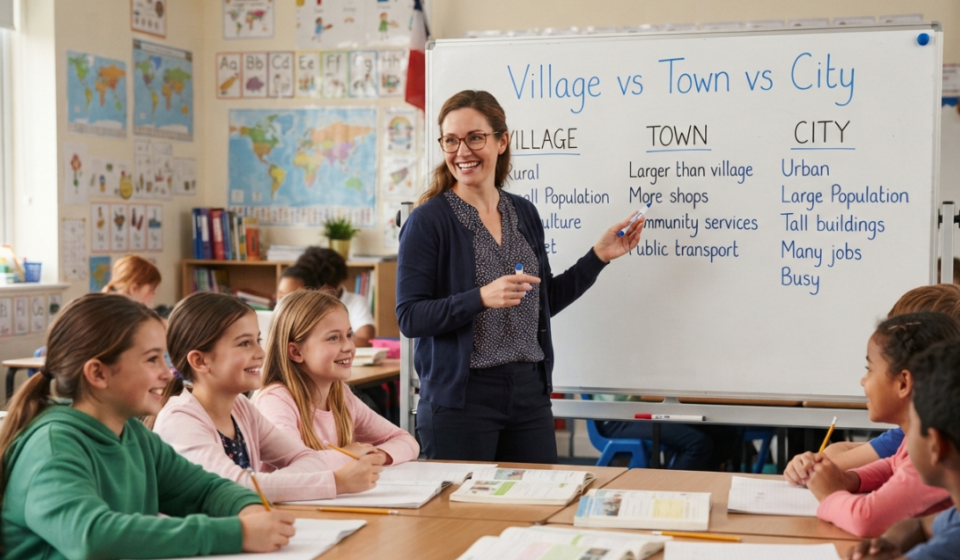

A place can feel completely different depending on whether you call it a village, town, or city. A village may have a small, close-knit population, a town may offer a middle ground between rural and urban life, while a city usually brings greater population density, more services, jobs, and infrastructure.
But there’s a catch: village vs town vs city is not a universal ranking based purely on population. The legal meaning of each term varies considerably from one country to another, and some places are officially called cities despite having fewer people than settlements elsewhere that are classified as towns. The United Nations notes that countries use different criteria for urban and rural classification, including population, density, administrative boundaries, economic activity, and available services.
That makes the city vs town vs village comparison more interesting than simply saying “small, medium, large.”
In this guide, we’ll compare these settlement types by population, density, services, employment, transportation, lifestyle, governance, and overall character—and explain why town vs city population cannot be judged using one worldwide number.
Village vs Town vs City: The Basic Difference
At a very general level, you can think of the three like this:
Village: Smaller settlement, generally lower population density and fewer services.
Town: Medium-sized settlement that often provides more shops, services, institutions, and employment than a village.
City: Larger or more densely developed settlement with extensive infrastructure, employment, services, transportation, and administrative or economic functions.
This is a useful everyday explanation, but it is not a universal legal definition. The United Nations specifically notes that there is no internationally agreed definition of urban and rural areas that applies to every country.
In other words, a place doesn’t automatically become a city when it reaches a particular population.
Quick comparison
| Feature | Village | Town | City |
| Population | Usually smaller | Usually medium | Usually larger |
| Population density | Low | Moderate | Often high |
| Housing | More spread out | Mixed | More concentrated |
| Shops & services | Basic | Moderate | Extensive |
| Jobs | Often local | Broader range | Highly diverse |
| Public transport | Limited | Moderate | Usually extensive |
| Infrastructure | Basic | Developed | Complex |
| Community | Often close-knit | Mixed | More socially diverse |
| Economic role | Local | Regional/local | Regional, national, or global |
| Cost of living | Often lower | Moderate | Often higher |
These are broad tendencies, not fixed rules.
Why There Is No Universal Village, Town, and City Population
One of the biggest misconceptions about town vs city population is that there is a single population threshold that works everywhere.
There isn’t.
The UN says national definitions of urban and rural areas can differ based on criteria such as population size, population density, distance between built-up areas, economic activity, administrative boundaries, and services or facilities.
That means:
A 20,000-person settlement might be considered a town in one country and an urban locality or city in another.
Even within one country, the terminology may have a legal or historical meaning that doesn’t perfectly match population size.
The U.S. Census Bureau, for example, has changed its definition of urban areas over time. Historically, its threshold for an urban place went from 8,000 in some early classifications to 4,000 and then 2,500 in 1910.
So population is important—but it is only part of the story.
Village vs Town vs City by Population
Population is usually the first thing people consider when comparing a village, town, and city.
And while it is not universally decisive, there is a general pattern:
Village → smaller
Town → medium
City → larger
The problem begins when you try to put exact numbers on those categories.
Village population
Villages generally have relatively small populations compared with towns and cities.
The population may range from a few dozen households to several thousand people depending on the country and its administrative system.
A village may consist mainly of residential homes, small businesses, agricultural land, community facilities, and a limited number of public services.
Town population
Towns tend to occupy the middle ground.
They often have enough population to support a wider range of services, such as:
- Supermarkets
- Schools
- Health clinics
- Banks
- Restaurants
- Local government offices
- Small businesses
- Professional services
But again, there is no worldwide population cutoff that defines a town.
City population
Cities generally have larger populations and much more developed built environments.
They often support:
- Hospitals
- Universities
- Major shopping districts
- Large employers
- Public transportation networks
- Government institutions
- Airports or major transport connections
- Cultural venues
- Specialized professional services
The UN’s latest World Urbanization Prospects also treats cities, towns, and rural populations as distinct categories for global analysis, while recognizing that national definitions vary.
City vs Town vs Village: Population Density
Population isn’t the only question. Density can be even more revealing.
Population density describes how many people live within a given area.
A village might contain relatively few people spread across a large amount of land.
A town may have more compact development.
A city often has much greater concentration of homes, businesses, roads, and public facilities.
That’s why a city of 100,000 people can feel completely different from a town with a similar population if one occupies a much smaller built-up area.
The UN notes that population density is among the criteria countries may use when distinguishing urban and rural areas.
Village Density
Villages tend to have more open space.
You may find:
- Farms
- Fields
- Gardens
- Forest
- Larger residential plots
- Unbuilt land
Homes may be separated by considerable distances, although some villages can also be compact.
Town Density
Towns tend to have a mixture of residential and commercial development.
A central area might be relatively dense, while the outskirts become more spacious.
This creates a transition between rural surroundings and more urban development.
City Density
Cities tend to have concentrated development.
Land is often used more intensively because of demand for housing, commercial space, transportation, and public services.
You may see:
- Apartment buildings
- Office towers
- Shopping centers
- Dense neighborhoods
- Industrial zones
- Major roads
- Rail networks
However, not every city is densely packed. Some cities cover large geographic areas and contain both dense urban districts and suburban or semi-rural sections.
Town vs City vs Village: Infrastructure
Infrastructure is another major difference.
A village may only need relatively simple infrastructure to support its population.
A city, by contrast, requires complex systems for millions of daily activities.
Village infrastructure
Typical infrastructure might include:
- Local roads
- Basic water systems
- Electricity
- Small schools
- Community buildings
- Limited public transport
Town infrastructure
A town may have more extensive:
- Roads
- Water and sewage systems
- Schools
- Clinics
- Retail areas
- Police and emergency services
- Public transportation
City infrastructure
Cities often require large-scale systems covering:
- Roads and highways
- Rail or metro systems
- Airports
- Major hospitals
- Universities
- Waste management
- Water treatment
- Electricity distribution
- Public transit
- Telecommunications
As settlements grow, infrastructure becomes more interconnected and expensive to maintain.
Village vs Town vs City: Jobs and Employment
Employment opportunities can be one of the biggest practical differences between settlement types.
Jobs in a village
Village economies may be closely connected to:
- Agriculture
- Fishing
- Forestry
- Small retail
- Local trades
- Tourism
- Government or community services
Employment may be highly dependent on the surrounding rural economy.
Jobs in a town
Towns often have a more varied local economy.
A resident might work in:
- Education
- Healthcare
- Retail
- Construction
- Hospitality
- Manufacturing
- Banking
- Professional services
Towns can also function as employment centers for surrounding villages.
Jobs in a city
Cities usually offer the widest range of occupations.
You may find employment in:
- Finance
- Technology
- Government
- Healthcare
- Education
- Manufacturing
- Media
- Entertainment
- Transportation
- International business
- Professional services
This diversity can attract workers from smaller settlements and contribute to urban growth.
Village vs Town vs City: Services and Amenities
Another easy way to understand the difference is to ask:
How much can I do without leaving the settlement?
A village may have only the essentials.
A town may provide most everyday needs.
A city may offer highly specialized services that attract people from an entire region.
Village
You might have:
- General store
- Small school
- Local clinic
- Community center
- Religious facilities
Town
You might additionally find:
- Multiple supermarkets
- Restaurants
- Banks
- Dental clinics
- Secondary schools
- Gyms
- Local government offices
City
A city may provide:
- Specialist hospitals
- Universities
- Large shopping centers
- Museums
- Theaters
- Major sports venues
- Specialized legal and financial services
- International transport links
This difference is one reason towns often serve as service centers for surrounding rural areas, while cities can serve much larger regions.
City vs Town vs Village: Transportation
Transportation also changes as settlements grow.
Village transportation
Private vehicles, walking, bicycles, motorcycles, and occasional buses may dominate.
Road networks are generally simpler.
Town transportation
Towns may have:
- Local bus routes
- Taxis
- Better road connections
- More frequent regional transportation
City transportation
Large cities can support extensive systems such as:
- Metro rail
- Subways
- Trams
- Commuter rail
- Bus rapid transit
- Airports
- Major highways
The more concentrated the population and economic activity, the greater the need for transportation systems capable of moving large numbers of people efficiently.
Town vs City Population: Why Size Can Be Misleading
One of the most important things to understand about town vs city population is that population alone doesn’t tell you what a place actually is.
Consider two settlements:
Settlement A: 50,000 people, legally classified as a town.
Settlement B: 30,000 people, officially classified as a city.
That might look strange if you assume every city must be larger.
But legal and administrative categories don’t always follow a simple population hierarchy.
The U.S. Census Bureau illustrates this complexity: cities, towns, villages, and boroughs are legal categories that vary by state, and incorporated-place definitions are not simply a universal population ladder.
In other countries, city status may be granted based on history, administration, economic significance, or formal legal recognition.
So:
Population can suggest settlement size, but it does not automatically determine legal status.
Village vs Town vs City: Lifestyle
Numbers tell only part of the story. What about everyday life?
This is where the three can feel dramatically different.
Life in a village
Village life is often associated with:
- Quieter surroundings
- More open space
- Stronger local social networks
- Less traffic
- Greater proximity to nature
- Fewer specialized services
The trade-off is that residents may need to travel farther for certain healthcare, education, shopping, or employment needs.
Life in a town
A town often offers a compromise.
You may get:
- More services than a village
- More job opportunities
- Better transportation
- Smaller communities
- Easier access to nature
- Less congestion than a major city
For some people, that middle ground is the biggest attraction.
Life in a city
City life can offer:
- More career choices
- More entertainment
- More educational opportunities
- More specialized healthcare
- More cultural diversity
- Better public transportation
But cities can also bring:
- Higher housing costs
- Traffic
- Noise
- Crowding
- Air pollution
- Faster pace of life
UN-Habitat notes that cities and towns bring opportunities for economic activity and innovation while also facing challenges such as inequality, environmental pressure, and infrastructure strain.
Village vs Town vs City: Cost of Living
Cost of living varies enormously by country and region, so there is no guarantee that every village will be cheaper than every city.
Still, there is a broad pattern.
Villages often have:
- Lower property prices
- Lower housing density
- Potentially lower everyday costs
But transportation costs may be higher if residents need to travel long distances.
Towns often provide:
- More affordable housing than major cities
- Better access to services than villages
- A balance between convenience and cost
Cities often have:
- Higher housing costs
- Higher rents in desirable areas
- Higher transportation or parking expenses
- More expensive commercial districts
At the same time, cities may provide higher salaries and more employment opportunities, which can offset some of those costs.
City vs Town vs Village: Education
Education is another useful comparison.
A village may have an elementary or primary school serving nearby families.
A town may offer:
- Primary schools
- Secondary schools
- Vocational institutions
- Private schools
A city can support much more specialized education:
- Universities
- Research institutions
- Medical schools
- Technical institutes
- Specialized colleges
This doesn’t mean village schools are necessarily worse. It simply reflects the ability of larger populations to support more specialized institutions.
Village vs Town vs City: Healthcare
Healthcare follows a similar pattern.
A village might have:
- Small clinic
- General practitioner
- Basic pharmacy
A town may have:
- Several clinics
- A general hospital
- Dentists
- Pharmacies
- Specialist visits
A major city may provide:
- Specialist hospitals
- Trauma centers
- Teaching hospitals
- Advanced diagnostic equipment
- Highly specialized doctors
Residents of smaller settlements often travel to towns or cities for specialized medical treatment.
Village vs Town vs City: Government and Administration
The administrative distinction can be just as important as population.
Some places are legally incorporated as cities, towns, villages, municipalities, boroughs, or other forms of local government.
The exact categories vary by jurisdiction.
In the United States, for example, incorporated places can legally be cities, towns, villages, or boroughs depending on state law.
That means “city” and “town” can sometimes be legal classifications rather than purely descriptive terms.
A settlement might therefore retain a historical designation even as its population changes.
How Villages, Towns, and Cities Are Connected
It’s tempting to imagine settlements as isolated categories:
Village → Town → City
But real settlement systems are much more interconnected.
A village may depend on a nearby town for:
- Shopping
- Healthcare
- Banking
- Education
- Employment
A town may depend on a nearby city for:
- Specialized medical care
- Higher education
- Major employment
- Airports
- Cultural events
This creates a network in which smaller settlements support larger urban centers and vice versa.
The UN also recognizes that settlement patterns don’t fit neatly into simple size categories, particularly as suburbanization and urban expansion blur the edges between different types of places.
Suburbs: The Missing Piece in Village vs Town vs City
There is another category worth mentioning: the suburb.
A suburb is generally a settlement or neighborhood located near a larger urban area and closely connected to it economically or socially.
Suburbs can have:
- Dense apartment buildings
- Detached houses
- Shopping centers
- Schools
- Offices
A suburban community may feel like a town even when it is legally part of a metropolitan city.
This is one reason the simple village vs town vs city hierarchy doesn’t always describe modern metropolitan areas very well.
Village vs Town vs City: Population Density vs Population Size
These two concepts are easy to confuse.
Population size asks:
How many people live there?
Population density asks:
How many people live there per unit of land?
A city can have a large population but relatively low average density if its boundaries cover a huge area.
A smaller town can have a surprisingly dense central area.
So when comparing settlements, you should consider both.
Can a Village Become a Town?
Yes, in a general sense, settlements can grow and change status.
Population growth, new businesses, infrastructure, transportation, and administrative decisions can all change how a place is classified.
But the process isn’t identical everywhere.
In one country, a settlement may receive a formal new legal designation.
In another, the same village may simply grow larger while retaining its traditional name.
This again demonstrates why there is no universal ladder from village to town to city.
Can a Town Become a City?
Yes, depending on the country’s laws and administrative system.
A town may grow substantially and eventually qualify for or receive city status.
But population growth is not always enough.
City status can involve:
- Legal recognition
- Administrative restructuring
- Historical significance
- Economic importance
- Government decision
- Specific statutory requirements
The precise process depends entirely on the jurisdiction.
Is a City Always Bigger Than a Town?
No.
This is one of the most important answers in the entire city vs town vs village discussion.
In everyday language, people often assume:
city > town > village
in terms of size.
But legal classifications do not always follow that order.
The United Nations emphasizes significant national differences in settlement definitions.
So a city can sometimes have fewer residents than a town elsewhere.
The label alone doesn’t tell you the population.
Is a Town Always Bigger Than a Village?
Again, not necessarily.
In ordinary usage, a town is generally understood to be larger or more developed than a village.
But administrative terminology varies.
A place called a village in one country could have a population larger than a place called a town somewhere else.
This is why comparisons should focus on the local definition being used.
Village vs Town vs City: Advantages and Disadvantages
Here’s a practical overview.
| Settlement | Main advantages | Common drawbacks |
| Village | Quiet, open space, community, nature | Fewer services and jobs |
| Town | Balance of convenience and community | Fewer specialized opportunities than cities |
| City | Jobs, services, education, entertainment | Cost, traffic, crowding |
These are general patterns, not guarantees.
A well-connected village can offer excellent services, while a poorly planned city can have serious infrastructure problems.
Which Is Better: Village, Town, or City?
There isn’t one universal answer.
The best choice depends on your priorities.
A village may suit you if you value:
- Peace and quiet
- Nature
- Privacy
- Community
- Lower-density living
A town may suit you if you want:
- Convenience without a huge city
- Moderate housing costs
- Local community
- Access to everyday services
- A quieter environment
A city may suit you if you prioritize:
- Career opportunities
- Universities
- Specialized healthcare
- Entertainment
- Public transportation
- Cultural diversity
In other words, the right settlement isn’t necessarily the biggest one.
It’s the one that fits your lifestyle.
Village vs Town vs City: A Simple Memory Trick
If you need a quick way to remember the general distinction, think:
Village = local
Town = regional
City = major urban center
Again, these are broad descriptions rather than strict legal definitions.
A village tends to serve its immediate community.
A town often serves surrounding communities as a service or commercial hub.
A city frequently serves a much larger population and may have regional, national, or even international economic importance.
Frequently Asked Questions About Village vs Town vs City
What is the difference between a village, town, and city?
Generally, a village is smaller and less densely developed, a town is a medium-sized settlement with more services and economic activity, and a city is larger or more urbanized with extensive infrastructure and specialized services.
However, the exact definitions vary by country. The UN notes that there is no single internationally agreed definition that applies everywhere.
Which is bigger: a village, town, or city?
In ordinary usage, the general order is:
Village → Town → City
But this is not a universal legal rule. A country’s administrative definitions may produce exceptions.
What is the population of a village?
There is no universal village population limit. The size can range from very small communities to settlements containing several thousand people, depending on the country.
What is the population of a town?
There is no worldwide population threshold for a town. Countries may consider population size alongside density, legal status, services, economic activity, and other factors.
What is the population of a city?
There is no single global minimum population that makes a place a city.
Some countries define cities through legal or administrative criteria, while others use population and density thresholds.
Can a city be smaller than a town?
Yes. A city can have fewer residents than a town if the two places are governed or classified under different legal systems.
Is town vs city population the main difference?
No. Population is important, but settlement classification can also depend on density, administrative status, economic activity, services, and history.
Is a village rural?
Usually, villages are associated with rural settlements, but the exact classification varies by country and region.
Is a town urban?
Often, but not necessarily under every national definition. The UN notes substantial differences in how countries classify urban and rural areas.
Is a city always more crowded than a town?
Usually cities have greater population concentration, but not always. Density depends on how much land the settlement occupies and how its neighborhoods are developed.
What is the difference between population and population density?
Population is the total number of people living in a place.
Population density is the number of people living within a specified area.
Why don’t countries use the same city and town definitions?
Countries have different administrative systems, histories, settlement patterns, and statistical methods. The UN therefore recognizes that no single urban-rural definition works universally.
Can a village become a town?
Yes. A settlement can grow, develop new services, or receive a new legal designation, depending on the country’s rules.
Can a town become a city?
Yes. In some jurisdictions, towns can receive city status after meeting legal, administrative, population, or other requirements. The exact process varies.
Which has more jobs: a village, town, or city?
Cities generally offer the greatest variety of employment because they contain larger and more diverse economies. Towns tend to offer more opportunities than villages, while villages may depend more heavily on local industries and surrounding rural economies.
Which is cheaper: a village, town, or city?
Villages often have lower housing costs, while large cities frequently have higher housing costs. However, transportation, wages, location, and local demand can change the picture significantly.
Which is better for families: village, town, or city?
It depends on the family’s priorities. Villages may offer more space and quiet, towns can provide a balance of services and community, and cities often provide greater access to schools, healthcare, jobs, and activities.
Conclusion: Village vs Town vs City
The village vs town vs city comparison looks simple at first, but the reality is more interesting.
In everyday language, a village generally means a smaller, lower-density settlement; a town sits somewhere in the middle; and a city is generally larger, denser, and more heavily developed.
But population alone doesn’t determine the difference. The United Nations notes that countries use different combinations of population, density, administrative boundaries, economic activity, and services to define and classify settlements.
So when you’re comparing city vs town vs village, think beyond the number of residents.
Look at:
- Population
- Density
- Infrastructure
- Employment
- Services
- Transportation
- Legal status
- Economic role
- Lifestyle
The simplest mental picture is still useful:
Village: smaller and more rural
Town: middle ground
City: larger and more urban
But real-world settlements don’t always fit neatly into three boxes. That flexibility is exactly why understanding the local definition matters whenever you’re comparing town vs city vs village populations or settlement types.