
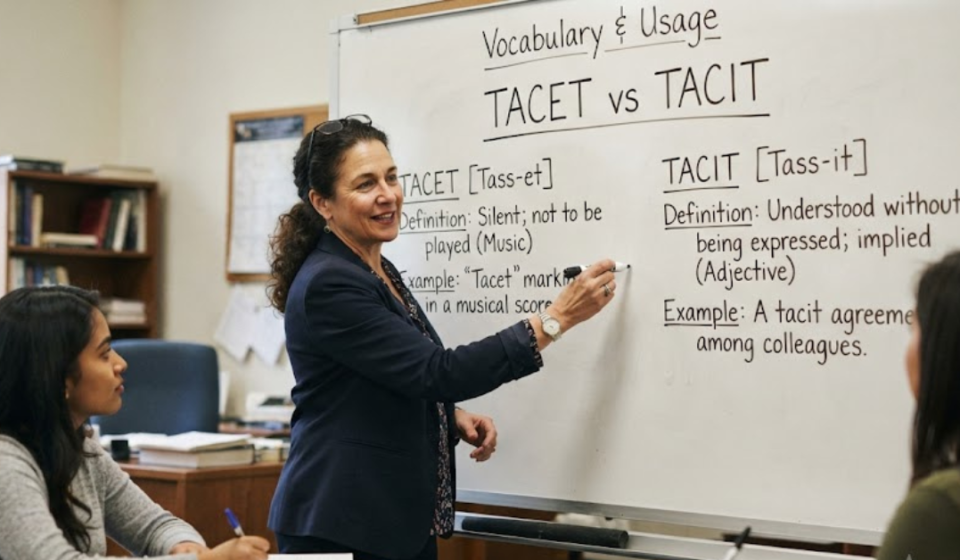

Some English words look so similar that it’s easy to assume they’re interchangeable. Tacet vs tacit is one of those confusing pairs. While the two words differ by just one letter, they belong to completely different fields and carry entirely different meanings.
If you’ve searched for tacet vs tacit, tacit vs tacet, or wondered whether it’s tacet or tacit, you’re not alone. This guide explains what each word means, when to use it, and how to remember the difference with simple examples.
Tacet vs Tacit: The Quick Answer
Although tacet and tacit look alike, they are not synonyms.
- Tacet is a musical term that tells a performer not to play or sing during a particular section.
- Tacit is an adjective meaning understood or implied without being directly stated.
Quick Examples
Tacet
- The trumpet part was marked tacet for the second movement.
- The percussion section remained tacet until the finale.
Tacit
- They reached a tacit agreement without discussing the details.
- Her silence gave tacit approval to the proposal.
Tacet vs Tacit Meaning
Understanding the meaning of each word separately makes it much easier to use them correctly.
What Does “Tacet” Mean?
Tacet is a musical direction borrowed from Latin, meaning “it is silent.”
In sheet music, it tells an individual musician or an entire section to remain silent during part or all of a composition. The performer simply waits until it’s time to rejoin.
Examples
- The flute was marked tacet for the opening movement.
- The trombone remains tacet until measure 128.
- The conductor reminded the brass section to observe the tacet marking.
Outside of music, tacet is rarely used.
What Does “Tacit” Mean?
Tacit is an adjective that describes something understood without being openly expressed.
Instead of being spoken or written directly, the meaning is implied through actions, circumstances, or shared understanding.
Examples
- They had a tacit understanding to keep the project confidential.
- His smile was tacit approval.
- There was tacit agreement among the committee members.
Unlike tacet, tacit appears regularly in business, law, politics, education, and everyday writing.
Tacet or Tacit: Which One Should You Use?
The correct choice depends entirely on the context.
Choose tacet if you’re talking about:
- Musical notation
- Orchestra scores
- Choir music
- Instrumental performances
- Silent passages in a composition
Choose tacit if you’re referring to:
- Unspoken agreements
- Implied consent
- Indirect approval
- Shared understanding
- Assumptions that everyone recognizes
Tacet vs Tacit: Side-by-Side Comparison
| Tacet | Tacit |
| Musical direction | English adjective |
| Means “remain silent” | Means “understood without being stated” |
| Found in sheet music | Used in everyday English |
| Common in orchestras and choirs | Common in business, law, and conversation |
| Indicates silence during performance | Describes implied ideas or agreements |
When to Use “Tacet”
Use tacet only when discussing music.
It appears in:
- Orchestra scores
- Band arrangements
- Choir music
- Instrumental parts
- Classical compositions
Example Sentences
- The clarinet part is marked tacet for the first movement.
- The horn players remain tacet until the final section.
- The conductor pointed out every tacet marking before rehearsal.
Because it is a technical musical term, it is uncommon in everyday conversation.
When to Use “Tacit”
Use tacit whenever something is understood without being explicitly communicated.
It often appears in discussions involving:
- Business relationships
- Contracts
- Politics
- Workplace expectations
- Personal relationships
Example Sentences
- Everyone gave their tacit approval.
- There was a tacit understanding that phones would remain off.
- His silence signaled tacit consent.
This word is much more common than tacet.
Easy Trick to Remember the Difference
A simple memory aid can prevent confusion.
Tacet = Concert
Notice that tacet contains letters similar to concert.
If the discussion involves music or musicians remaining silent, choose tacet.
Tacit = Implied
Think of the I in tacit as standing for implied.
If something is understood without being spoken, tacit is the correct word.
Common Mistakes to Avoid
Since the words look nearly identical, writers sometimes substitute one for the other.
Incorrect
- They reached a tacet agreement.
- Her silence showed tacet approval.
- The orchestra remained tacit for two movements.
Correct
- They reached a tacit agreement.
- Her silence showed tacit approval.
- The orchestra remained tacet for two movements.
Always ask yourself whether you’re talking about music or an implied understanding.
Pronunciation
Although the spellings are similar, the pronunciations differ slightly.
- Tacet: TAH-ket
- Tacit: TASS-it
The different endings can help you remember they are separate words with unrelated meanings.
Related Words
Learning related vocabulary can reinforce the distinction.
Words Related to Tacet
- Rest
- Silence
- Pause
- Musical notation
- Performance
Words Related to Tacit
- Implied
- Unspoken
- Implicit
- Understood
- Assumed
- Silent approval
Real-Life Examples
Music
The second violin section remained tacet until the final movement, allowing the woodwinds to carry the melody.
Business
The employees had a tacit agreement not to interrupt meetings unless necessary.
Law
The court considered whether the company’s actions amounted to tacit acceptance of the contract.
Frequently Asked Questions
What is the difference between tacet and tacit?
Tacet is a musical instruction meaning a performer should remain silent. Tacit means something is understood or implied without being directly stated.
Is tacet a real word?
Yes. Tacet is a legitimate musical term derived from Latin and commonly used in orchestral and choral sheet music.
Is tacit a real English word?
Yes. Tacit is a standard English adjective used to describe implied understanding, consent, or agreement.
Can tacet and tacit be used interchangeably?
No. Although they look similar, they have unrelated meanings and are used in entirely different contexts.
What does tacit agreement mean?
A tacit agreement is an agreement that exists without being formally expressed. Everyone understands it even though no one says it directly.
Where is tacet used?
You’ll primarily find tacet in musical scores, rehearsal instructions, and performance notation.
Conclusion
Understanding tacet vs tacit is easier once you know the context. Tacet belongs to the world of music and tells performers to remain silent during a section of a composition. Tacit, on the other hand, describes ideas, agreements, or approval that are implied rather than directly stated.
A helpful way to remember the difference is to associate tacet with concerts and musical performances, while linking tacit with implied understanding. Keeping these meanings separate will help you write with greater confidence and avoid a common spelling mix-up.