
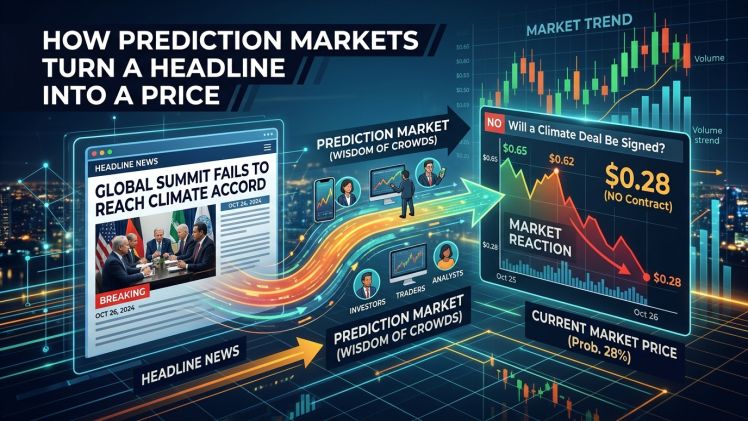
How Prediction Markets Turn a Headline Into a Price

A headline lands, and within seconds a number moves. That number is the whole point of an event contract: a yes or no claim that trades between zero and one, where the price reads as the crowd’s estimate of the odds. It’s whatever buyers and sellers agree on right now.
The distinction matters because a price only means something if you know how it’s formed, who sits on the other side, and what the contract pays on. Here I walk through the mechanics for a colleague who has traded perps but never touched an event book.
From Claim to Quote
Every event contract starts as a sentence. Will the central bank hold rates at the next meeting, yes or no? The yes share pays one unit if the answer is yes and nothing if it’s no. A quote of sixty cents on the dollar implies roughly a three in five chance.
That arithmetic is why these instruments feel simple. A trader buying yes at sixty is risking sixty to win forty, and the break-even belief is exactly the quoted odds. If your own estimate is higher, the contract looks cheap to you. If it’s lower, you’d sell yes or buy no.
Order Book or Automated Pool
Two designs dominate. In an order book, resting bids and offers sit at set prices and your market order takes the best one on the other side. In an automated market maker, a formula quotes a price from the pool’s inventory and moves it as you buy. Books reward patience, pools always quote.
Either way, someone is taking the other side. In a book it’s another trader or a market maker who earns the spread. In a pool it’s the liquidity providers who fund the inventory and absorb the loss when informed traders arrive first. Knowing which design you face tells you where slippage will bite.
The Spread Is the Price of Admission
Bid-ask spread is a real cost. If bids sit at fifty-eight and offers at sixty-two, buying at market and selling straight back loses four points before anything happens. On a quiet contract the gap can be a cent or two, and on a thin one it can swallow most of a small edge.
Spreads widen exactly when you want to trade, in the minutes after news, because market makers pull quotes while they reprice. A few venues list event contracts next to crypto perps, and Quanta Exchange is one of them, so a trader can compare the cost of expressing a view in each instrument.
Who Decides What Counts as Yes
Before a contract lists, it names a resolution source: an official statistic, an exchange closing print, a court record. A contract on a jobs figure resolves to the agency’s first published number, not to a later revision, unless the rules say otherwise. Read that clause first, because it can differ from the headline you traded on.
Ambiguous wording is where disputes start. Does hold mean unchanged after an emergency move? Good rules spell out edge cases and the fallback when a source is delayed or withdrawn. Poor ones leave it to a discretionary call, and then the price carries a discount for the chance that the ruling goes against you.
A Jobs Report, Repriced
Take a contract on whether the central bank cuts rates at its next meeting, trading at forty cents on the dollar the morning of a jobs report. The payrolls number comes in far weaker than forecast. Within a minute the bids vanish and the offers jump, and the first trades print near sixty.
Over the next hour the price drifts to a level the crowd can live with, say a bit above fifty-five. Early buyers of yes show a gain on paper, while late buyers paid for most of the move. Speed was the edge, and speed is what a retail order rarely has.
Fixed Risk, Not No Risk
The most you can lose on a bought contract is what you paid for it. There’s no margin call and no liquidation price. A yes share bought at forty can only fall to zero. That cap makes sizing straightforward, because you can decide in advance what a full loss would cost you.
Fixed risk still means losing. A contract that goes to zero takes the entire stake, and event outcomes cluster, so several positions tied to one macro story can fail together. Trading these contracts can lose all the money you put in, and a capped loss shouldn’t tempt anyone into sizing them like a coin flip.
Before You Trade Any Event
My checklist is short. Read the resolution rule word for word, including the source and what happens if it’s delayed. Look at liquidity: the depth at the top few price levels. Then find the fee schedule, because a fee on entry plus a fee on settlement changes the break-even odds.
Last, note the settlement time. A contract can be right on Friday and still lock your capital until the following week while a source confirms the number. The price on screen is only a starting point, and the fine print decides how much of that probability you actually get to keep.