
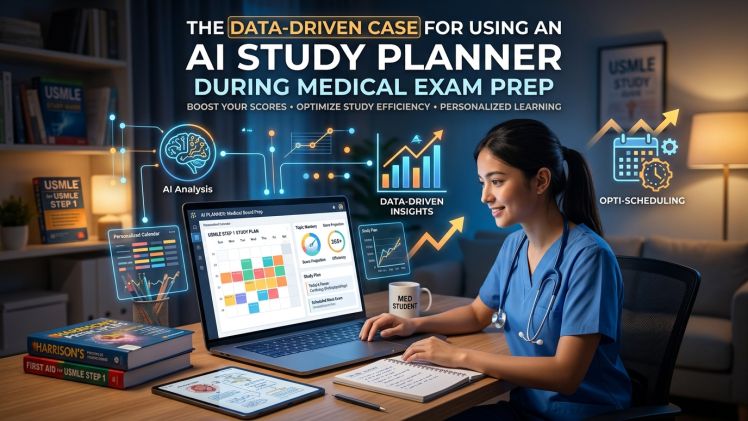

Exam preparation in medical school has never followed a one-size-fits-all formula, yet most students still rely on generic planning methods borrowed from other fields. An AI study planner for medical exams offers a different approach, one built around measurable performance data rather than guesswork about what to review next. As medical curricula expand and licensing exams grow more comprehensive, the margin for inefficient studying continues to shrink.
This shift toward data-informed preparation isn’t just a trend among tech-savvy students. It reflects a broader recognition that medical knowledge retention follows predictable patterns, and tools that respect those patterns tend to produce better-prepared candidates. Resources such as iatroX have built their study support features around this principle, pairing medically accurate content with structured progress tracking.
What Does the Data Say About Traditional Study Habits?
Research into learning science has repeatedly shown that cramming produces short-term recall at the expense of long-term retention. Medical students, however, often fall into cramming patterns simply because manually tracking dozens of subjects across months is logistically difficult. Without a system that flags which topics need revisiting, students default to reviewing whatever feels most urgent right before an exam, rather than what’s actually weakest in their long-term memory.
This pattern creates a measurable gap between study effort and exam readiness. A student can log extensive hours and still underperform if those hours weren’t distributed according to actual knowledge gaps.
How Does an AI Study Planner Address This Gap?
An AI-based planner tracks performance across practice questions, self-assessments, and review sessions to build a profile of strengths and weaknesses. Rather than asking a student to remember which topics need more attention, the system surfaces this information automatically and adjusts the schedule accordingly.
Key functions typically include:
- Automatically resurfacing weaker topics at scientifically-informed intervals.
- Reprioritizing the study calendar when a student misses sessions or falls behind.
- Highlighting high-yield topics based on exam blueprints and past performance trends.
- Reducing time spent on material the student has already demonstrated mastery over.
This data-driven prioritization is what separates adaptive planning from a basic digital calendar.
How Significant Is the Content Volume in Medical Exams?
Licensing and certification exams for medical and dental students cover an extraordinarily wide range of subject matter, spanning basic sciences, clinical medicine, and applied reasoning. Preparing for these exams typically requires reviewing thousands of discrete concepts, many of which interrelate across subjects. Without structured prioritization, students risk spending disproportionate time on familiar material while under-reviewing higher-yield but less comfortable topics.
This volume problem is one of the primary reasons structured planning tools have gained traction. Platforms built specifically for healthcare education, including iatroX, organize content around exam-relevant structures rather than generic subject headings, which helps students map their study time more directly to what’s being tested.
Does Personalization Actually Improve Study Outcomes?
Personalization in study planning isn’t about convenience alone. It’s about matching review intensity to actual need. A student strong in cardiology but weak in nephrology gains little from a plan that treats both subjects equally. Adaptive planners adjust the ratio of review time based on demonstrated performance, which theoretically narrows knowledge gaps faster than a fixed, evenly distributed schedule.
While individual results vary, the underlying principle, that spaced and targeted review improves retention more than uniform repetition, is well established in cognitive science research.
What Role Does Consistency Play in Exam Readiness?
Consistency often matters more than total study hours. A student who studies moderately but consistently over several months typically retains more than one who studies intensely for a short period before the exam. AI planners support consistency by sending structured reminders and breaking large volumes of content into manageable daily sessions, which reduces the likelihood of last-minute cramming.
Frequently Asked Questions
How does an AI study planner determine which topics need more review?
It typically analyzes performance data from quizzes, practice questions, or self-reported confidence levels, then flags topics with lower accuracy or longer gaps since last review for more frequent reinforcement.
Is this approach backed by learning science, or is it just a marketing feature?
The core principle, spaced repetition combined with targeted review of weak areas, is grounded in established cognitive science research on memory retention. The AI component automates what would otherwise require manual tracking across a large volume of subjects.
Will an AI planner work for students with irregular schedules, such as those on clinical rotations?
Yes, this is one of the primary advantages. Because the system adjusts based on actual study activity rather than a fixed calendar, it can reprioritize sessions when a student’s availability changes unexpectedly.
Do students need prior experience with study apps to use an AI planner effectively?
No. Most platforms, including iatroX, are designed with straightforward interfaces so that students can begin tracking their progress without a learning curve getting in the way of actual studying.
Making Study Time Count
The volume and complexity of medical exams aren’t going to decrease, which makes efficient use of study time increasingly important. Data-driven planning tools offer a practical way to address the gap between hours spent studying and actual exam readiness, particularly for students juggling unpredictable clinical schedules. As more students turn to platforms like iatroX to structure their preparation, the broader shift toward adaptive, evidence-based study methods is likely to continue reshaping how future healthcare professionals prepare for their most demanding exams.